SS
Здесь есть возможность читать онлайн «SS» весь текст электронной книги совершенно бесплатно (целиком полную версию без сокращений). В некоторых случаях можно слушать аудио, скачать через торрент в формате fb2 и присутствует краткое содержание. Жанр: Справочники, на английском языке. Описание произведения, (предисловие) а так же отзывы посетителей доступны на портале библиотеки ЛибКат.

- Название:SS
- Автор:
- Жанр:
- Год:неизвестен
- ISBN:нет данных
- Рейтинг книги:5 / 5. Голосов: 1
-
Избранное:Добавить в избранное
- Отзывы:
-
Ваша оценка:
SS: краткое содержание, описание и аннотация
Предлагаем к чтению аннотацию, описание, краткое содержание или предисловие (зависит от того, что написал сам автор книги «SS»). Если вы не нашли необходимую информацию о книге — напишите в комментариях, мы постараемся отыскать её.
SS — читать онлайн бесплатно полную книгу (весь текст) целиком
Ниже представлен текст книги, разбитый по страницам. Система сохранения места последней прочитанной страницы, позволяет с удобством читать онлайн бесплатно книгу «SS», без необходимости каждый раз заново искать на чём Вы остановились. Поставьте закладку, и сможете в любой момент перейти на страницу, на которой закончили чтение.
Интервал:
Закладка:
Conduct a strategic analysis for every market space, major customer and Service Portfolio to determine current strategic positions and desired strategic positions for success. This analysis requires service provider s to gather data from customer surveys, service level review s, industry benchmarks, and competitive analysis conducted by third parties or internal research teams. Each critical success factor is measured on a meaningful index or scale. It is best to adopt indices and scales that are commonly used within a market space or industry to facilitate benchmarking and comparative analysis. Critical success factors are used to define playing fields, which serve as reference frameworks for evaluation of strategic positions and competitive scenarios (Figure 4.23).
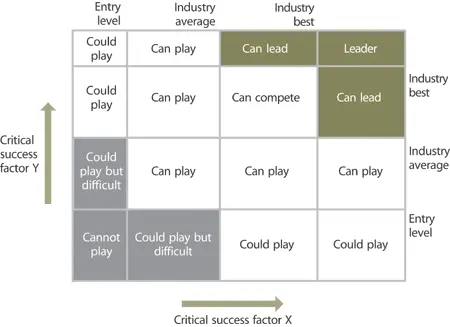
Figure 4.23 Critical success factors and competitive positions in playing fields
Playing fields have the following benchmark s that determine the various zones in which a service provider is currently positioned or plan s to be.
Entry level: performance below this level is not acceptable to customers (grey in Figure 4.23)
Industry average: performance below this level is not competitive (white in Figure 4.23)
Industry best: performance above this level signifies leadership (green in Figure 4.23).
These benchmarks are relative (not absolute) and their values on an index may vary over time. For example, the initial entry-level benchmark for cost as a CSF may be quite easy to cross in a new market space with low levels of competition. The benchmark may become higher (lower costs) because of competitive action combined with technology innovations or other factors, such as excessive supply of resource s in the market space (as happened a few years ago with telecommunications bandwidth). Strategic analysis should take into account not only the current benchmarks for a playing field but also the direction in which they are expected to move (higher or lower), the magnitude of change , and the related probabilities.
This analysis is necessary for service providers to avoid being surprised by changes in the market space that can completely destroy their value proposition. Type I service provider s may be particularly vulnerable to such blind spots if they are not accustomed to the business analysis found in Type II and Type III providers. Type I providers also face competition even if they have captive customers within their enterprise. The playing field is used to conduct strategic analysis of Market Space s, Customer Portfolio s (Figure 4.24), Service Portfolio s, and Contract Portfolio s. Managers decide the required scenarios to construct using applicable CSFs, scales and indices.
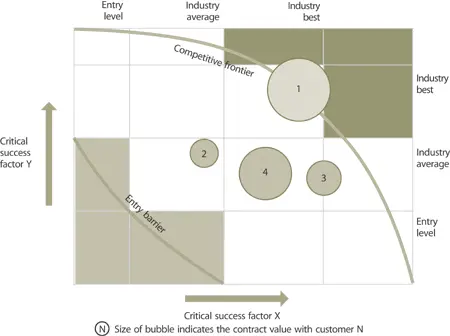
Figure 4.24 Strategic analysis of Customer Portfolio
4.4.6 Prioritizing investments
One common problem service providers have is prioritizing investments and managerial attention on the right set of opportunities. There is a hierarchy in customer needs analogous to Maslow’s Hierarchy of Needs for individuals. At any one time, the business needs of customers are fulfilled to varying levels of satisfaction. The combination of hierarchy or importance of a need and its current level of satisfaction determines the priority in the customer’s mind for purchases. The best opportunities for service providers lie in areas where an important customer need remains poorly satisfied (Figure 4.25).
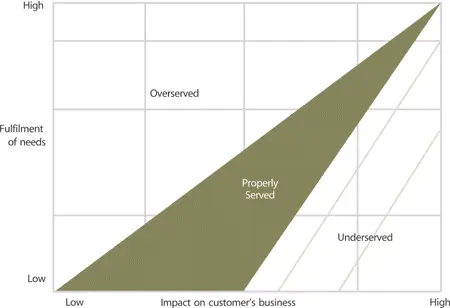
Figure 4.25 Prioritizing strategic investments based on customer needs23
Service Portfolio s should be extended to support such areas of opportunity. This typically means there is a need for services to provide certain levels of utility and warranty . However, managers should not overlook the costs and risk s in such areas. There are usually strong reasons why certain needs of customers remain unfulfilled. Breakthrough performance and innovation are usually required to successfully deliver value in underserved areas of opportunity.
4.4.7 Exploring business potential
Service providers can be present in more than one market space. As part of strategic planning , service provider s should analyse their presence across various market spaces. Strategic review s include the analysis of strengths, weaknesses, opportunities and threat s in each market space. Service providers also analyse their business potential based on unserved or underserved market spaces. This is an important aspect of leadership and direction provided by the senior management of service providers. The long-term vitality of the service provider rests on supporting customer needs as they change or grow as well exploiting new opportunities that emerge. This analysis identifies opportunities with current and prospective customers. It also prioritizes investments in service asset s based on their potential to serve market space s of interest. For example, if a service provider has strong capabilities and resource s in service recovery , it explores all those market spaces where such assets can deliver value for customers.
Begin with a broad set of outcomes such as business asset productivity. This defines a broad market space. Lost business asset productivity is linked with how it is recovered through services. Unserved and underserved customer needs are identified within this context and focus is applied based on existing strengths and opportunities. This defines narrower market spaces with specialization based on the categories of business assets and the manner in which they are supported by services (service archetypes).
Providers decide which customer needs are effectively and efficiently served through services, while choosing to serve certain market spaces and avoid others. This essential aspect of service strategy is broken down into the following decisions. Firstly, identify:
Market space s that are best served by existing service asset s
Market spaces to avoid with existing service assets.
Then for each market space to be served (Figure 4.26), decisions are made with respect to:
Service s to offer ( Service Portfolio )
Customers to serve ( Customer Portfolio )
Critical success factor s
Underserved market spaces
Service model s and service assets
Service Pipeline and Service Catalogue .
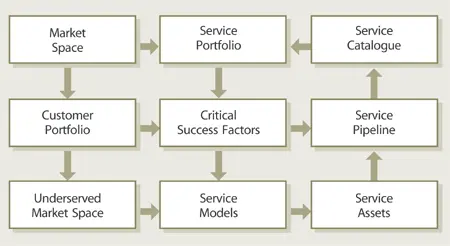
Figure 4.26 New service development
Market space analysis for Type I and Type II providers follows similar principles to those for Type III. Differences are in terms of the extent to which decisions are influenced by:
Priority and strategic value
Investments required
Financial objective s (including profit motive)
Risk s involved
Policy constraints.
Читать дальшеИнтервал:
Закладка:
Обсуждение, отзывы о книге «SS» и просто собственные мнения читателей. Оставьте ваши комментарии, напишите, что Вы думаете о произведении, его смысле или главных героях. Укажите что конкретно понравилось, а что нет, и почему Вы так считаете.