SS
Здесь есть возможность читать онлайн «SS» весь текст электронной книги совершенно бесплатно (целиком полную версию без сокращений). В некоторых случаях можно слушать аудио, скачать через торрент в формате fb2 и присутствует краткое содержание. Жанр: Справочники, на английском языке. Описание произведения, (предисловие) а так же отзывы посетителей доступны на портале библиотеки ЛибКат.

- Название:SS
- Автор:
- Жанр:
- Год:неизвестен
- ISBN:нет данных
- Рейтинг книги:5 / 5. Голосов: 1
-
Избранное:Добавить в избранное
- Отзывы:
-
Ваша оценка:
SS: краткое содержание, описание и аннотация
Предлагаем к чтению аннотацию, описание, краткое содержание или предисловие (зависит от того, что написал сам автор книги «SS»). Если вы не нашли необходимую информацию о книге — напишите в комментариях, мы постараемся отыскать её.
SS — читать онлайн бесплатно полную книгу (весь текст) целиком
Ниже представлен текст книги, разбитый по страницам. Система сохранения места последней прочитанной страницы, позволяет с удобством читать онлайн бесплатно книгу «SS», без необходимости каждый раз заново искать на чём Вы остановились. Поставьте закладку, и сможете в любой момент перейти на страницу, на которой закончили чтение.
Интервал:
Закладка:
Service management initiative
Increasing service potential from capabilities
Increasing service potential from resources
Data centre rationalization
Better control over service operation s
Lower complexity in infrastructure
Development of infrastructure and technology assets
Increases the capacity of assets
Increases economies of scale and scope
Capacity building in service asset s
Training and certification
Knowledgeable staff in control of Service Lifecycle
Improved analysis and decisions
Staffing of key competencies
Extension of Service Desk hours
Implement Incident Management process
Better response to service incident s
Prioritization of recovery activities
Reducing losses in resource utilization
Develop service design process
Systematic design of services
Enrichment of design portfolio
Reuse of service component s
Fewer service failures through design
Thin client computing
Increased flexibility in work locations
Enhanced service continuity capabilities
Standardization and control of configuration s
Centralization of admin function s
Table 4.4 Examples of how service potential is increased
Through Configuration Management , all service assets should be tagged with the name of the services to which they add service potential. This helps decisions related to service improvement and Asset Management . Clear relationships make it easier to ascertain the impact of changes, make business case s for investments in service assets, and identify opportunities for scale and scope economies. It identifies critical service assets across the Service Portfolio for a given customer or market space .
4.3.2.2 Increasing performance potential
The services offered by a service provider represent the potential to increase the performance of customer assets (Figure 4.18). Without this potential there is no justification for customers to procure the services. Visualize and define the performance potential of services so that all decisions made by managers are rooted in the creation of value for customers. This approach avoids many of the problems of service businesses where value for customers is created in intangible forms and therefore harder to define and control . Working backwards from the performance potential of customers ensures that service provider s are always aligned with business needs regardless of how often those needs change.
The performance potential of services is increased primarily by having the right mix of services to offer to customers, and designing those services to have an impact on the customer’s business . The key questions to be asked are:
What is our market space ?
What does that market space want?
Can we offer anything unique in that space?
Is the space already saturated with good solutions?
Do we have the right portfolio of services developed for a given market space?
Do we have the right catalogue of services offered to a given customer?
Is every service designed to support the required outcomes?
Is every service operated to support the required outcomes?
Do we have the right model s and structures to be a service provider?
The productive capacity of service asset s is transformed into the productive capacity of customer assets. An important aspect of delivering value for customers through services is the reduction of risk s for customers. By deciding to utilize a service, customers are often seeking to avoid owning certain risks and costs. Therefore the performance potential of services also arises from the removal of costs and risks from the customer’s businesses.
For example, a service that securely processes payments or transfer of funds for the customer reduces the risks of financial losses through error and fraud and at the same time reduces the cost per transaction by leveraging economies of scale and scope on behalf of the customer. The service provider can deploy the same set of service assets to process a large volume of transactions and free the customer from having to own and operate such assets. For certain business function s such as payroll, finance, and administration, the customer may face the financial risk of under-utilized or over-utilized assets and may therefore prefer a service offered by a Type I, Type II or a Type III service provider .
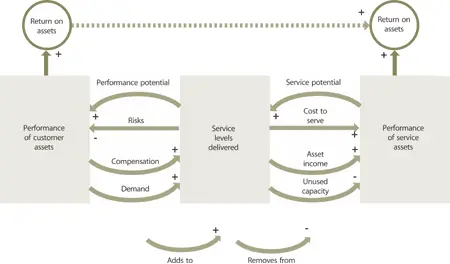
Figure 4.18 Closing the loop with demand, capacity and cost to serve
4.3.2.3 Demand, capacity and cost
When services are effective in increasing the performance potential of customer assets there is an increase in the demand for the services. This acts as a positive feedback to the system to be taken into account. An increase in the performance potential leads to an increase in customer demand (Figure 4.18). The demand for services is accompanied by compensation from customers for the service level s received. The form of compensation received depends on the type of agreement between the service unit and business unit . The higher the service levels, the greater the compensation that services providers can expect to achieve. All decisions in service management should be directed towards increasing this positive feedback. The compensation earned by the service contributes to the incomes earned by the service asset s deployed by the service unit to deliver and support the service. The returns depend on the asset income and the cost to serve. The model is used by managers for managing the finances of every service. In general, the cost to serve increases with the service levels delivered. However, the actual nature of this relationship varies across service delivery system s.
As the maturity of service management increases, it is possible to deliver higher levels of utility and warranty without a proportional increase in costs. Due to the effect of fixed cost s and overheads, the costs of providing additional units of service output can decrease with an increase in the demand for services. Service assets are in a productive state when they are engaged in supporting customer assets. In every demand cycle of the customer, value is created by a corresponding delivery cycle. Value creation for the customer is matched by value capture for the service provider .
4.4 Prepare for execution
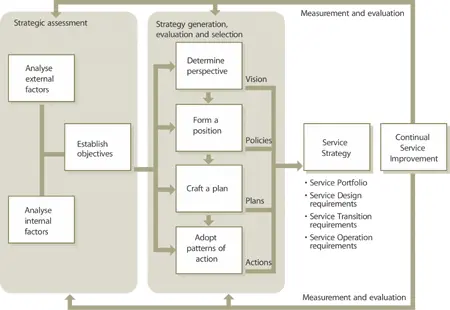
Every model represents a kind of process . This model represents a clear and practical approach for formulating service strategies. It does not, however, guarantee success. What is needed is, through reflection and examination, to make a strategy suitable in an organization ’s context or situation. Strategy involves thinking as well as doing. See Figure 4.19. For senior managers accountable for investment decisions, financial- and personnel-related, the stakes are high. Strategy is critical to the performance of the organization . Service strategies must be formed and be formulated. Broad outlines are deliberate while details are allowed to emerge and adapt en route.
Интервал:
Закладка:
Обсуждение, отзывы о книге «SS» и просто собственные мнения читателей. Оставьте ваши комментарии, напишите, что Вы думаете о произведении, его смысле или главных героях. Укажите что конкретно понравилось, а что нет, и почему Вы так считаете.