SS
Здесь есть возможность читать онлайн «SS» весь текст электронной книги совершенно бесплатно (целиком полную версию без сокращений). В некоторых случаях можно слушать аудио, скачать через торрент в формате fb2 и присутствует краткое содержание. Жанр: Справочники, на английском языке. Описание произведения, (предисловие) а так же отзывы посетителей доступны на портале библиотеки ЛибКат.

- Название:SS
- Автор:
- Жанр:
- Год:неизвестен
- ISBN:нет данных
- Рейтинг книги:5 / 5. Голосов: 1
-
Избранное:Добавить в избранное
- Отзывы:
-
Ваша оценка:
SS: краткое содержание, описание и аннотация
Предлагаем к чтению аннотацию, описание, краткое содержание или предисловие (зависит от того, что написал сам автор книги «SS»). Если вы не нашли необходимую информацию о книге — напишите в комментариях, мы постараемся отыскать её.
SS — читать онлайн бесплатно полную книгу (весь текст) целиком
Ниже представлен текст книги, разбитый по страницам. Система сохранения места последней прочитанной страницы, позволяет с удобством читать онлайн бесплатно книгу «SS», без необходимости каждый раз заново искать на чём Вы остановились. Поставьте закладку, и сможете в любой момент перейти на страницу, на которой закончили чтение.
Интервал:
Закладка:
4.4.3 Aligning service assets with customer outcomes
Service providers must manage asset s much in the same manner as their customers. Service asset s are coordinated, controlled, and deployed in a manner that maximizes the value to customers while minimizing risks and costs for the provider. For example, a messaging service such as wireless email increases the performance of one of the most critical and expensive type of customer assets: managers and staff. The customer deploys these assets in a manner that gets the most out of their productive capacities.
This means, for example, that sales managers spend more time on-site with clients, technicians are quickly dispatched to cover equipment failure s in the field, and administrative staff are consolidated at strategic locations to improve operational effectiveness . To support the customer, the service provider configures and deploys its assets in a manner that effectively supports the customer’s own deployments. It may require the design , deployment , operation , and maintenance of highly available and secure messaging on wireless phones or computers. What matters is that the customer’s employees are able to coordinate business activities, access business applications and control business process es.
4.4.4 Defining critical success factors
For every market space there are critical success factor s that determine the success or failure of a service strategy . These factors are influenced by customer needs, business trends, competition, regulatory environment , supplier s, standards, industry best practice s and technologies. Critical success factors are also referred to in business literature as strategic industry factors (SIF) and have the following general characteristics:24
They are defined in terms of capabilities and resource s
They are proven to be key determinants of success by industry leaders
They are defined by market space levels, not peculiar to any one firm
They are the basis for competition among rivals
They change over time, so they are dynamic not static
They usually require significant investments and time to develop
Their value is extracted by combination with other factors.
Critical success factors by themselves are altered or influenced by one or more of the following factors:
Customers
Competitors
Supplier s
Regulators.
Identifying critical success factor s for a market space is an essential aspect of strategic planning and development . In each market space service provider s require a core set of assets in order to support a Customer Portfolio through a Service Portfolio (Figure 4.21). For example, in the market space for high-volume real-time data processing, such as those required by the financial services industry, service providers must have large-scale computer system s, highly reliable network infrastructure, secure facilities, knowledge of industry regulations, and a very high level of contingency. Without these assets, it would not be possible for such service units to provide the utility and warranty demanded by customers in that market space.
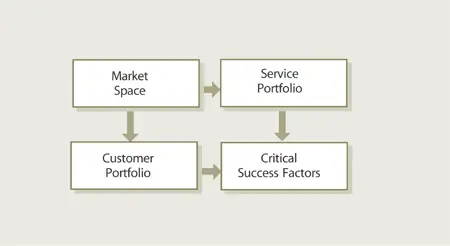
Figure 4.21 Critical success factors
The dynamic nature of markets, business strategies, and organizations requires critical success factors to be reviewed periodically or at significant event s such as changes to Customer Portfolios, expansion into new market spaces, changes in the regulatory environment and disruptive technologies. For example, new legislation for the healthcare industry on the portability and privacy of patient data would alter the set of critical success factors for all service providers operating in market spaces related to healthcare.
The dominating success of a new market leader in search engines and online advertising may add a new critical success factor through a combination of innovative business model and technological capability . Most critical success factors are a combination of several service asset s such as financial assets, experience, competencies, intellectual property, processes, infrastructure, and scale of operations.
Critical success factors determine the service assets required to implement a service strategy successfully. For example, if a strategy requires services to be made available across a large network of locations or a wide area of coverage, the service provider must not only build capacity at key locations. The provider must also operate the network as a system of nodes so that the cost of serving all customers is roughly identical to and within a price point consistent with a strategic position in a market space. Not all critical success factors need favour large organizations or economy of scale in operations. Some strategies favour organizations small in size but highly competitive through the knowledge they have of customers and related market spaces. Managers must therefore conduct evaluation exercises to ascertain the critical success factors in force.
One way to define critical success factors is by customer assets and the service archetypes (Figure 4.22). For example, in healthcare, IT Service Provider s have extensive knowledge of hospital procedures, medical equipment, interactions between physicians, clinicians and pharmacists, insurance policies and privacy regulations. Service providers present in market spaces related to the quality of outcomes in healthcare typically have physicians and clinicians on their payroll. Service strategies for the healthcare market spaces take into account the need to deal with user s with highly specialized skills, special-purpose equipment, low tolerance for error , and the need to balance security with usability of services. These are critical success factors for a cluster of market spaces related to healthcare. A subset of these critical success factors is shared by other market spaces such as military applications. Critical success factors can therefore span more than one market space. They represent opportunities for leveraging economies of scale and scope .
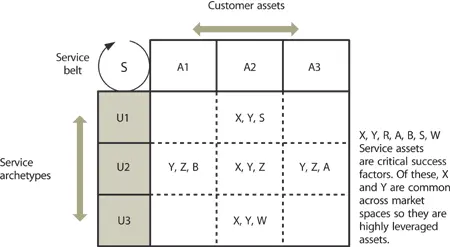
Figure 4.22 Critical success factors leveraged across market spaces
4.4.5 Critical success factors and competitive analysis
CSFs are determinants of success in a market space . They are also useful in evaluating a service provider’s strategic position in a market space and driving changes to such positions. This requires CSFs to be further refined in terms of some distinct value proposition to customers. For example, being competitive in a market space may require very high levels of availability , fail-safe operation of IT infrastructure , and adequate capacity to support business continuity of services. In many market spaces cost-effectiveness is a common CSF, while in others it may be specialized domain knowledge or reliability of infrastructure. Customer satisfaction, richness of service offerings, compliance with standards and global presence are also common CSFs. Type I and Type II providers tend to score well on familiarity with the customer’s business.
Читать дальшеИнтервал:
Закладка:
Обсуждение, отзывы о книге «SS» и просто собственные мнения читателей. Оставьте ваши комментарии, напишите, что Вы думаете о произведении, его смысле или главных героях. Укажите что конкретно понравилось, а что нет, и почему Вы так считаете.