SS
Здесь есть возможность читать онлайн «SS» весь текст электронной книги совершенно бесплатно (целиком полную версию без сокращений). В некоторых случаях можно слушать аудио, скачать через торрент в формате fb2 и присутствует краткое содержание. Жанр: Справочники, на английском языке. Описание произведения, (предисловие) а так же отзывы посетителей доступны на портале библиотеки ЛибКат.

- Название:SS
- Автор:
- Жанр:
- Год:неизвестен
- ISBN:нет данных
- Рейтинг книги:5 / 5. Голосов: 1
-
Избранное:Добавить в избранное
- Отзывы:
-
Ваша оценка:
SS: краткое содержание, описание и аннотация
Предлагаем к чтению аннотацию, описание, краткое содержание или предисловие (зависит от того, что написал сам автор книги «SS»). Если вы не нашли необходимую информацию о книге — напишите в комментариях, мы постараемся отыскать её.
SS — читать онлайн бесплатно полную книгу (весь текст) целиком
Ниже представлен текст книги, разбитый по страницам. Система сохранения места последней прочитанной страницы, позволяет с удобством читать онлайн бесплатно книгу «SS», без необходимости каждый раз заново искать на чём Вы остановились. Поставьте закладку, и сможете в любой момент перейти на страницу, на которой закончили чтение.
Интервал:
Закладка:
Figure 4.19 Forming and formulating a service strategy
4.4.1 Strategic assessment
In crafting a service strategy , a provider should first take a careful look at what it does already. It is likely there already exists a core of differentiation. An established service provider frequently lacks an understanding of its own unique differentiators. The following questions can help elucidate a service provider’s distinctive capabilities:
Which of our services or service varieties are the most distinctive?
Are there services that the business or customer cannot easily substitute? The differentiation can come in the form of barriers to entry, such as the organization’s know-how of the customer’s business or the broadness of service offerings. Or it may be in the form of raised switching costs, due to lower cost structures generated through specialization or service sourcing . It may be a particular attribute not readily found elsewhere, such as product knowledge, regulatory compliance , provisioning speeds, technical capabilities or global support structures.
Which of our services or service varieties are the most profitable?
The form of value may be monetary, as in higher profits or lower expenses, or social, as in saving lives or collecting taxes. For non-profit organizations, are there services that allow the organization to perform its mission better? Substitute ‘profit’ with ‘benefits realized’.
Which of our customers and stakeholders are the most satisfied?
Which customers, channels or purchase occasions are the most profitable?
Again, the form of value can be monetary, social or other.
Which of our activities in our value chain or value network are the most different and effective?
The answers to these questions will likely reveal patterns that lend insight to future strategic decisions. These decisions, and related objective s, form the basis of a strategic assessment . See Table 4.5.
Factor
Description
Strength and weaknesses
The attributes of the organization . For example, resource s and capabilities, service quality , operating leverage, experience, skills, cost structures, customer service, global reach, product knowledge, customer relationships and so on.
Distinctive competencies
As discussed throughout the chapter, ‘What makes the service provider special to its business or customers?’
Business strategy
The perspective, position, plan s and patterns received from a business strategy. For example, a Type I and II may be directed, as part of a new business model , to expose services to external partners or over the internet.
This is also where the discussion on customer outcomes begins and is carried forward into objectives setting.
Critical success factor s
How will the service provider know when it is successful? When must those factors be achieved?
Threat s and opportunities
Includes competitive thinking. For example, ‘Is the service provider vulnerable to substitution?’
Or, ‘Is there a means to outperform competing alternatives?’
Table 4.5 Internal and external factors for a strategic assessment
4.4.2 Setting objectives
Objective s represent the results expected from pursuing strategies, while strategies represent the actions to be taken to accomplish objectives. Clear objectives provide for consistent decision making, minimizing later conflicts. They set forth priorities and serve as standards. Organizations should avoid the following means of ‘not managing by objectives’.
Managing by crisis – the belief that the measure of an organization is its problem solving ability. It is the approach of allowing event s to dictate management decisions.
Managing by extrapolation – continuing the same activities in the same manner because things are going well.
Managing by hope – making decisions on the belief they will ultimately work out.
Managing by subjective – doing the best you can to accomplish what should be done. There is no general plan .
To craft its objective s, an organization must understand what outcomes customers desire to achieve and determine how best to satisfy the important outcomes currently underserved. This is how metric s are determined for measuring how well a service is performing. The objectives for a service include three distinct types of data. These data sources are the primary means by which a service provider creates value. See Table 4.6.
Type of Objective Data
Description
Customer tasks
What task or activity is the service to carry out? What job is the customer seeking to execute?
Customer outcomes
What outcomes is the customer attempting to obtain? What is the desired outcome ?
Customer constraints
What constraints may prevent the customer from achieving the desired outcome? How can the provider remove these constraints?
Table 4.6 Customer tasks, outcomes and constraints
There are four common categories of information frequently gathered and presented as objectives. Senior managers should understand the risk that comes with each category , if not altogether avoided:23
Solutions – customers present their requirement s in the form of a solution to a problem . Customers may lack the technical expertise to be able to arrive at the best possible solution. Customers may be ultimately disappointed by the very solution they present. To mitigate this risk, rather than looking to customer ideas about the service itself, look for the criteria they use to measure the value of a service.
Specification s – customers present their requirements in the form of specifications – vendor, product, architectural style, computing platform, etc. By accepting specifications, a provider needlessly prevents its own organization from devising optimal services.
Needs – customers present their requirements as high-level descriptions of the overall quality of the service. By their nature, high-level descriptions do not include a specific benefit to the customer. For example, ‘...service will be available 99.9% of the time’. These inputs are frequently ambiguous and imprecise. They leave the provider wondering what customers really mean: ‘99.9% of business hours? 99.9% of a calendar year? Does this include maintenance windows? Can the 0.1% be used all at once?’ By leaving room for interpretation, the provider leaves too much to chance. Be sure all input is measurable and actionable (Figure 4.20).
Benefits – customers present their requirements in the form of benefit statements. Again, the risk is in the ambiguity or imprecision of the statements. ‘Highly reliable’, ‘Faster response’ and ‘Better security’ take on many meanings and present different implications for the organization.
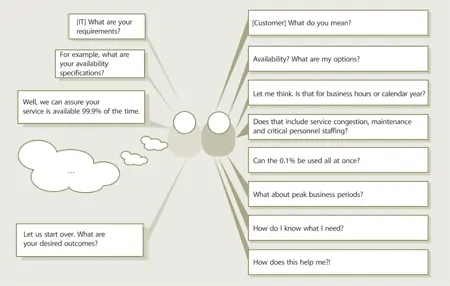
Figure 4.20 Moving from customer-driven to customer-outcomes
When service provider s solicit requirement s, customers respond in a manner and language meaningful and convenient to them. This customer -driven approach fails because it inevitably solicits the wrong inputs – the type that cannot be used to predictably ensure success. This explains the frequent disconnection between IT organizations and the businesses they serve. What the customer values is frequently different from what the organization believes it provides. Service providers should think very differently. A clear understanding of what the customer values is called a marketing mindset, compared to a manufacturing mindset. Rather than focusing inward on the production of services, look from the outside in, from the customer’s view. Rather than lagging indicators, begin with the leading indicators of Table 4.6, Common business objective s. These indicators lead to a clearer understanding of service utility and service warranty , which in turn lead to defining better requirements. Customer s do not buy services; they buy the satisfaction of a particular need.
Читать дальшеИнтервал:
Закладка:
Обсуждение, отзывы о книге «SS» и просто собственные мнения читателей. Оставьте ваши комментарии, напишите, что Вы думаете о произведении, его смысле или главных героях. Укажите что конкретно понравилось, а что нет, и почему Вы так считаете.