Rupert Thomson - Katherine Carlyle
Здесь есть возможность читать онлайн «Rupert Thomson - Katherine Carlyle» весь текст электронной книги совершенно бесплатно (целиком полную версию без сокращений). В некоторых случаях можно слушать аудио, скачать через торрент в формате fb2 и присутствует краткое содержание. Год выпуска: 2015, ISBN: 2015, Издательство: Other Press, Жанр: Современная проза, на английском языке. Описание произведения, (предисловие) а так же отзывы посетителей доступны на портале библиотеки ЛибКат.
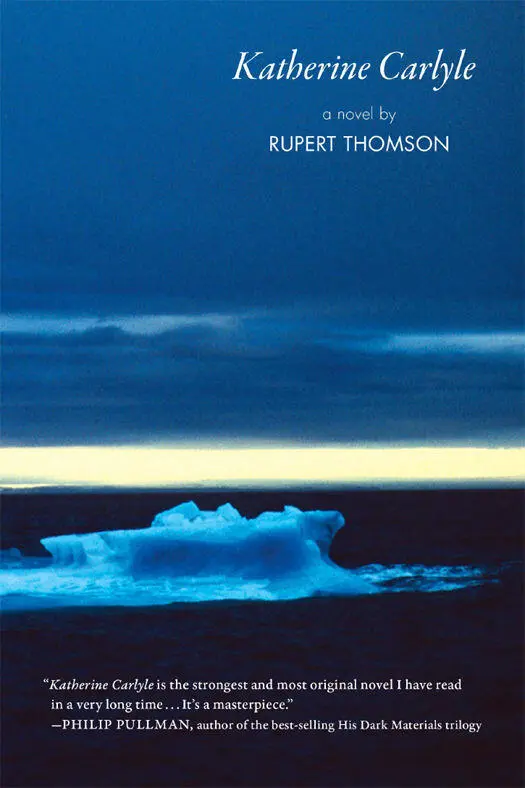
- Название:Katherine Carlyle
- Автор:
- Издательство:Other Press
- Жанр:
- Год:2015
- ISBN:9781590517390
- Рейтинг книги:5 / 5. Голосов: 1
-
Избранное:Добавить в избранное
- Отзывы:
-
Ваша оценка:
Katherine Carlyle: краткое содержание, описание и аннотация
Предлагаем к чтению аннотацию, описание, краткое содержание или предисловие (зависит от того, что написал сам автор книги «Katherine Carlyle»). Если вы не нашли необходимую информацию о книге — напишите в комментариях, мы постараемся отыскать её.
“[T]his road trip through a snow dome of mesmeric hallucinations is Thomson at his best.” —Richard Flanagan, author of The Narrow Road to the Deep North, winner of the 2015 Man Booker Prize
Katherine Carlyle is Rupert Thomson’s breakthrough novel. Written in the beautifully spare, lucid, and cinematic prose Thomson is known for, and powered by his natural gift for storytelling, it uses the modern techniques of IVF to throw new light on the myth of origins. It is a profound and moving novel about identity, the search for personal meaning, and how we are loved.
Unmoored by her mother’s death and feeling her father to be an increasingly distant figure, Katherine Carlyle abandons the set course of her life and starts out on a mysterious journey to the ends of the world. Instead of going to college, she disappears, telling no one where she has gone. What begins as an attempt to punish her father for his absence gradually becomes a testing ground of his love for her, a coming-to-terms with the death of her mother, and finally the mise-en-scène for a courageous leap to true empowerment.
Katherine Carlyle — читать онлайн бесплатно полную книгу (весь текст) целиком
Ниже представлен текст книги, разбитый по страницам. Система сохранения места последней прочитанной страницы, позволяет с удобством читать онлайн бесплатно книгу «Katherine Carlyle», без необходимости каждый раз заново искать на чём Вы остановились. Поставьте закладку, и сможете в любой момент перейти на страницу, на которой закончили чтение.
Интервал:
Закладка:
“Where did you get to last night?” Cheadle says.
“I stayed at a friend’s house.”
“The dentist?”
“No.”
Cheadle and Anna exchange a look.
Anna reaches sideways into a bag and takes out an unsealed envelope. “Your visa,” she says, “and a letter of invitation.”
My heart leaps. “That was quick.”
“I told you. We have a contact.”
I open my passport and find the visa, which occupies an entire page. The date of entry is October 10. The visa expires on November 9.
“Thirty days,” I say.
Anna nods. “Yes.”
“And if I stay longer?”
“It’s illegal. If the police stop you, you will have big problems. Also when you try to leave the country.”
I turn to the letter. Since it’s written in Russian I can’t understand a word, but I spot my name in the middle of a paragraph, surrounded by Cyrillic script, like a ship in rough water. I ask Anna what it says. Cheadle answers. The letter is from an acquaintance of Oleg’s, who remembers having met my father at a conference in Geneva. He has invited me to stay with him and his family in Arkhangel’sk, and assures me of a warm welcome.
“This man never met your father in Geneva,” Cheadle goes on, “or anywhere else, for that matter, and there will be no warm welcome. When you get to Arkhangel’sk you’ll be on your own.”
I nod, then turn to Anna. “Perhaps I will also visit your hometown.”
Nothing shows in her face, though I sense rapid thoughts beneath the surface, a kind of scurrying, like rats inside a wall.
“You’re from Cherepovets,” I say.
“Yes,” she says. “But it’s a steel town. Very industrial. Not so much to see.”
“There’s always something. You just have to look.” I glance at my Russian visa. “I can’t thank you enough for this. You’ve been very kind.”
Anna’s eyes glint, as sequins do when they catch the light, and she says something to Cheadle in Russian. Her words have a flat interrogative sound.
“In exchange for the visa,” Cheadle says, “Anna will require your services.”
In the kitchen no one moves. Even the fridge seems to be holding its breath.
“My services?” I say.
“It won’t take up more than a few hours of your time.”
I swallow. “What’s involved?”
“You’ll go to a hotel — the Kempinski — where you’ll meet a man called Raul. You’ll be his companion for the evening.”
Raul . I’ve heard the name before. In the restaurant on Schlüterstrasse.
“Who is he, this Raul?”
“That’s none of your concern,” Cheadle says.
The fridge shudders, then begins to hum.
“What about Tanzi?” I say. “Wouldn’t she be a better choice?”
Cheadle smiles. “She doesn’t have what it takes.”
“I’m sure you understand,” he tells me later, when Anna has left, “that my Russian friends are not the sort of people who would give you something for nothing.”
“No,” I say. “I see.”
“If you feel uncomfortable about it or if it seems too high a price to pay you don’t have to do it. But your visa will be rescinded.”
I say nothing.
Cheadle picks up a big glossy bag off the floor and hands it to me. “Something to wear, when the time comes.”
Inside the bag is a golden dress by a designer I have never heard of and a pair of matching high-heeled sandals. I hold up the dress.
“It’s beautiful,” I say. “Where’s it from?”
Cheadle shrugs. “Anna brought it.”
/
That evening I sit on my bed and sketch a section of my room — the transom window, the car tires, the cracked yellow wall. It’s my aunt Lottie who first inspired me to draw. When I was a child she showed me her notebooks — she designs costumes for theatre and film — and talked about the importance of recording your ideas and your experiences. Later, I started keeping notebooks of my own. The fluorescent tube light sizzles overhead, its frosted plastic cover filled with dead flies. My door is ajar, and the smell of roasting meat creeps up the corridor and through the gap. Tanzi’s cooking.
Putting my notebook down, I open the silver heart I carry everywhere with me. The two locks of my mother’s hair lie curled into the tiny musty space, one fair, one dark, and I think what I always think: before and after .
There was a period of about a year when it seemed she had made a full recovery. Chemotherapy was over, and the operation to remove a tumor from her ovaries had been a success. Her doctors had found no evidence of metastasis. Apart from the scar on her abdomen and the color of her hair she was the same Stephanie Carlyle. That was how I saw it anyway. But I was only twelve. Looking back, I think she behaved as if her time was limited, the pleasure she took in things disproportionate, nostalgic. Somehow the present was no longer the present; it was already past. She loved Rome as you love a place you’re about to leave. She walked the streets with her face tilted towards a sun she no longer took for granted. She sat on the rounded lips of fountains and dangled her bare feet in the cool green water. She touched every plant she saw, as if hoping to leave an imprint of herself, as if prompting them to remember her. Even the air she drew into her lungs was treated as a luxury. Even the simple act of breathing. Everything was precious all of a sudden, me included. Her love could feel like a weight. Love me less , I wanted to say, though I could never have put such a complex feeling into words, not at the time. She was always drawing attention to the world — the beauty of this, the power of that — when all I wanted was to read my books or think my thoughts. She was exhilarating to be around. She was exhausting. Though she was approaching fifty she didn’t seem to have an age anymore. The gap between living and dying, usually so unimaginably wide, had narrowed to almost nothing. She would not grow any older. The face she woke with every morning was the last face she would ever have.
My poor brave darling.
In her final months she became capricious, and I would sometimes feel she was usurping territory that should have been my own. I was the adolescent, after all. Let’s go shopping , she might say. Or equally, Let’s go to Venice . She appeared to have such energy. Only later did it occur to me that it wasn’t energy at all but hunger. Only later did I realize how hard-won these seemingly whimsical projects were, and how much they meant to her. We often argued. We weren’t always the good friends people took us for.
One Friday afternoon she picked me up from school as usual but instead of taking me home she drove out along Via Nomentana, the road narrowing as it moved northeast, the dusty verges lined with pizza places, umbrella pines, petrol stations, and washed-out pink apartment blocks. There were stalls stacked high with ripe fruit — apricots, cherries, watermelons — and the jammed cars ahead of us sparkled and vibrated in the heat.
I asked her where we were going.
“Switzerland,” she said.
We crossed the border that same night — my mother loved long drives — and by the afternoon of the next day we were walking along the shore of Lake Zurich, the air drowsy, the partially snow-capped mountains showing through the haze like pieces of white lace. She had been an au pair here once, she told me, before she met my father. This was a time I knew nothing about, and could not imagine.
On Sunday she bought a local paper. There was a cruise, she said, with live country-and-western music.
“A country-and-western cruise — in Switzerland!” She was laughing. “You couldn’t make it up.”
On the boat that evening two women stood out from the Swiss holidaymakers. They were both elderly, in their late sixties or early seventies. One had squeezed herself into a backless leopardskin-print dress. Her hair was a frizz of bright-orange candyfloss and she smoked nonstop. Her companion’s dress was made from a shiny electric-green material that resembled satin. They looked like extras from Priscilla Queen of the Desert . By eavesdropping on their conversation we learned they were from Naples.
Читать дальшеИнтервал:
Закладка:
Похожие книги на «Katherine Carlyle»
Представляем Вашему вниманию похожие книги на «Katherine Carlyle» списком для выбора. Мы отобрали схожую по названию и смыслу литературу в надежде предоставить читателям больше вариантов отыскать новые, интересные, ещё непрочитанные произведения.




Обсуждение, отзывы о книге «Katherine Carlyle» и просто собственные мнения читателей. Оставьте ваши комментарии, напишите, что Вы думаете о произведении, его смысле или главных героях. Укажите что конкретно понравилось, а что нет, и почему Вы так считаете.