Rupert Thomson - Katherine Carlyle
Здесь есть возможность читать онлайн «Rupert Thomson - Katherine Carlyle» весь текст электронной книги совершенно бесплатно (целиком полную версию без сокращений). В некоторых случаях можно слушать аудио, скачать через торрент в формате fb2 и присутствует краткое содержание. Год выпуска: 2015, ISBN: 2015, Издательство: Other Press, Жанр: Современная проза, на английском языке. Описание произведения, (предисловие) а так же отзывы посетителей доступны на портале библиотеки ЛибКат.
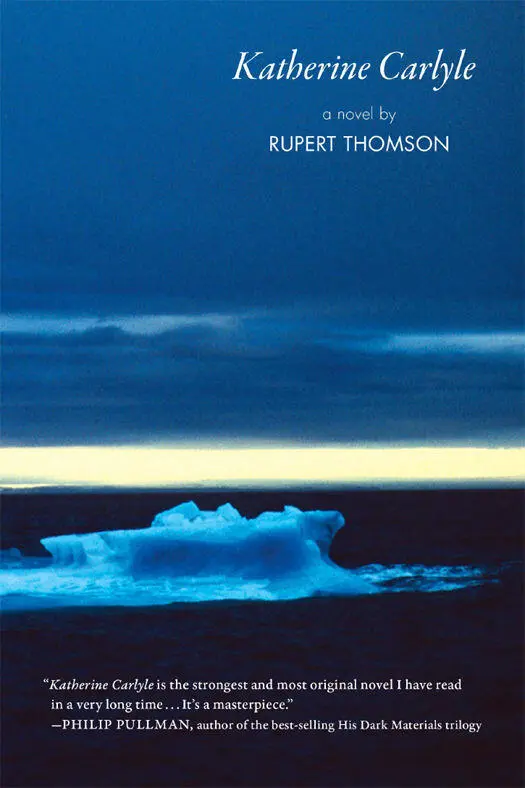
- Название:Katherine Carlyle
- Автор:
- Издательство:Other Press
- Жанр:
- Год:2015
- ISBN:9781590517390
- Рейтинг книги:5 / 5. Голосов: 1
-
Избранное:Добавить в избранное
- Отзывы:
-
Ваша оценка:
Katherine Carlyle: краткое содержание, описание и аннотация
Предлагаем к чтению аннотацию, описание, краткое содержание или предисловие (зависит от того, что написал сам автор книги «Katherine Carlyle»). Если вы не нашли необходимую информацию о книге — напишите в комментариях, мы постараемся отыскать её.
“[T]his road trip through a snow dome of mesmeric hallucinations is Thomson at his best.” —Richard Flanagan, author of The Narrow Road to the Deep North, winner of the 2015 Man Booker Prize
Katherine Carlyle is Rupert Thomson’s breakthrough novel. Written in the beautifully spare, lucid, and cinematic prose Thomson is known for, and powered by his natural gift for storytelling, it uses the modern techniques of IVF to throw new light on the myth of origins. It is a profound and moving novel about identity, the search for personal meaning, and how we are loved.
Unmoored by her mother’s death and feeling her father to be an increasingly distant figure, Katherine Carlyle abandons the set course of her life and starts out on a mysterious journey to the ends of the world. Instead of going to college, she disappears, telling no one where she has gone. What begins as an attempt to punish her father for his absence gradually becomes a testing ground of his love for her, a coming-to-terms with the death of her mother, and finally the mise-en-scène for a courageous leap to true empowerment.
Katherine Carlyle — читать онлайн бесплатно полную книгу (весь текст) целиком
Ниже представлен текст книги, разбитый по страницам. Система сохранения места последней прочитанной страницы, позволяет с удобством читать онлайн бесплатно книгу «Katherine Carlyle», без необходимости каждый раз заново искать на чём Вы остановились. Поставьте закладку, и сможете в любой момент перейти на страницу, на которой закончили чтение.
Интервал:
Закладка:
“How is the fish?” Raul asks.
“Delicious.” I reach for my wine. “There’s something I forgot to say. It’s exciting, going out on a limb. No, exciting isn’t the right word. It’s too small. Too weak. When you go out on a limb you feel alive — in every part of your being. Your whole being sings.” I look at Raul and see him as a man who has taken more risks than I can possibly imagine, and so I say, half to myself, “But perhaps you know that already.”
He pushes his fork into a slice of duck but doesn’t lift it towards his mouth. He hasn’t touched the noodles.
“You’re beautiful,” he says.
His voice is so grave that it makes me laugh. Once again I wonder if I’ve had too much to drink.
“Thank you,” I say. “Are you married?”
“Of course.”
“Do you have children?”
“One child. A boy.”
“He’s in Zagreb?”
“In the country. Outside.”
I tell Raul about my childhood, and how I associate the grayness and rain of London with stability and contentment, and how the sunlit years that followed were years of illness, frailty, and sorrow.
“We moved to Rome because my mother was diagnosed with cancer,” I say. “We went because she wanted to. All her life she wanted to live in Italy.”
“Your mother’s dead?” Raul says.
“She died six years ago. I scattered her ashes myself. I did it secretly.”
“And your father?”
“He’s a journalist.”
Raul pours us both another glass of wine. Black hairs bristle on the backs of his fingers. The symbol on his signet ring is an animal. I can’t tell what sort.
“You’re not eating,” he says.
“I’ve been talking too much. Am I boring you?”
“I like to hear you talk. It’s relaxing.”
“Relaxing?” I laugh again.
“Did I say something strange?” For the first time I sense that he might be vulnerable, and that the balance of power has shifted in my favor. But it doesn’t last. Aware of the lapse, he makes immediate internal adjustments.
“You make it sound as if I’m playing an instrument,” I say. “As if you’re listening to music.”
He nods. “Yes.”
Later, as we speed back to the hotel — he doesn’t offer to drop me where I’m staying — all the energy drains out of me. The tires hiss on the road and everything beyond the window gleams; it must have rained while we were having dinner. The driver has turned up the heating. I can’t seem to draw any air into my lungs. The car rocks and sways, and I could easily fall asleep in my seat, but Raul’s gaze is on me, just as before, and I dare not close my eyes.
The Kempinski appears. Gold lights bouncing, a blur of tinted glass. As I climb out onto the pavement, Raul takes me by the arm and guides me up the steps and into the lobby. Behind me I hear the car glide off into the night. The sound of the engine fading is like loneliness. Raul’s thumb presses into the slender muscle in my upper arm. Everything feels different suddenly. There’s an urgency, an undertow — and the way the car raced away the moment the doors were closed, as if fleeing a crime scene … But we’re in the corner of the lobby, near the black doors of the lifts, before I find my voice.
“What’s going on?”
He still has a tight grip on my arm and he is breathing heavily like someone who’s been running.
“You come to my room, yes?” His English has deteriorated since leaving the restaurant.
“I should be going home,” I tell him.
“Home?”
“My friend’s apartment.” I gesture towards reception, which seems far away, on some horizon. “He’ll be worried.”
“One drink,” Raul says. “In my room.”
As he alters his grip on my arm he brushes my breast with the back of his hand.
“That wasn’t part of the agreement,” I say.
“They didn’t tell you?”
“Tell me what?”
He pushes me up against the wall next to the lift, then jabs the call button. “One hour in my room,” he says. “You come now.” He has me pinned. I can smell the musk duck on his breath.
An elderly Japanese couple approach, the man in a business suit, the woman in a traditional kimono. The man is holding an umbrella. Water drips off the tip and collects in a pool on the sand-colored marble floor. Raul pretends to be adjusting the collar of my coat, then he turns to the couple and says good evening. The man’s head dips. The woman blinks.
I look straight at them. “Help me. Please.”
The couple don’t seem to have heard. Their faces, curiously unlined, are tilted upwards, fixed on the glowing red number above the lifts.
“Can’t you do something?” I say.
There’s a brisk ping! as the lift reaches the ground floor. The doors slide open and the couple step inside. We stay where we are. The doors slide shut again.
“Nobody will help you,” Raul says.
A second ping! as another lift arrives. Raul bundles me inside and presses the button for his floor.
“Excuse me? Is everything —?”
A bellhop in a round red hat and a gray jacket has appeared and is asking if I’m all right but the doors close over him before I can answer. Raul is facing away and doesn’t notice. As soon as we’re alone he puts a hand round my throat and pushes me up against the wall.
The lift soars upwards.
You’re not out of your depth, are you, baby?
Raul pulls my coat off my shoulders, then turns me round and forces me into the corner. My arms are pinioned behind my back. I feel him reach beneath my dress.
“Do you know what my name means?” he says.
I try to kick backwards, but he’s standing up against me, between my legs. One of his hands is in my knickers.
“Wolf,” he says. “It means wolf.”
I remember a vase in the lobby, huge and glossy and stuffed with tropical flowers and blossoms. I wonder if I’m about to faint.
The lift doors open.
Raul grunts, then lets me go. Two men are waiting by the lift. One of them is bald. He has black eyebrows and wears a sheepskin jacket. The other man is taller, with silver hair. Raul ushers me out of the lift.
“You dropped your coat.” The man with the silver hair picks up my coat and hands it to me.
The other man wants to know if there’s a problem.
I lean against the wall next to the lift while Raul addresses the two men in German. I’m too sickened and dizzy to follow what he says. I only know he sounds indignant and threatening, and that he scarcely allows the men to speak. But they stand their ground. Raul swears at them and then at me and walks away.
There’s a long, still moment, then the bald man asks if I’m a guest at the hotel. I shake my head. He offers to escort me back to the lobby. The lift has already gone, and the man with the silver hair steps forward and presses the call button. After what has just happened, though, I don’t want to travel in the lift. I try to explain but my German has deserted me. Still, the men seem to understand. In the distance a door slams.
As we walk down the stairs, the bald man asks if I want to file a complaint. Should the police be called?
“No,” I say. “I’m fine. Thank you.” My legs are trembling and it’s all I can do to stay upright.
On the ground floor the men guide me to one of the orange sofas. Would I like to sit down? I shake my head again. The man with the silver hair fetches me a glass of water. I drink half of it, then straighten my clothes.
“You’re really all right?” he says.
I nod quickly. “I think so.”
They will see me out, he says, when I feel ready. He tells me I should take my time.
As we cross the lobby a few moments later, I keep thinking the Croatian will intervene. He’s a man who can impose his will on any given situation and extract exactly what he’s after. He’s accustomed to being taken seriously, to being obeyed. To being effective. But there’s no sign of him. Only the hum of voices, like insect life, and the Muzak, which is orchestral — a low lush wash of strings. I seem to see him as if from behind, sitting on the edge of a wide bed, his head lowered, his suit jacket stretched tight across his shoulders. What will he do now? Smash something? Get drunk?
Читать дальшеИнтервал:
Закладка:
Похожие книги на «Katherine Carlyle»
Представляем Вашему вниманию похожие книги на «Katherine Carlyle» списком для выбора. Мы отобрали схожую по названию и смыслу литературу в надежде предоставить читателям больше вариантов отыскать новые, интересные, ещё непрочитанные произведения.










Обсуждение, отзывы о книге «Katherine Carlyle» и просто собственные мнения читателей. Оставьте ваши комментарии, напишите, что Вы думаете о произведении, его смысле или главных героях. Укажите что конкретно понравилось, а что нет, и почему Вы так считаете.