Rupert Thomson - Katherine Carlyle
Здесь есть возможность читать онлайн «Rupert Thomson - Katherine Carlyle» весь текст электронной книги совершенно бесплатно (целиком полную версию без сокращений). В некоторых случаях можно слушать аудио, скачать через торрент в формате fb2 и присутствует краткое содержание. Год выпуска: 2015, ISBN: 2015, Издательство: Other Press, Жанр: Современная проза, на английском языке. Описание произведения, (предисловие) а так же отзывы посетителей доступны на портале библиотеки ЛибКат.
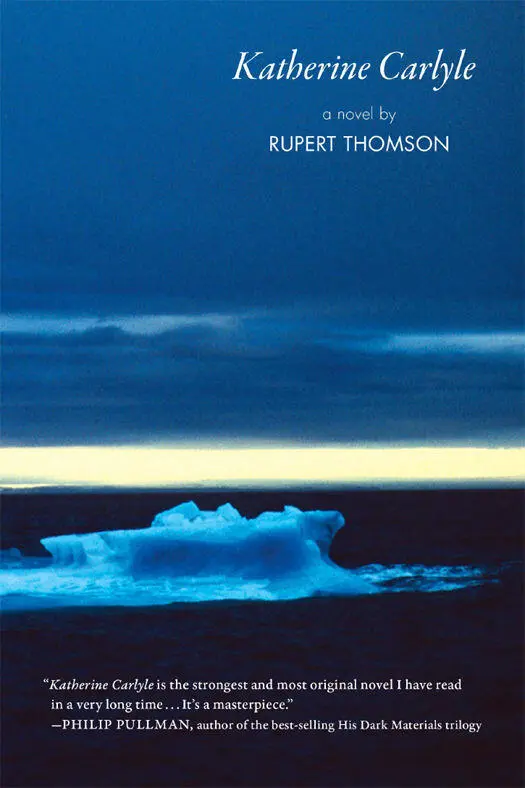
- Название:Katherine Carlyle
- Автор:
- Издательство:Other Press
- Жанр:
- Год:2015
- ISBN:9781590517390
- Рейтинг книги:5 / 5. Голосов: 1
-
Избранное:Добавить в избранное
- Отзывы:
-
Ваша оценка:
Katherine Carlyle: краткое содержание, описание и аннотация
Предлагаем к чтению аннотацию, описание, краткое содержание или предисловие (зависит от того, что написал сам автор книги «Katherine Carlyle»). Если вы не нашли необходимую информацию о книге — напишите в комментариях, мы постараемся отыскать её.
“[T]his road trip through a snow dome of mesmeric hallucinations is Thomson at his best.” —Richard Flanagan, author of The Narrow Road to the Deep North, winner of the 2015 Man Booker Prize
Katherine Carlyle is Rupert Thomson’s breakthrough novel. Written in the beautifully spare, lucid, and cinematic prose Thomson is known for, and powered by his natural gift for storytelling, it uses the modern techniques of IVF to throw new light on the myth of origins. It is a profound and moving novel about identity, the search for personal meaning, and how we are loved.
Unmoored by her mother’s death and feeling her father to be an increasingly distant figure, Katherine Carlyle abandons the set course of her life and starts out on a mysterious journey to the ends of the world. Instead of going to college, she disappears, telling no one where she has gone. What begins as an attempt to punish her father for his absence gradually becomes a testing ground of his love for her, a coming-to-terms with the death of her mother, and finally the mise-en-scène for a courageous leap to true empowerment.
Katherine Carlyle — читать онлайн бесплатно полную книгу (весь текст) целиком
Ниже представлен текст книги, разбитый по страницам. Система сохранения места последней прочитанной страницы, позволяет с удобством читать онлайн бесплатно книгу «Katherine Carlyle», без необходимости каждый раз заново искать на чём Вы остановились. Поставьте закладку, и сможете в любой момент перейти на страницу, на которой закончили чтение.
Интервал:
Закладка:
“Cheadle,” I whisper. “It’s six o’clock.”
But it’s the black woman who lifts her head. She stares at me blankly.
“He asked me to wake him,” I tell her.
She pushes roughly at Cheadle’s shoulder.
Cheadle rolls over. “Fuck.”
I shut the door.
Later that night he opens a liter bottle of red wine and we sit at the kitchen table drinking out of jam jars. They had some people over, he explains. The glasses all got broken.
I ask when I can meet his Russian friends.
“It’s all you ever talk about.” He lights the stub of a cigar. “You’re using me.”
I smile but keep quiet.
“What is it with you and Russians?” he says.
I’m about to answer — or avoid answering — when the toilet flushes and the woman from Cheadle’s bedroom appears in a purple halter neck and pink hot pants.
“Well, this is cozy.” She reaches for Cheadle’s jar and swallows half his wine.
Cheadle introduces us.
“He found me on the street,” Tanzi says.
“Me too,” I say.
“Not sleeping with you as well, is he?”
I shake my head. “Too old.”
Tanzi lets out a raucous laugh. “Damn. You’ve got a tongue on you, girl.”
We’re talking about Cheadle as if he isn’t there and he seems to be enjoying it. Cigar between his teeth, he’s leaning back in his chair with a grin on his face, his fingers interlocked behind his head.
Tanzi is curious about my age.
I tell her.
“Nineteen,” she says dreamily, like you might say “diamonds” or “caviar.”
Cheadle stubs out his cigar. “The thing is, when you’re young, you’re always adding to yourself. Accumulating. Even negative experiences contribute to the sum of who you are. When you’re older, it’s different.”
“What happens then?” I ask.
“You’re like a battery that’s going flat. You’ve got less energy, and you can’t be recharged as easily. The day will come when you can’t be recharged at all. You just go dead. In the meantime there’s a dwindling. Everything’s trying to get away from you.”
“You’re not flat yet, right?” Tanzi gives him a cheeky look, then finishes his wine.
Old people often think they know more than young people, simply because they’ve been around for longer, but it’s not necessarily the case. They can be as wrong about things as anybody else. Once in a while, though, Cheadle comes out with a line that switches a light on in my head, and whenever that happens I know without a shadow of a doubt that I’m in the right place.
Even negative experiences contribute to the sum of who you are .
/
If I’m really staying, Cheadle says — if, as he puts it, I’m going to become “one of the family” — I will be expected to do chores, and given that he hasn’t asked for any rent, that seems reasonable enough. On my second morning, as I’m heating milk for his coffee, he places a BlackBerry on the work surface in front of me.
“A gift,” he says.
I tell him I don’t need it. I tell him what I did with my last phone.
“But that was your old life,” he says.
He has a point.
I accept the BlackBerry as a symbol of all the changes I have made. I have a new number — a Berlin number! — and only one contact: J. Halderman Cheadle.
That afternoon I add two more: Klaus Frings and Oswald Überkopf.
A couple of days later I’m in my room, looking at recent entries in my notebook — the quote from Farewell to an Idea , my drawing of Pavlo’s icon — when my phone rings for the first time. Cheadle’s name appears on the screen. He tells me he has organized a dinner with his Russian friends for nine o’clock that night. The restaurant is on Schlüterstrasse. I fall silent. It’s only a week since Klaus took me to a restaurant on Schlüterstrasse, which is just round the corner from his apartment. What if he walks in while we’re there?
“Misty?”
“Yes?”
“Happy now?”
When I arrive that evening Cheadle is sitting at the back of the restaurant with a drink in front of him. He’s alone. I take a seat beside him, facing out into the room. The walls are the color of wet sand, and a vase filled with red gerberas stands on the bar. It’s not the restaurant Klaus took me to.
Cheadle glances at his phone. “They’re on their way.”
“What,” I say, “like last time?”
He grins, then swirls the whiskey in his glass. “Drink?”
I order sparkling water. I want to stay sharp.
My eyes swerve towards the door every time it opens. My left leg is jiggling under the table. To distract myself, I go to the Ladies. As I walk back across the restaurant, Cheadle looks past me.
“Here they are,” he says.
A man and a woman join us. We all shake hands. The woman looks about forty. She has short reddish hair, which may or may not be dyed, and very white, slightly greasy skin. Her full lips conceal small uneven teeth. Her name is Anna. The man — Oleg — is younger. He is wearing a designer black leather jacket with an open-necked white shirt, and his round head is covered with close-cropped hair of an indeterminate color, like bean sprouts or Tupperware. Anna chooses the seat opposite mine and studies the menu. Oleg brushes at the tablecloth with the backs of his fingers, even though it’s spotless, immaculate. No one speaks. It’s as if we’re about to play a game so esoteric that it doesn’t require any pieces.
For the first half hour talk revolves around business. Delivery dates are mentioned — the fifteenth, the twenty-fourth. Place-names too. Kiev, Piraeus. Minsk. There’s a lengthy debate about Pavlo, and mention of somebody called Raul. Anna’s English is fluent, though heavily accented, and she tends to be the one who answers Cheadle’s questions. Sometimes they switch to Russian, and Cheadle’s understanding of the language surprises me. Oleg seems distracted throughout. He tilts his beer in its glass, and his vague, violent eyes keep drifting round the room.
Eventually — and abruptly — the conversation stops, and a busy silence ensues, as if everybody at the table is thinking different but interconnected thoughts.
“It’s Misty’s first time in Berlin,” Cheadle says at last. “She arrived two weeks ago.”
I hear a faint click as Anna’s lips part on her teeth. It’s the stealthiest of smiles.
“How do you like the city?” she asks.
“I like it very much,” I say.
Oleg is watching me, but nothing shows in his face. Neither curiosity nor interest. He doesn’t even convey indifference.
“You like to travel?” Anna says.
“I like new places.”
I didn’t know it was possible for a conversation to be both mundane and tense, but that is how it feels. Though I requested the meeting, the Russians suddenly seem to have more invested in it than I do, and more to lose. Oleg is looking at my mouth rather than my eyes. He looks so intently that I imagine he can see my words emerging, one by one, like plastic ducks in a fairground rifle range. Cheadle gazes into his glass. He is smiling to himself. For some reason, I have the feeling he’s proud of me.
“And when you leave Berlin,” Anna says, “you will go back to Rome?”
“Oh no. No, I don’t think so.”
She looks at me steadily, her voice quiet but insistent. “Where will you go?”
“Somewhere else. I haven’t decided yet.”
“Somewhere you have never been?”
The question lacks rigor — the future I imagine is intensely foreign, and yet familiar as grass or water — but I try to answer truthfully. “I’m looking for a place where I’ll feel at home.”
“You’re not at home in Italy?”
“Not really.”
“And in Berlin?”
Читать дальшеИнтервал:
Закладка:
Похожие книги на «Katherine Carlyle»
Представляем Вашему вниманию похожие книги на «Katherine Carlyle» списком для выбора. Мы отобрали схожую по названию и смыслу литературу в надежде предоставить читателям больше вариантов отыскать новые, интересные, ещё непрочитанные произведения.




Обсуждение, отзывы о книге «Katherine Carlyle» и просто собственные мнения читателей. Оставьте ваши комментарии, напишите, что Вы думаете о произведении, его смысле или главных героях. Укажите что конкретно понравилось, а что нет, и почему Вы так считаете.