Alexander Theroux - Darconville’s Cat
Здесь есть возможность читать онлайн «Alexander Theroux - Darconville’s Cat» весь текст электронной книги совершенно бесплатно (целиком полную версию без сокращений). В некоторых случаях можно слушать аудио, скачать через торрент в формате fb2 и присутствует краткое содержание. Год выпуска: 1996, Издательство: Holt Paperbacks, Жанр: Современная проза, на английском языке. Описание произведения, (предисловие) а так же отзывы посетителей доступны на портале библиотеки ЛибКат.
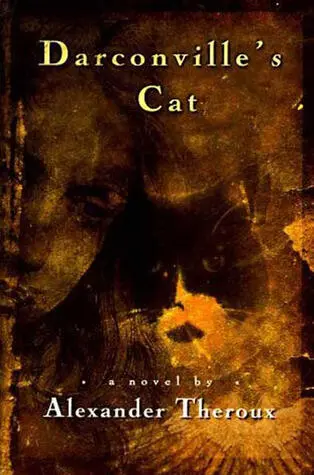
- Название:Darconville’s Cat
- Автор:
- Издательство:Holt Paperbacks
- Жанр:
- Год:1996
- ISBN:нет данных
- Рейтинг книги:3 / 5. Голосов: 2
-
Избранное:Добавить в избранное
- Отзывы:
-
Ваша оценка:
Darconville’s Cat: краткое содержание, описание и аннотация
Предлагаем к чтению аннотацию, описание, краткое содержание или предисловие (зависит от того, что написал сам автор книги «Darconville’s Cat»). Если вы не нашли необходимую информацию о книге — напишите в комментариях, мы постараемся отыскать её.
Darconville's Cat Its chapters embody a multiplicity of narrative forms, including a diary, a formal oration, an abecedarium, a sermon, a litany, a blank-verse play, poems, essays, parodies, and fables. It is an explosion of vocabulary, rich with comic invention and dark with infernal imagination.
Alexander Theroux restores words to life, invents others, liberates a language too long polluted by mutters and mumbles, anti-logic, and the inexact lunacies of the modern world where the possibility of communication itself is in question. An elegantly executed jailbreak from the ordinary,
is excessive; funny; uncompromising; a powerful epic, coming out of a tradition, yet contemporary, of both the sacred and the profane.
Darconville’s Cat — читать онлайн бесплатно полную книгу (весь текст) целиком
Ниже представлен текст книги, разбитый по страницам. Система сохранения места последней прочитанной страницы, позволяет с удобством читать онлайн бесплатно книгу «Darconville’s Cat», без необходимости каждый раз заново искать на чём Вы остановились. Поставьте закладку, и сможете в любой момент перейти на страницу, на которой закончили чтение.
Интервал:
Закладка:
Darconville declined to be seen anymore — for real abnormalities, seriously convincing him he was losing his mind, began to appear— and he locked himself in his rooms. During the first few days he had tried to write, savagely, but didn’t, coming to welcome interruptions and obstacles because they could be held responsible for his crude failures, then the delay, and finally his mercilessness; now, he fully refused to see anyone, to leave the rooms, or to answer any of the knocks on his door, delicately holding his breath under such circumstances until whoever it was went away. An appalling disorder soon prevailed up there, and school papers became misplaced, communications went unanswered, as he fell into more prolonged fits of mental and physical torpor. The atmosphere of the rooms was now like a little self-contained and closed universe, a kind of ambiguous gloom in which almost immediately it became hard to distinguish with certainty between the menacing and the merely ludicrous. Nothing was real or of any significance except that which went on in his mind, and over everything hovered a subdued air not only of constant expectancy but also of sibylline disappointment, of promises kept to the ear but broken to the hope.
Whole days blotted out. He would sit in the darkness feeling a weird urethral chill, frozen in silence, or go maundering up and down for hours whispering to himself and trying to follow his torturous thoughts over every incident of the long four years as if in thinking, like surpassing the speed of light, he might move backward in time, but time is a curve, and, rounding around on him, it only brought him back once more to the immediacy of his own great grief. The coexistence of his despair with her joy became a hideous paradox. Did she feel nothing for him? Could there be nothing between two people? On the one hand, he reasoned, if there is strictly not anything between two things, then they are together! Or adjacent, perhaps — so joined? But what that is joined can then be two? A distinction thus emerged for Darconville between nothing and a nothing — and yet can you “have” a nothing? My God, he thought, there’s proof of the thing in my very own heart!
One night he tried, unsuccessfully, to telephone Isabel sixteen times. He spoke, several times, into the dead receiver.
The terrible sin of tristitia set in. Darconville felt guilty now about his intellectual aspirations to probe, and, although in his heart he knew the conspiracy in Fawx’s Mt. had been long in the making, he prayed: let me only understand, not judge. But why had it happened? What, he wondered, did losing a father mean to a girl? What immeasurable insecurity, what anxieties, had to be relieved? What unknowns did she fear she’d face in leaving that small town? What kind of love could instantly become so brutal, mocking him with his own words that once so loosely prophesied that one emotion by the other might be read? What had she feared in him, then? It occurred to him suddenly that perhaps Isabel inspired in him a desire for much more than herself ! What if she knew, somehow, that she was only that inspiration and nothing more — even to herself — an insubstantial creature empty as the light by which someone else sought to find the very meanings she herself, merely hinting at, never embodied and never possessed and never would? Could that be? The beloved object not a beloved object but only a means of loving? The thought stabbed him. He sagged, driven and derided by the ridiculous and incompetent creature he’d become, by the derangement erotic passion had caused in him. It had been more than a week since he’d eaten, and if physical movement had become difficult now even the simplest reasoning seemed to require enormous effort. The persistently gnawing feeling of inferiority he felt, living as he now was between insignificance and silence, might itself be a clue, he thought, for perhaps she saw she couldn’t be all that he loved, coming to hate in herself what he expected and yet needing at the same time to destroy the possibility of what she felt she could never achieve. Expectation is temptation. Where there’s a won’t there’s a way. And yet could such things be ?
Darconville looked at her photograph, faintly lit by the flickering candle: had that face, he wondered, been an inspiration or a challenge to his love? The composition of beauty could not have been more classical; it reflected what it had promised, yet in what had been shown was the utter moral defeat of its form. Content and form were at loggerheads. There were two simultaneous but incompatible forces within her — a classical love, embodied, and the disruptive insight, expressed, that that was precisely what she couldn’t bear. Were both equally real and yet each unaware of the other? Was it possible? Can the mind prod itself into deciding which value it will observe in a universe where those unobserved, but equally real, have also actually happened? Could she hate the very legs she used to walk away and wish in the ones she never had to have come? The picture reflected exactly what it wasn’t, as if framed in a paradox that seemed to ask “Who speaks of the failure of vision?” and implicitly answering “I.”
The close reasoning somewhat deranged Darconville, and it became the point of departure for another one of his fugues, a theory whereby, in trying to re-establish his hope, he formulated an approach to experience in which radically opposed and yet equally total commitments to whatever event might be able to coexist in a single harmonious vision, and with painstaking exactitude he tried to make an existence assertion out of exhibitive but seemingly irresolvable paradoxes and contrarieties: a realibus ad reliora . Every negation, he concluded, is also a determination! And in that dismal set of rooms he resumed again that strange and willful attempt at psychokinesis — trying to move something by the power of the mind — and as if convinced that miracles must exist and didn’t only for want of someone around to be amazed by them (for wasn’t opportunity but chance favoring the prepared mind?) he this time began to reason that there must be an alternate universe that constructs the opposite decision points of those made in this universe, for if what doesn’t happen could have, so somewhere, in-determinism says, it must! Desperately he tried to reason logical necessity into his love, for reality, he decided, was not thinkable but in relation to an activity by means of which it becomes thinkable: nothing that couldn’t come to happen is unthinkable; nothing could come to happen that won’t; nothing that could come to happen doesn’t. I am who am not, thought Darconville, walking in circles and mounting fertile and despairing explanations for his own barrenness, for who can affirm, he concluded, that meaning does not exist in terms which don’t also imply it does? Am I ignored, he wondered then, only that I might love the more, to savor in the breach what I can’t in the observance? How else could Laura have been Petrarch’s when she married someone else?
It was insane, Darconville suddenly saw, all of it! To try to divine exactly and scientifically the ultimate reality which is not ? With a raw glare of grief into these monstrous distortions, he saw the tangle of logic for what it was, a confusion which pointed only toward itself as an example of the silence it feared and the truth it cowered before. The humiliation of not-knowing: it was a black fast of the mind, for what he knew was little, and worthless in the face of what he tried to believe without knowing, and still less in respect of that which he had been prevented from finding out. There was no light. There was no noise. There was nowhere to turn. He felt only the ceaseless thumping of his heart under the bedclothes, the rigid stillness of what passed for repose, and, occasionally, the absurd begging whisper in the darkness, “ Un altro, un altro, gran’ Dio, ma meno forte .”
Читать дальшеИнтервал:
Закладка:
Похожие книги на «Darconville’s Cat»
Представляем Вашему вниманию похожие книги на «Darconville’s Cat» списком для выбора. Мы отобрали схожую по названию и смыслу литературу в надежде предоставить читателям больше вариантов отыскать новые, интересные, ещё непрочитанные произведения.








Обсуждение, отзывы о книге «Darconville’s Cat» и просто собственные мнения читателей. Оставьте ваши комментарии, напишите, что Вы думаете о произведении, его смысле или главных героях. Укажите что конкретно понравилось, а что нет, и почему Вы так считаете.