Andre Aciman - Eight White Nights
Здесь есть возможность читать онлайн «Andre Aciman - Eight White Nights» весь текст электронной книги совершенно бесплатно (целиком полную версию без сокращений). В некоторых случаях можно слушать аудио, скачать через торрент в формате fb2 и присутствует краткое содержание. Год выпуска: 2010, ISBN: 2010, Издательство: Farrar, Straus and Giroux, Жанр: Современная проза, на английском языке. Описание произведения, (предисловие) а так же отзывы посетителей доступны на портале библиотеки ЛибКат.
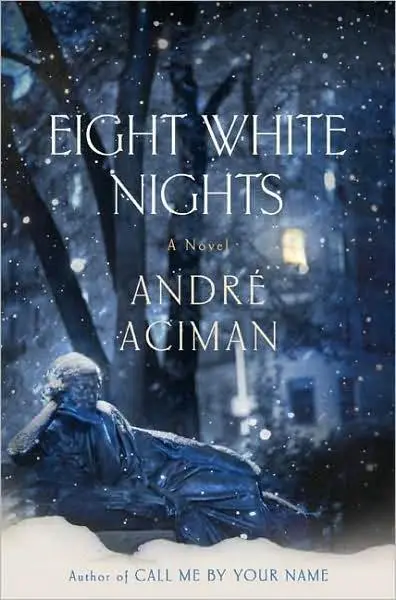
- Название:Eight White Nights
- Автор:
- Издательство:Farrar, Straus and Giroux
- Жанр:
- Год:2010
- ISBN:9780374228422
- Рейтинг книги:3 / 5. Голосов: 1
-
Избранное:Добавить в избранное
- Отзывы:
-
Ваша оценка:
Eight White Nights: краткое содержание, описание и аннотация
Предлагаем к чтению аннотацию, описание, краткое содержание или предисловие (зависит от того, что написал сам автор книги «Eight White Nights»). Если вы не нашли необходимую информацию о книге — напишите в комментариях, мы постараемся отыскать её.
Eight White Nights is an unforgettable journey through that enchanted terrain where passion and fear and the sheer craving to ask for love and to show love can forever alter who we are. A man in his late twenties goes to a large Christmas party in Manhattan where a woman introduces herself with three words: "I am Clara." Over the following seven days, they meet every evening at the same cinema. Overwhelmed yet cautious, he treads softly and won’t hazard a move. The tension between them builds gradually, marked by ambivalence, hope, and distrust. As André Aciman explores their emotions with uncompromising accuracy and sensuous prose, they move both closer together and farther apart, culminating on New Year's Eve in a final scene charged with magic and the promise of renewal. Call Me by Your Name, Aciman's debut novel, established him as one of the finest writers of our time, an expert at the most sultry depictions of longing and desire. As The Washington Post Book World wrote, "The beauty of Aciman’s writing and the purity of his passions should place this extraordinary first novel within the canon of great romantic love stories for everyone." Aciman’s piercing and romantic new novel is a brilliant performance from a master prose stylist.
Eight White Nights — читать онлайн бесплатно полную книгу (весь текст) целиком
Ниже представлен текст книги, разбитый по страницам. Система сохранения места последней прочитанной страницы, позволяет с удобством читать онлайн бесплатно книгу «Eight White Nights», без необходимости каждый раз заново искать на чём Вы остановились. Поставьте закладку, и сможете в любой момент перейти на страницу, на которой закончили чтение.
Интервал:
Закладка:
“One thousand and three!” exclaimed Clara, referring to the number of Don Giovanni’s mistresses in Spain.
At which we all clapped.
“Or was it ninety-one?” asked Clara, the Don’s mistresses in Turkey.
“Six hundred and forty,” added Margo, referring to those in Italy.
“Two hundred and thirty-one, and not a woman more!” thundered Max, the Don’s mistresses in Germany.
"Madamina. .” I began, deepening my voice till it growled with comic gravity the way Leporello catalogs the number of Don Giovanni’s mistresses around the world.
It was so unlike me to hurl a joke among people I barely knew, much less with song, that I was surprised to hear Clara laugh the loudest, and more surprised yet when she took up what wasn’t even meant as a cue and began humming the opening bars of the aria, and then actually singing the aria, with a voice that, once again, came unannounced and was more lacerating than the one I’d heard at the party or by the jukebox, because this time it seemed to palm my neck with its breath, once, twice, every syllable a caress. “Madamina, il catologo è questo, delle belle che amò il padron mio. .” A few verses more and her voice had so totally shaken and moved me that, in an effort to keep my composure, I found myself putting an arm around her and then, pressing my head against her back, squeezing her toward me. She didn’t seem to mind, because, more surprising yet, she held my hand on her waist and, turning to me, kissed me on the neck, letting her hand linger there, the way she’d done last night, as though the hand was part of the kiss.
Her kiss unsettled me more than the singing. I had to keep quiet, focus on the soup, show that this third wine was far better than the first two. But I was too flustered for words. I had touched her sweater, and its softness belied every cutting inflection in her speech, in her face, her body.
By then we had each already finished two servings of soup and begun eating the marinated greens. More wines.
After the salad, Margo got up and came back with a cake. “It’s a strudel gâteau. I hope you all like it.”
She also brought to the table more crème fraîche. “This is everyone’s favorite.”
She had probably meant to say, This is Inky’s favorite, but had caught herself in time. Or perhaps I was making this up. But Clara’s determined focus on her slice of the turned-over apple pie told me once again that she had intercepted the very same backpedaling and was passing over it in silence.
“Max, want some strudel gâteau ?”
“Silly woman. Must you always call it strudel gâteau ?”
“Behave,” whispered Clara.
Who knows what existed between Clara and the old couple. I would have to ask her at some point, probably on our way back, during one of those long silences that were bound to crop up between us. But part of me was tired of so many reminders of Clara’s past with Inky. Had they grown up together? Would his shadow linger forever between us? If she was done with him, why go visit his grandparents? To show she was with another man now, hoping they’d tell him? But anyone with half a brain could instantly spot by our behavior together that we were not together. Was her kiss meant to suggest we were? Is this why she’d brought me along? Getting me out of the shower, bringing me breakfast, making me feel special, giving me all this nonsense about lying low, which she knew would stoke anyone’s curiosity, calling herself a Gorgon — all this just to send Inky the message that love was dead?
I wondered what kind of evil monster she turned into when her love died — did she tell you it was finished: Just let it go? Did she drop you back into the fish tank where you sank or swam, or did she release a few bubbles at a time and throw you tiny pellets of food as she did with Inky that night at the party, so you wouldn’t go belly-up, though you know and she knows it’s only a matter of time before they pick you up and flush you down where all fish souls end when they go back to the greater scheme of things? Was I making all this up, or was I myself gradually being put in a straitjacket before being dunked in a pickle jar as I looked up at the hole that was about to close on me?
I could always escape. The train to the city. My beloved Greek diner. Doing the New York Times crossword puzzle. I still had Christmas presents to buy, the stores would still be open if I left now. Was there a limit to how late one could give Christmas presents?
“Another slice of strudel gâteau?” asked Margo.
I looked at her and wondered where she stood on the Inky front. Then I remembered that they’d sat us near each other, not once but twice.
Yes, I would take another slice of the strudel gâteau.
“All young men like this cake,” said Margo.
I looked over at Clara. Once again, her face was neutral.
“Ladies and gentlemen, it’s been nice,” said Max. “Come, Margo.”
I looked up at them, totally baffled.
“I need to take a nap. Otherwise I age by five years, and that, dear friends, takes us to unreal numbers. Or I start dozing in public, and frankly, no one enjoys watching old people nod and drool and mutter things that had better be left unsaid.”
“As if he ever watches his speech.”
“ Ach , Margo, it’s not like you don’t nod in the afternoon either.”
“—and leave our guests?”
“Come and cuddle and don’t fuss so much, woman.”
“Cuddling, he calls it — phooey.”
“Fie and phooey to you too, besotted harridan; come upstairs, I said, and watch me be daring in love and dauntless in war—”
“—and dangle your bonnet and plume? I’m not sleepy.”
“Don’t bother about us,” interrupted Clara. “I’ll make coffee and put the dishes away.”
“Esmeralda will do it. Otherwise we pay her for what?”
“On second thought,” Clara said, “we might as well say goodbye now. We’re leaving in a short while. It might snow again.”
“Yes, you don’t want to be snowed in.”
Clara suddenly turned to me. “Do you want to be snowed in?”
What an amazing, amazing woman.
“You know damn well I would love nothing better,” I said.
“Margo never asked if I wanted to be snowed in. You’re a lucky man.”
“Upstairs, Lochinvar,” said Margo. “Upstairs, with your old bonnet and plume.”
Clara kissed the two of them more affectionately than when she’d greeted them.
“You’ll see, you’ll be your dashing self in no time,” she added, knowing he was worried about his operation.
“Just don’t forget to listen to the Handel. With all this talk of soup, wine, and bonnets, I forgot.”
“Don’t blame the wine or my soup, you forgot because you’re old.”
“ Because you’re old. Those are probably the last words I’ll hear before I head out to the eternal landfill. But don’t forget the Handel. That Handel was worth waiting seven decades for.”
•
“Let’s make coffee first.”
I watched her open one of the kitchen cabinets and take out the espresso maker. She knew exactly where to find it. She tried to twist it open, but it was shut tight. “Here, you open it,” she said, handing it to me. “They don’t drink coffee anymore,” she added, as though registering yet another instance of their decline. The packet of ground coffee was also where she knew it would be, in the freezer. Even the silver spoon with which she spooned out three heaping spoonfuls was in an old wooden drawer that rattled first before suddenly dipping at a precarious angle once you pulled it out — a cemetery of old cutlery that hadn’t seen sunlight in who knows how many years. “Here,” she said, handing me two mugs. “Spoon. Sugar. Milk?”
Читать дальшеИнтервал:
Закладка:
Похожие книги на «Eight White Nights»
Представляем Вашему вниманию похожие книги на «Eight White Nights» списком для выбора. Мы отобрали схожую по названию и смыслу литературу в надежде предоставить читателям больше вариантов отыскать новые, интересные, ещё непрочитанные произведения.







Обсуждение, отзывы о книге «Eight White Nights» и просто собственные мнения читателей. Оставьте ваши комментарии, напишите, что Вы думаете о произведении, его смысле или главных героях. Укажите что конкретно понравилось, а что нет, и почему Вы так считаете.