Andre Aciman - Eight White Nights
Здесь есть возможность читать онлайн «Andre Aciman - Eight White Nights» весь текст электронной книги совершенно бесплатно (целиком полную версию без сокращений). В некоторых случаях можно слушать аудио, скачать через торрент в формате fb2 и присутствует краткое содержание. Год выпуска: 2010, ISBN: 2010, Издательство: Farrar, Straus and Giroux, Жанр: Современная проза, на английском языке. Описание произведения, (предисловие) а так же отзывы посетителей доступны на портале библиотеки ЛибКат.
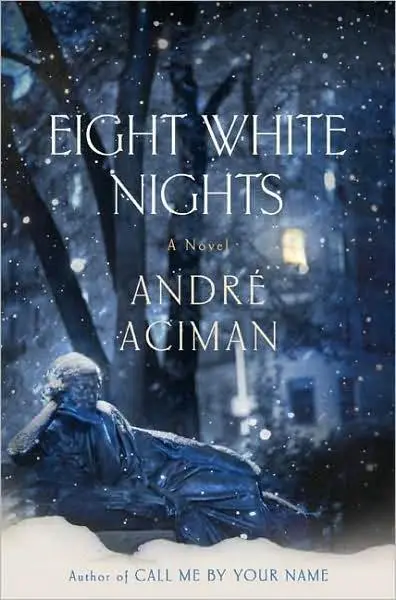
- Название:Eight White Nights
- Автор:
- Издательство:Farrar, Straus and Giroux
- Жанр:
- Год:2010
- ISBN:9780374228422
- Рейтинг книги:3 / 5. Голосов: 1
-
Избранное:Добавить в избранное
- Отзывы:
-
Ваша оценка:
Eight White Nights: краткое содержание, описание и аннотация
Предлагаем к чтению аннотацию, описание, краткое содержание или предисловие (зависит от того, что написал сам автор книги «Eight White Nights»). Если вы не нашли необходимую информацию о книге — напишите в комментариях, мы постараемся отыскать её.
Eight White Nights is an unforgettable journey through that enchanted terrain where passion and fear and the sheer craving to ask for love and to show love can forever alter who we are. A man in his late twenties goes to a large Christmas party in Manhattan where a woman introduces herself with three words: "I am Clara." Over the following seven days, they meet every evening at the same cinema. Overwhelmed yet cautious, he treads softly and won’t hazard a move. The tension between them builds gradually, marked by ambivalence, hope, and distrust. As André Aciman explores their emotions with uncompromising accuracy and sensuous prose, they move both closer together and farther apart, culminating on New Year's Eve in a final scene charged with magic and the promise of renewal. Call Me by Your Name, Aciman's debut novel, established him as one of the finest writers of our time, an expert at the most sultry depictions of longing and desire. As The Washington Post Book World wrote, "The beauty of Aciman’s writing and the purity of his passions should place this extraordinary first novel within the canon of great romantic love stories for everyone." Aciman’s piercing and romantic new novel is a brilliant performance from a master prose stylist.
Eight White Nights — читать онлайн бесплатно полную книгу (весь текст) целиком
Ниже представлен текст книги, разбитый по страницам. Система сохранения места последней прочитанной страницы, позволяет с удобством читать онлайн бесплатно книгу «Eight White Nights», без необходимости каждый раз заново искать на чём Вы остановились. Поставьте закладку, и сможете в любой момент перейти на страницу, на которой закончили чтение.
Интервал:
Закладка:
“Want to pass it up?” she asked.
“No. I was going to ask you to stop.”
“Lipton tea that good?”
I nodded.
“You know we’re not being very good,” she said.
“I know. But a cup of tea never hurt anyone.”
We parked the car exactly where we’d parked that morning. I ordered two teas just as I’d done before. Clara went to the bathroom. I chose the same spot by the wood-paneled wall. The fire was still burning in the fireplace. And she knew exactly where I’d be. Except that this time as soon as she sat down I told her to scoot over, because I wanted to sit next to her. She didn’t seem to mind. She didn’t let much time go by before asking, “So tell me about her.” Did she really want to know? I asked. Yes, she really wanted to know. And as though to entice me, she snuggled into the corner between the end of the seat and the glass panel with the darkling view of the Hudson right behind her. I met her right after college, I said. The love of your life? No, not the love of my life. So why are you telling me about her? You’ll see if you let me finish. She was a dancer, but by day an editor, a good cook, and three times a week a single mother. She was older than I was. By how much? Ten years — and don’t interrupt. She cooked meals for me that I’d never eaten before, with sauces that would seem to require chefs and sous-chefs days to prepare but which she’d whip up in a matter of minutes. Here I was almost a vegetarian eating steak dinners every night. It took me a while to realize why she was feeding me so much protein. She, on the other hand, never ate. She smoked all the time. So we’d have those fabulous dishes on the tea table, and I would eat and eat and eat, while she sat next to me on the floor and watched me chomp away. She was probably bulimic, or anorexic, or both, except that you’d never know it, because she was always bingeing in secret. She was also addicted to sedatives, laxatives, antidepressants.
“What was good about her?”
“For a while everything.”
“Then?”
“I stopped loving her. I tried not to stop, but I couldn’t. From not loving her I started not wanting to listen to her, then to not wanting to touch her, to hating the sound of her laugh or the rattle of her keys when she came home, or the sound of her slippers when she woke up in the middle of the night and went into the living room for a smoke, and sat there in the dark because I said the light bothered me, down to the click of the television when she’d turn it off, which meant she was coming back to bed. It was horrible. I was horrible. So I left her.”
“Are you not good for people, either?”
“I don’t think I am. And she knew it. One day, toward the end, she said, ‘I’m someone you won’t remember having loved. You’ll walk out on me and won’t give it a second thought.’ And she was right.”
I fell silent.
“Well, go on with your story.”
“Late last winter, out of the blue, one evening I got a call from her. We’d not spoken in three or four years. She said she wanted to see me — no, needed to see me. Well, I knew she hadn’t borne me a child in secret, I knew she wasn’t short of money, and I knew she hadn’t uncovered an STD she had to tell all her old lovers about. She just needed to see me, that’s all. The man of my life, she called me. It tickled me somewhat. We made a lunch date, but it fell through, then another, which also fell through. And then she never called again, and I didn’t either. A few months ago, through a series of coincidences, I found out she had died. The news of her death still haunts me, or perhaps I want it to.”
“And?”
“And nothing. She’d found out she was very sick and needed to reach out to someone who’d mattered and say a few things she’d never had the courage to say before. Now that the veil was shed and there was no room for pride or other nonsense, all she wanted was to spend a few hours together.”
There was a moment of silence between us.
“I thought she was lonely and had run down a list of old flames, old friends,” I added.
“I wonder whom I’ll call when my time comes. Not Inky, that’s for sure. Who would you call?”
“That’s a Door number three question. And we don’t do those in diners and grills.”
“I hear pandangst.”
I gave her a look that said, You should know.
She replied, I most certainly do know.
She straightened up and sipped from her tea, holding both palms around her mug.
I wanted to grab both her hands, put them together, and hold them in between my own and then spread them open as one opens the pages of a hymnal and kiss each palm.
I told her I liked watching her drink tea.
“And I love your forehead,” she said.
I looked out the window, feeling that this working-class diner had something unbelievably magical, as if it understood that for us to be together and feel comfortable here it had to be as ordinary and unassuming and as run-down as anything in a Hopper painting, like Lipton tea, like the plaid faux-linen curtains that kept rubbing her hair, and the thick chipped earthenware mugs we drank from. I wondered if she and I were not like Hopper’s perpetual convalescents — Hopper people, vacuous, stunned, frozen Hopper people, resigned to hidden injuries that might never heal but that have long since ceased to stir either sorrow or pain. I wasn’t sure I liked the Hopper analogy. But this, I realized, was exactly what she meant by lying low. Staying put like Hopper’s people, sitting upright at a slight distance from things like jittery lemurs scoping out an all-too-familiar landscape called life with neither interest nor indifference.
“I can see why she called you, though.”
It took a few moments for me to realize she was referring to my old flame.
“Why?”
“No why. I can just see it.”
•
“It’s getting late,” I said.
And suddenly, as soon as I’d said this, I knew she knew why I’d said it.
“At what time does it start?”
“Seven-ten, didn’t you know?”
“Am I invited?”
I looked at her. “Who’s the Printz Oskár now?”
“So we’re going to the movies?”
“Yes,” I said, as if I were finally yielding to a request she’d been struggling to make all day.
“So we’re going to the movies.”
It took me a while to understand what the near-imperceptible lilt in her voice meant when she said “So we’re going to the movies.” She was either enacting or genuinely expressing the excitement of children whose parents on a bleary Sunday afternoon suddenly decide to put on their coats and herd everyone to the movies. We’re going to the movies, I repeated after her, the way a schoolmate who’d been visiting me after school, rather than being sent back to his parents in the evening, was invited to come along to the movies.
We had less than an hour to drive to the city and find a parking space. Or we could park in her garage and hail a cab. “It could be done,” she said. Or I could jump out and buy tickets while she parked nearby. Could we call the theater and have them save two spots under our name? Which name? Your name. My name. “You know what name,” she said.
We were now speeding along the highway, and in no time spotted the lights of the George Washington Bridge glimmering over the vast and tranquil Hudson. “The city,” she said, the way anyone might say on spotting a familiar lighthouse signaling the way home. I remembered the tension in the car earlier that morning, and the muffins and bagels in the white-gray paper bag, and the Bach version we’d listened to and how it all belonged to another time warp. “Look to your right,” she said, having spotted it before I did. And there it was, exactly where we’d left it earlier this morning, anchored smack in the middle of the Hudson, the Prince Oscar, our beacon, our lodestar, our emblem, our double, our namesake, our spellbound word for the things we had no words for — love of my life, my dear, dear Prince Oscar, dear, troubled ship that you are, lord of all ships in the catalog of ships, give us a sign, tell us, oh, boatswain, what of this night, tell us of this land of dreams you ferry passengers to, tell us what’s to become of us, what’s to become of me — can you hear?
Читать дальшеИнтервал:
Закладка:
Похожие книги на «Eight White Nights»
Представляем Вашему вниманию похожие книги на «Eight White Nights» списком для выбора. Мы отобрали схожую по названию и смыслу литературу в надежде предоставить читателям больше вариантов отыскать новые, интересные, ещё непрочитанные произведения.









Обсуждение, отзывы о книге «Eight White Nights» и просто собственные мнения читателей. Оставьте ваши комментарии, напишите, что Вы думаете о произведении, его смысле или главных героях. Укажите что конкретно понравилось, а что нет, и почему Вы так считаете.