Andre Aciman - Eight White Nights
Здесь есть возможность читать онлайн «Andre Aciman - Eight White Nights» весь текст электронной книги совершенно бесплатно (целиком полную версию без сокращений). В некоторых случаях можно слушать аудио, скачать через торрент в формате fb2 и присутствует краткое содержание. Год выпуска: 2010, ISBN: 2010, Издательство: Farrar, Straus and Giroux, Жанр: Современная проза, на английском языке. Описание произведения, (предисловие) а так же отзывы посетителей доступны на портале библиотеки ЛибКат.
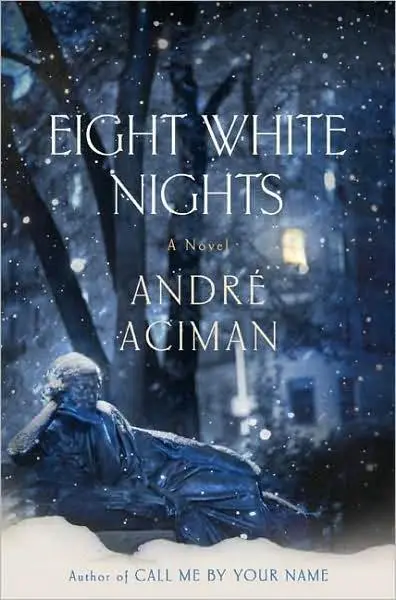
- Название:Eight White Nights
- Автор:
- Издательство:Farrar, Straus and Giroux
- Жанр:
- Год:2010
- ISBN:9780374228422
- Рейтинг книги:3 / 5. Голосов: 1
-
Избранное:Добавить в избранное
- Отзывы:
-
Ваша оценка:
Eight White Nights: краткое содержание, описание и аннотация
Предлагаем к чтению аннотацию, описание, краткое содержание или предисловие (зависит от того, что написал сам автор книги «Eight White Nights»). Если вы не нашли необходимую информацию о книге — напишите в комментариях, мы постараемся отыскать её.
Eight White Nights is an unforgettable journey through that enchanted terrain where passion and fear and the sheer craving to ask for love and to show love can forever alter who we are. A man in his late twenties goes to a large Christmas party in Manhattan where a woman introduces herself with three words: "I am Clara." Over the following seven days, they meet every evening at the same cinema. Overwhelmed yet cautious, he treads softly and won’t hazard a move. The tension between them builds gradually, marked by ambivalence, hope, and distrust. As André Aciman explores their emotions with uncompromising accuracy and sensuous prose, they move both closer together and farther apart, culminating on New Year's Eve in a final scene charged with magic and the promise of renewal. Call Me by Your Name, Aciman's debut novel, established him as one of the finest writers of our time, an expert at the most sultry depictions of longing and desire. As The Washington Post Book World wrote, "The beauty of Aciman’s writing and the purity of his passions should place this extraordinary first novel within the canon of great romantic love stories for everyone." Aciman’s piercing and romantic new novel is a brilliant performance from a master prose stylist.
Eight White Nights — читать онлайн бесплатно полную книгу (весь текст) целиком
Ниже представлен текст книги, разбитый по страницам. Система сохранения места последней прочитанной страницы, позволяет с удобством читать онлайн бесплатно книгу «Eight White Nights», без необходимости каждый раз заново искать на чём Вы остановились. Поставьте закладку, и сможете в любой момент перейти на страницу, на которой закончили чтение.
Интервал:
Закладка:
Were we just going to stare at each other for however long it took to hear the music?
So it seemed.
So I left my chair and, all the while continuing to stare at her — she was still following me with her gaze — kneeled down right next to her on the rug, my heart racing, neither of us taking our eyes off each other, I not knowing whether I was breaking some tacit understanding I hadn’t altogether agreed to, she not knowing what I was up to — except that suddenly I caught her nether lip give a tremor, her chin seemed to cramp ever so slightly, and, before I knew what was happening, her eyes were filled with tears and she began crying. I envied her even this freedom.
“Clara,” I said.
She shrugged her shoulders, as if to mean, Can’t be helped.
“I don’t know what’s come over me. I don’t know.”
I reached out and held both her hands in mine.
“I’m a total mess, aren’t I?”
“It’s the Handel.”
She said nothing, just shook her head. I should have kissed her right there and then.
“Or maybe it’s Inky,” I threw in. “Or seeing Max and Margo,” I added, trying to help her narrow down the cause of her tears, the way a parent might help a child find the exact spot where his arm hurts.
“We’re taking the CD. He made other copies,” she finally said. She was trying to show she was quite able to compose herself. “Poor man, him with his dead music and his rotting body and all that talk of eternal landfills—”
She began to cry again, this time in earnest.
“You left out strudel gâteau” I was trying to distract her and make her laugh, though I wouldn’t have minded if she continued crying. Tears seemed to have removed every barb from her body and, better yet, to have humanized her the way I’d seldom seen someone be so human before. It left me feeling totally rudderless. I attempted another joke, this time at the expense of art and pipi caca art.
She gave a mild laugh, but wasn’t falling for the diversion.
“Does music always make you cry?”
But my question was a weak diversion, and she wasn’t falling for it either.
“I’m not ready,” she finally said.
I knew exactly what she meant. Might as well bring it out into the open.
“Because I am?” I asked, as though to undo any pretense that I might be.
Were we saying yes by saying no?
Or was it the other way around? Saying no to mean yes to say no?
“What messes,” she said.
“Well, at least we know we’re safe messes.”
She took this in. I thought I had finally comforted her.
“I don’t know that I am — safe, that is. Perhaps neither of us is.”
Even in the midst of tears, I could heed the light, windblown cheep of rusted barbed wire dangling on a long country fence.
I took out my handkerchief and gave it to her.
She grabbed it as though it were a jug of ice water in July, wiped her tears several times, then crumpled it tightly in her fist.
I feared she might hold this moment against me.
“You’re the only person I know”—she hesitated a moment, making me think she was about to say something ever so sweet about me—“who still uses handkerchiefs.”
“What do most people use, their fingers?” I asked.
“Some do. Most use tissues. Others gloves.”
I could sense that maybe humor wasn’t going to work.
“I’m just afraid I may never see this house.”
She was on the verge of tears again.
“What if we promise to be back here in a week — together?”
She looked at me point-blank and said nothing, the same vague, absent look on her face, which told me she either didn’t trust my motives or that she simply lacked the will to remind me how quixotic was my plan. For all I knew, she had other things lined up for next week, things I wasn’t part of — for all I knew, this should have been the time to bring up her admonition yet again, but she didn’t have the strength or the heart to do so now.
“Why not, you’ll pick me up, bring me breakfast, and sing for me in the car.”
“You’re such a Printz Oskár.”
When she gave me back my handkerchief, I could feel its dampness. I put it back in my pocket, hoping it might never dry.
“You’re the best person to have Vishnukrishnus with,” she finally said. “Today was my turn; yesterday, yours.”
“Keep talking like this and you’ll make me have one this minute.”
“What wrecks,” she said.
•
On the way back we listened to Handel’s sarabande again and again. I knew that this would be our song, the song of December 26, and that wherever I’d be in the years to come, if, like a traveler in the desert I should lose my bearings one night, all I would have to do was think of this sarabande as played by a man who had disappeared into the hinterland of time, and like an anthropologist piecing bone fragments together one by one, I’d be able to bring back who I was on this day, where I’d been, what I’d wanted most in life, and how I’d fallen for it and almost touched it. As we listened to the music quietly, I thought of how she and I had stepped down the ramp onto the riverbed and heard the ice break, and how that too was forever laced into that moment on the rug when I realized, as I’d never done since meeting her, that the remainder of my life could hang on that tune and that it would take nothing but a misplaced breath to make my life go one way or the other.
“Clara Brunschvicg,” I said.
“Yes, Printz Oskár?”
“Clara Brunschvicg, I’ll never forget you,” I was going to say. But then I thought it sounded too wistful. “Clara Brunschvicg, I could so easily fall in love with you — if I haven’t already.” No, too laden. “Clara Brunschvicg, I could do this for the rest of my life — me and you, alone together, whenever, wherever, forever. Spend every minute the way we’ve done today, winter, car, ice, stones, soup, because one hundred years from now, those minutes are all we’ll have to show for ourselves, all we’re ever going to want to pass on to others, and frankly, in one hundred years they’ll all forget or won’t care or know how to remember, and I don’t want to end up like my father with dreams of love and of a better life he’d been robbed of or is still sailing out to. I don’t want to pass by your building in thirty years and, looking up, say to myself or to the person I’ll be with that day, You see this building? There my life stopped. Or there my life split. Or there life turned on me, so that the person looking at the building right now and talking to you is, ever since that one winter so many years ago, still on hold; the hand holding your hand is a phantom limb, and the rest of me is prosthetic, too, and I’m a shadow and she’s a shadow, and, as in Verlaine’s poem, we’ll still speak shadow words of our shadow love while the decades trawl past us as we stay put and hold our breath. The real me is frozen on this block and chances are will outlive me by many years until he turns into one of those family legends that gets retold on ritual anniversaries and from tragedy become a font of laughter and ridicule. So, tell me the one about the man who was named after a large tanker, they’ll say, the way I’d ask my father about ancestors who’d had their heads lopped off.”
“What were you going to say?” she said.
“Nothing.”
“That’s not what you were going to say,” she said.
“Yes, I know,” I replied.
At which we laughed. “Aren’t we so very, very clever, Printz.”
“We are, we are.”
•
The same thing happened twice again that day.
We were speeding down the country road on our way back to the city. It was past sunset, and we watched a pale, listless color line the white Hudson we’d been staring at all day. We’d been driving for around half an hour when the tiny town began to come into view. Neither of us said anything, and it seemed we’d both forgotten and were going to pass in silence. Clara, who was driving, looked at me. Then she began to pick up speed, and I could tell she was smiling. She was bluffing.
Читать дальшеИнтервал:
Закладка:
Похожие книги на «Eight White Nights»
Представляем Вашему вниманию похожие книги на «Eight White Nights» списком для выбора. Мы отобрали схожую по названию и смыслу литературу в надежде предоставить читателям больше вариантов отыскать новые, интересные, ещё непрочитанные произведения.








Обсуждение, отзывы о книге «Eight White Nights» и просто собственные мнения читателей. Оставьте ваши комментарии, напишите, что Вы думаете о произведении, его смысле или главных героях. Укажите что конкретно понравилось, а что нет, и почему Вы так считаете.