Andre Aciman - Eight White Nights
Здесь есть возможность читать онлайн «Andre Aciman - Eight White Nights» весь текст электронной книги совершенно бесплатно (целиком полную версию без сокращений). В некоторых случаях можно слушать аудио, скачать через торрент в формате fb2 и присутствует краткое содержание. Год выпуска: 2010, ISBN: 2010, Издательство: Farrar, Straus and Giroux, Жанр: Современная проза, на английском языке. Описание произведения, (предисловие) а так же отзывы посетителей доступны на портале библиотеки ЛибКат.
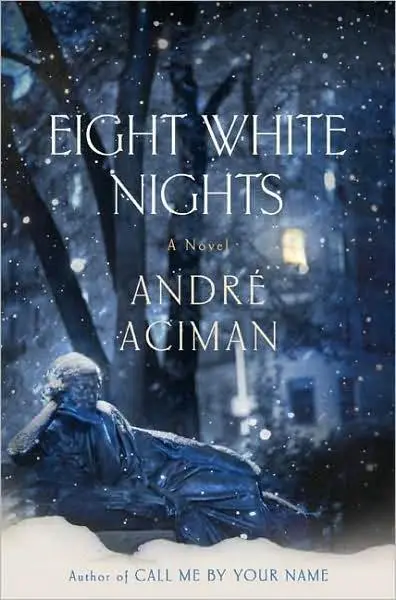
- Название:Eight White Nights
- Автор:
- Издательство:Farrar, Straus and Giroux
- Жанр:
- Год:2010
- ISBN:9780374228422
- Рейтинг книги:3 / 5. Голосов: 1
-
Избранное:Добавить в избранное
- Отзывы:
-
Ваша оценка:
Eight White Nights: краткое содержание, описание и аннотация
Предлагаем к чтению аннотацию, описание, краткое содержание или предисловие (зависит от того, что написал сам автор книги «Eight White Nights»). Если вы не нашли необходимую информацию о книге — напишите в комментариях, мы постараемся отыскать её.
Eight White Nights is an unforgettable journey through that enchanted terrain where passion and fear and the sheer craving to ask for love and to show love can forever alter who we are. A man in his late twenties goes to a large Christmas party in Manhattan where a woman introduces herself with three words: "I am Clara." Over the following seven days, they meet every evening at the same cinema. Overwhelmed yet cautious, he treads softly and won’t hazard a move. The tension between them builds gradually, marked by ambivalence, hope, and distrust. As André Aciman explores their emotions with uncompromising accuracy and sensuous prose, they move both closer together and farther apart, culminating on New Year's Eve in a final scene charged with magic and the promise of renewal. Call Me by Your Name, Aciman's debut novel, established him as one of the finest writers of our time, an expert at the most sultry depictions of longing and desire. As The Washington Post Book World wrote, "The beauty of Aciman’s writing and the purity of his passions should place this extraordinary first novel within the canon of great romantic love stories for everyone." Aciman’s piercing and romantic new novel is a brilliant performance from a master prose stylist.
Eight White Nights — читать онлайн бесплатно полную книгу (весь текст) целиком
Ниже представлен текст книги, разбитый по страницам. Система сохранения места последней прочитанной страницы, позволяет с удобством читать онлайн бесплатно книгу «Eight White Nights», без необходимости каждый раз заново искать на чём Вы остановились. Поставьте закладку, и сможете в любой момент перейти на страницу, на которой закончили чтение.
Интервал:
Закладка:
I ducked outside on the pretext of wanting to glimpse the scenery. Then I realized I wasn’t interested in their scenery either, came back in, and shut the kitchen door.
“I just made you coffee,” said the arthritic Margo, handing me a mug with her right hand and, with the other, offering me a packet of sugar held between her thumb, forefinger, and middle finger, her bent and troubled arm almost beseeching me to come closer and take it from her before she dropped it and then fell trying to catch it. I wondered why she was offering me coffee and not Clara; but then I saw that Clara had already helped herself to some and was about to sit at an empty corner of the large kitchen table. The old woman’s pleading, beckoning gesture, at once humble and contrite, had touched me.
“Clara always complains I make very weak coffee,” she said.
“She makes the worst coffee in the world.”
“It’s not bad at all!” I said, as if I’d been asked an opinion and was siding with the host.
“ Ach , Clara, he’s so polite,” she said. She was still sizing me up and, so far, approved.
“Who is so polite?” came the voice of an elderly man. Mr. Jäcke Knöwitall himself.
Kisses. Just as I’d expected. Firm handshake, hyperdecorous Old World smile that doesn’t mean a thing, slight bow of the head as he hastened, indeed rushed, to take my hand. I recognized the move instantly. Deference writ all over, except when you turn your back. And yet, unlike his wife, not a trace of a German accent, totally Americanized— A real pleasure to meet you!
“What are these ugly shoes, Max?” asked Clara, pointing at what were obviously orthotic contraptions with rows of Velcro fasteners. It was, I realized, her way of asking about his health.
“See, didn’t I tell you they were ugly!” He turned to his wife.
“They’re ugly because your legs and your knees and every other bone in your wobbly, weather-beaten body is out of whack,” she said. “Last year your hips, this year your knees, next year. .”
“Leave that part of my anatomy alone, you pernicious viper. It served you well enough in its time.” This, it took me a second to realize, was all for Clara’s benefit. “Sir Lochinvar may no longer be among us, may he rest in peace, but in the middle of the night you can hear his headless torso galloping above our bedroom in search of a dark passage, and if you paid attention, you toothless daughter of scorpions, you’d open your window, offer him your sagging pan-fried eggs, and put your mouth to work.”
Everyone laughed.
“ Ach , Max, you’ve become downright lurid,” said his wife, looking in my direction as though imploring me to pay no mind to his latest outcry.
“Dear, dear Clara, I am out of whack with myself, that’s what I am.”
“Complain, complain. His new thing now is he wants to die.”
He ignored her.
“Do I really complain all that much?” He was holding Clara’s hand.
“You always complained, Max.”
“But he complains even more now, all the time” came back old arthritic.
“It’s the Jewish way. Clara, if I were younger,” he began, “if I were younger and had better knees and a better charger and steed—”
Margo asked me if I could help. Naturlich! Would I mind going with her outside? “Put your coat on. And you’ll need gloves.”
Soon I discovered why. I had to get some wood for the stove and bring it into the kitchen. “We love cooking with wood. Ask my husband. What am I saying — ask me.”
Together we walked out toward the shed where the gardener stored the firewood. She complained about the deer, sidestepped their droppings, cursed when she stepped on something that wasn’t mud, then scraped the bottom of her shoe against a boulder. I wasn’t sure whether she was speaking to me or just muttering. Finally, out of the blue: “I am happy to see Clara.” Perhaps it was an opener of sorts, making conversation, or she might just have been talking to herself, so I didn’t respond.
I returned with two logs. In the kitchen, Margo opened the stove and displayed several halved golden butternut squashes glistening with oil and herbs.
Max uncorked both a red and a white. “To while away the time,” he said, and proceeded to pour the white wine into four glasses. Then, pinching the base of his glass between his thumb and his index finger, he swirled the liquid a few times and finally brought it to his lips.
“A sonnet, a miracle,” he said. Clara clinked glasses with Margo and Max and then three times with me, and twice three times more, repeating the old Russian formula in a mock-whisper. No one said anything until he spoke: “All it takes is a senseless round fruit no bigger than a baby’s testicle and you have heaven.”
We were all tasting his wine.
“Now try the other,” he said, proceeding to decanter the pinot into my glass once he saw that I had downed the sauvignon.
“Another small miracle.”
We all tasted, swayed approbation on our faces. Inky’s grandfather was staring at me. He suspects they’ve broken up already. He’s trying to feel her out before seeing if he can patch things up between them. I’m now definitely the one-too-many in this crowd. I should have called a cab. I’d be in the station and far away by now.
“I think both wines are wonderful,” I said, “but I’m such a boor when it comes to wines that I very often can’t tell one from the other.”
“Oh, just ignore him, he’s just being his usual Printz Oskár.” She was speaking to them, but seemed to be winking at me, or neither winking at them nor at me. Just winking, or maybe not at all.
She is far too clever for me, I thought. Too, too clever. How she shifts and beckons and rebuffs and then switches, and just when you’re about to give up and head for the first train back to the city, she’ll throw you a Printz Oskár for you to chew on, and dangle it way over your head to see if you’ll try to yap and jump, yap and jump.
“Has she said why she’s here?” he finally asked me.
“No, I didn’t,” she interrupted.
“Well, prepare yourself. You’ve come for Leo Czernowicz, Czernowicz playing the Bach-Siloti. Then we’ll hear him doing the Handel. And then we’ll be in heaven, and we’ll have soup and wine, and, if we’re truly, truly lucky, one of Margo’s salads with these strange mushrooms she’ll use to shut me up for good if one more bawdy comment comes out of my mouth.”
“Sit,” he said. I looked around at the many chairs and armchairs in the living room. “No, not over there — here!”
He opened the pianola and began fiddling with it before inserting the head of what turned out to be a long, unfolded strip of something like perforated yellowed parchment.
“Is he familiar with the Bach?” he asked.
I looked at her and nodded.
She was made to sit right next to me on a narrow love seat. I’d wait for the music, and then I would just let my hand rest on her shoulder, that shoulder which now, more than ever, seemed to know and to second and to want me to know it knew everything I was thinking.
“Well, even if he knows the prelude, this is something you’ve never heard in your life. Never. Nor will you ever hear it played this way. First you’ll hear him play the Bach prelude on the pianola and then Siloti’s transposition of that Bach prelude. Then you’ll hear it as I’ve had two students from one of the colleges nearby remaster it. And if you behave, and you don’t interrupt too many times, and eat your soup, I’ll let you listen to Leo’s Handel. Ladies and gentlemen, this is Leo Czernowicz, just a few years before the Germans found him and took him away and didn’t know what to do with him, so they killed him.
Читать дальшеИнтервал:
Закладка:
Похожие книги на «Eight White Nights»
Представляем Вашему вниманию похожие книги на «Eight White Nights» списком для выбора. Мы отобрали схожую по названию и смыслу литературу в надежде предоставить читателям больше вариантов отыскать новые, интересные, ещё непрочитанные произведения.







Обсуждение, отзывы о книге «Eight White Nights» и просто собственные мнения читателей. Оставьте ваши комментарии, напишите, что Вы думаете о произведении, его смысле или главных героях. Укажите что конкретно понравилось, а что нет, и почему Вы так считаете.