Andre Aciman - Eight White Nights
Здесь есть возможность читать онлайн «Andre Aciman - Eight White Nights» весь текст электронной книги совершенно бесплатно (целиком полную версию без сокращений). В некоторых случаях можно слушать аудио, скачать через торрент в формате fb2 и присутствует краткое содержание. Год выпуска: 2010, ISBN: 2010, Издательство: Farrar, Straus and Giroux, Жанр: Современная проза, на английском языке. Описание произведения, (предисловие) а так же отзывы посетителей доступны на портале библиотеки ЛибКат.
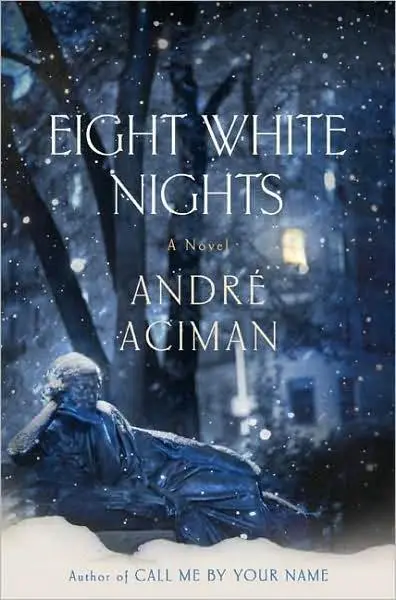
- Название:Eight White Nights
- Автор:
- Издательство:Farrar, Straus and Giroux
- Жанр:
- Год:2010
- ISBN:9780374228422
- Рейтинг книги:3 / 5. Голосов: 1
-
Избранное:Добавить в избранное
- Отзывы:
-
Ваша оценка:
Eight White Nights: краткое содержание, описание и аннотация
Предлагаем к чтению аннотацию, описание, краткое содержание или предисловие (зависит от того, что написал сам автор книги «Eight White Nights»). Если вы не нашли необходимую информацию о книге — напишите в комментариях, мы постараемся отыскать её.
Eight White Nights is an unforgettable journey through that enchanted terrain where passion and fear and the sheer craving to ask for love and to show love can forever alter who we are. A man in his late twenties goes to a large Christmas party in Manhattan where a woman introduces herself with three words: "I am Clara." Over the following seven days, they meet every evening at the same cinema. Overwhelmed yet cautious, he treads softly and won’t hazard a move. The tension between them builds gradually, marked by ambivalence, hope, and distrust. As André Aciman explores their emotions with uncompromising accuracy and sensuous prose, they move both closer together and farther apart, culminating on New Year's Eve in a final scene charged with magic and the promise of renewal. Call Me by Your Name, Aciman's debut novel, established him as one of the finest writers of our time, an expert at the most sultry depictions of longing and desire. As The Washington Post Book World wrote, "The beauty of Aciman’s writing and the purity of his passions should place this extraordinary first novel within the canon of great romantic love stories for everyone." Aciman’s piercing and romantic new novel is a brilliant performance from a master prose stylist.
Eight White Nights — читать онлайн бесплатно полную книгу (весь текст) целиком
Ниже представлен текст книги, разбитый по страницам. Система сохранения места последней прочитанной страницы, позволяет с удобством читать онлайн бесплатно книгу «Eight White Nights», без необходимости каждый раз заново искать на чём Вы остановились. Поставьте закладку, и сможете в любой момент перейти на страницу, на которой закончили чтение.
Интервал:
Закладка:
“I didn’t upset you, did I?” she asked.
I shrugged my shoulders to mean, You couldn’t if you tried.
Why did I still refuse to acknowledge that she had — why not say something?
“Twice in the same morning — you must think me a real Gorgon.”
“A Gorgon?” I teased, meaning, A Gorgon only?
“You know I’m not,” she said, almost sadly, “you just know I’m not.”
•
“What is your hell, Clara?” I finally asked, trying to speak her language.
She stopped cold, as if I’d thrown her off, or offended her, and had put her in the mood to tell me off. I had asked something no one seemed to have asked before, and it would take a long time before she’d either forgive or forget it.
“My hell?”
“Yes.” Now that I’d asked, there was no turning back. A moment of silence fell between us. The fences, so hastily broken down, had come back up again, only to be pulled down the next minute, and were being raised right back up again.
Was ours a jittery, easy, shallow familiarity, and nothing more? Or did we share the exact same hell, because, like neighbors on the same apartment line, I knew the layout of her home, from the hidden fuse box down to the shelves in her linen closet? “Maybe our hells are not so different after all,” I finally said.
She thought about it.
“If it makes you happy to think so. .”
In the car she took out her cell phone and decided to call her friend to tell him that we would be there in less than twenty minutes. “No,” she said, after a hasty greeting. Then: “You don’t know him. At a party.” I fastened the seat belt and waited, trying to look nonchalant as though drifting to sleep in the comfort of my reclining seat. “Two days ago.” A complicit glance, aimed in my direction, meant to pacify me. Pause. “Maybe.” He must have asked the same question twice. “I don’t know.” She was growing impatient. “I won’t, I promise. I won’t.” Then, clicking shut her cell phone and looking at me: “I wonder what all that was about,” she said, trying to make light of the questions I’d clearly inferred by her answers.
To change the subject: “When was the last time you saw him?” I asked.
“Last summer.”
“How do you know him?”
“My parents have known him forever. He’s the one who introduced me to Inky.”
“A friend of a friend of a friend?” Why was I trying to be funny when I clearly hated having Inky’s name thrown at me all the time?
“No, not a friend. His grandfather.”
She must have loved scoring this point. She caught the missing question. “We’ve known each other since childhood. If you must know.”
Clara never spoke of Inky in the simple past, as someone permanently locked away in some hardened, inaccessible dungeon of the heart whose key she had tossed in the first moat she crossed no sooner than she left him. She spoke of him in a strange optative mood, the way disenchanted wives speak of husbands who can’t seem to get their act together and should try to pass the bar exam again, or grow up and stop cheating, or make up their minds to have children. She had spoken of him with a grievance that seemed to reach into the present from a past tense that could any moment claim to have a future.
Where did I fit in all this? I should have asked. What on earth was I doing in the car with her? To keep her company so she’d have a warm body to chat with in case she got drowsy? Someone to feed her muffin bits? Was I to devolve into the best-friend sort — the guy you open up to and bare your soul to and walk around naked with because you’ve told him to put away his Guido?
I had never seen it as clearly as I was seeing it now. This was precisely the role I was being cast into, and I was letting it happen, because I didn’t want to upset anything, which was also why I wasn’t going to tell her how much of a Gorgon she’d really been to me. Rollo was right.
“Music?” she asked.
I asked her to play the Handel again.
“Handel it is.”
“Here, this is for you,” she said as soon as she turned on the engine. She handed me a heavy brown paper bag. “What is it?”
“I’m sure it will bring bad memories.”
It was a small snow globe bearing Edy’s name at the bottom. I turned it upside down, then right side up, and watched the snow fall on a tiny log cabin in an anonymous postcard village. It reminded me of us, shielded from everyone and everything that day.
“But they aren’t bad memories for me,” she added. She must have known I’d give everything to kiss the open space between her bare neck and her almost-shoulder when we were sitting in our warm corner at Edy’s. She must have known.
“Romance with snow,” I said, as I stared at the glass globe. “Do you already own one of these?”
It was what I ended up asking instead of Why do you turn on and off like this?
“No, never owned one. I’m not the kind who stows away ticket stubs or old keepsakes; I don’t make memories.”
“You savor and spit, like wine experts,” I said.
She saw where I was headed.
“No, my specialty is heartburn.”
“Remind me never—”
“Don’t be a Printz Oskár!”
•
We arrived at the old man’s house sooner than we figured. The roads were empty, the houses seemed shuttered, as though every family in this part of Hudson County was either hibernating in the city or had flown off to the Bahamas. The house was located at the end of a semicircular driveway. I had imagined a shack, or something unkempt and broken down, held together with the insolent neglect that old age heaps on those who have long given up touching up the world around them. This was a mansion on top of a hill, and right away I guessed that the back overlooked the river. I was right. We stepped out of the car and made our way to the front door. But then Clara had a change of heart and decided to enter by way of a side door, and sure enough, there was the river. We stood outside a large porch with a wrought-iron table and chairs whose cushions had either been removed for the winter season or that disuse and sheer age had totally ruined and which no one bothered to replace. But the wooden path down to the boat dock seemed to have been rebuilt recently — so these people did care for the house, and the cushions on the porch were probably being carefully stowed away during winter. From the porch Clara attempted to open a glass door, but it was locked. So she tapped three times with her knuckles. Once again she put on her little freezing-shoulders performance by rubbing her arms. Why didn’t I believe her? Why not take her at face value? The woman is cold. Why go looking for that something else about her, why the hunt for subtexts? To remember to be cautious? To disbelieve what she’d said to me last night and repeated at least twice this morning?
“Don’t you think it would be wiser to ring the front bell?”
“It just takes them a while. They’re scared of wolves. But I keep telling them all they have here are wild turkeys.”
Sure enough, a Gertrude-type old woman opened the door ever so gingerly. Arthritic hands, bad limp, scoliotic back.
They exchanged hugs and greeted each other in German. I shook the arthritic hand. “And I am Margo,” she said. She led us indoors. She’d been working in the kitchen. A large tabletop displayed scattered hints of a lunch to come. Max would be with us soon, she said. They continued to chatter in German.
I felt totally lost in this house, a stranger.
I wished I had taken the train back to New York. Wished I had never stepped out of the shower, or answered the buzzer, or gone to the movies last night. I could undo all this in a second. Excuse myself, step outside the house, take out my cell phone, call a local car service, dash back into their house, utter a hasty toodle-oo — and then be gone, adiós, Casablanca. You, Margo, Inky, and your whole tribe of limp, pandangst kultur wannabes.
Читать дальшеИнтервал:
Закладка:
Похожие книги на «Eight White Nights»
Представляем Вашему вниманию похожие книги на «Eight White Nights» списком для выбора. Мы отобрали схожую по названию и смыслу литературу в надежде предоставить читателям больше вариантов отыскать новые, интересные, ещё непрочитанные произведения.









Обсуждение, отзывы о книге «Eight White Nights» и просто собственные мнения читателей. Оставьте ваши комментарии, напишите, что Вы думаете о произведении, его смысле или главных героях. Укажите что конкретно понравилось, а что нет, и почему Вы так считаете.