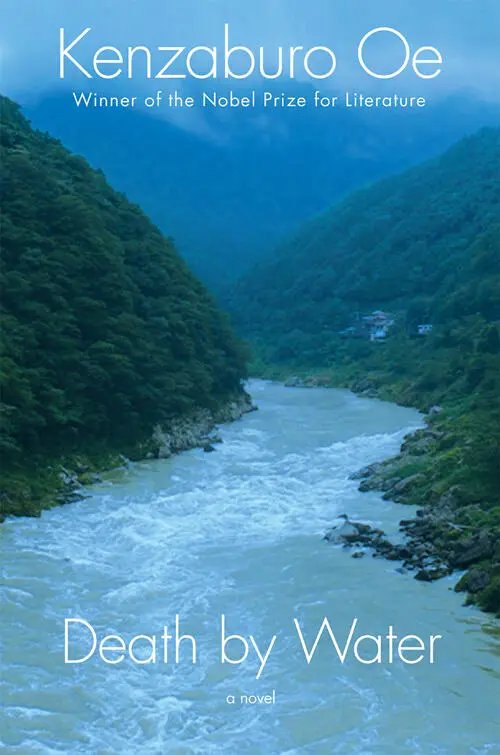
Kenzaburo Oe - Death by Water
Здесь есть возможность читать онлайн «Kenzaburo Oe - Death by Water» весь текст электронной книги совершенно бесплатно (целиком полную версию без сокращений). В некоторых случаях можно слушать аудио, скачать через торрент в формате fb2 и присутствует краткое содержание. Год выпуска: 2015, ISBN: 2015, Издательство: Grove/Atlantic, Inc., Жанр: Современная проза, на английском языке. Описание произведения, (предисловие) а так же отзывы посетителей доступны на портале библиотеки ЛибКат.
- Название:Death by Water
- Автор:
- Издательство:Grove/Atlantic, Inc.
- Жанр:
- Год:2015
- ISBN:9780802190871
- Рейтинг книги:3 / 5. Голосов: 1
-
Избранное:Добавить в избранное
- Отзывы:
-
Ваша оценка:
Death by Water: краткое содержание, описание и аннотация
Предлагаем к чтению аннотацию, описание, краткое содержание или предисловие (зависит от того, что написал сам автор книги «Death by Water»). Если вы не нашли необходимую информацию о книге — напишите в комментариях, мы постараемся отыскать её.
, his recurring protagonist and literary alter-ego returns to his hometown village in search of a red suitcase fabled to hold documents revealing the details of his father’s death during WWII: details that will serve as the foundation for his new, and final, novel.
Since his youth, renowned novelist Kogito Choko planned to fictionalize his father’s fatal drowning in order to fully process the loss. Stricken with guilt and regret over his failure to rescue his father, Choko has long been driven to discover why his father was boating on the river in a torrential storm. Though he remembers overhearing his father and a group of soldiers discussing an insurgent scheme to stage a suicide attack on Emperor Mikado, Choko cannot separate his memories from imagination and his family is hesitant to reveal the entire story. When the contents of the trunk turn out to offer little clarity, Choko abandons the novel in creative despair. Floundering as an artist, he’s haunted by fear that he may never write his tour de force. But when he collaborates with an avant-garde theater troupe dramatizing his early novels, Kogito is revitalized by revisiting his formative work and he finds the will to continue investigating his father’s demise.
Diving into the turbulent depths of legacy and mortality,
is an exquisite examination of resurfacing national and personal trauma, and the ways that storytelling can mend political, social, and familial rifts.
Death by Water — читать онлайн бесплатно полную книгу (весь текст) целиком
Ниже представлен текст книги, разбитый по страницам. Система сохранения места последней прочитанной страницы, позволяет с удобством читать онлайн бесплатно книгу «Death by Water», без необходимости каждый раз заново искать на чём Вы остановились. Поставьте закладку, и сможете в любой момент перейти на страницу, на которой закончили чтение.
Интервал:
Закладка:
“I’m glad we brought Unaiko down here, aren’t you?” Asa said, obviously trying to nudge me into echoing her sentiments. “The incident she mentioned, where an OL was attacked in a parking lot, really did happen. It got a lot of newspaper coverage at the time.”
I didn’t reply. A few moments later Asa had Unaiko park the car in that same notorious parking lot, not far from the embankment that sloped down to the river, while she went off to explain to the attendant that a different person would be coming to fetch the car later on.
We set off on foot, climbing the hill on the eastern side of town, and when we reached the top — where there were still a few old-fashioned, tile-roofed houses left over from previous centuries — we all turned around and feasted our eyes on the glittering ribbon of gray-green river below. Then we ambled along the old road, which I remembered from childhood, occasionally pausing to gaze with interest at the rows of stores and houses on the way. Our pace quickened abruptly when Asa noticed a bus approaching along the new embankment-like road above, which ran parallel to the narrower one we were on, and she suggested we hop over from the old road to the new one. When everyone agreed, she told Unaiko to go ahead to the bus stop and ask the driver to wait a few minutes while the senior citizens caught up.
Unaiko ran up to the new road with long, easy strides, while Asa and I followed at a slow trot, huffing and puffing all the way. After we had boarded the bus, Asa began chatting with the driver and he agreed to let us off at the point where the new road, which was presently running parallel to the old one, veered off on its own toward Matsuyama.
Asa had been employed for many years as a nurse at the local hospital, and she was still very well known around Okawara. As we rode along, she returned the friendly greetings of a number of our fellow passengers while simultaneously explaining our route to Unaiko.
“If we get off where I asked the driver to stop, we’ll be near the place where Meisuke II was stoned to death,” she said. “It’s at the entrance to a sort of ravine.” After ten minutes or so, the bus stopped and we got off. While we were walking, Asa resumed her dissertation.
“If you head east from Okawara and then veer inland, cutting through the valley to the north toward the forest, that’s where Meisuke’s mother and Meisuke II split up with their compatriots after the uprising and started home by way of the woods,” she told Unaiko. “The topography of the route is basically unchanged, even now. There’s a part of the recitative where it describes how Meisuke’s mother put Meisuke II on a horse and led it by the reins, and if you were to follow the road to the top of the forested hill, you would come upon a giant fir tree that’s believed to be the eternal dwelling place of Meisuke’s spirit. (I’m talking about the original Meisuke, not the reborn one; for some reason, the legend doesn’t mention where the second Meisuke’s spirit ended up.) Meisuke’s mother was planning to take Meisuke II up there to give thanks to the spirit of the original Meisuke for helping them win the battle. But the pair had been followed, and they were ambushed and captured by their pursuers. (There’s another version of the story in which the hooligans were already lying in wait, but the heartbreaking outcome is the same in both scenarios.)
“First, the samurai thugs stuffed Meisuke II into a hole in the ground and cruelly stoned him to death. Then, on a grassy area nearby, Meisuke’s mother was repeatedly raped by several of the attackers. The horse got loose and went running back toward the village, where it came upon the other insurgents, who were on their way home to the valley. They turned around and followed the horse up to the scene of the crimes, where they found Meisuke’s mother lying on the grass alone and badly injured. And then they somehow found an old wooden storm shutter and turned it into a makeshift stretcher for their injured leader. The story never seems to mention what became of Meisuke II’s dead body; maybe that part of the tragedy was just too unbearable for people to talk about. I mean, he was just a child.”
After walking in silence for quite a while, we crossed an old earthen bridge over a mountain stream and found ourselves in front of a small, weather-beaten Shinto shrine. Tall, spiky grass had grown all around the wooden shrine, so to make things easier for Unaiko, who was wearing a skirt, Asa hacked out a path with a rusty scythe she’d found tucked away in the shadows beneath the short staircase leading to the altar.
With a scythe-wielding Asa leading the way, we approached our historically fraught destination. Behind the shrine was an empty patch of land where the sunlight shone brightly through a grove of trees that appeared to have been recently pruned, and lying on the ground in the center of the vacant field were some loosely bound bundles of bamboo sticks, cut to a uniform length.
“The bamboo is covering the pit in the ground, but since there’s really nothing to see — it’s just an old hole — we’ll leave them undisturbed,” Asa said. “When they’re loosely bound together like this, the long sticks of bamboo are hard to handle, so this arrangement is meant to discourage visitors from trying to remove them. After a few forestry workers fell into the cavity, it was declared a safety hazard and at one point someone filled it with dirt, but apparently the number of accidents around the forest actually increased afterward. People said it was because Meisuke II was displeased and had put a curse on the area, so the hole was dug out again. Around that time someone came to Mother asking for a donation to help finance the project, and she told me about the connection between our family and this shrine. Every few years Mother would make the trip over here to reseed the bamboo grove, and I’ve continued the tradition although (unlike her) I delegate the actual labor to professionals.”
“The shrine is obviously very old, but do you suppose it was built sometime after Meisuke’s mother and Meisuke II underwent their ordeals, or was it here all along?” Unaiko asked as she gazed around the area.
“I don’t think it was here in those days,” I replied. “No matter how rowdy those young samurai might have been, surely they would have gotten cold feet about doing their mischief right behind a sacred shrine. I’ve heard this area used to be frequented by wild pigs — perhaps it still is — and most likely the hole was originally dug by hunters to use as an animal trap. The shrine might have been constructed as a way of placating the ghost of Meisuke II, who was cruelly stoned to death in that very pit, or maybe it was just built for general purposes of purification, after the atrocious things that happened here.”
Unaiko was crouched down, trying to peek into the hole through the gaps in the bundled bamboo, and when she lifted her head she gave a wordless gasp of surprise. When Asa and I turned to look, we saw two middle-aged women — one with a rather mannish forehead, the other with a perfectly round face, like a pale moon — standing by the shrine and staring fixedly in our direction. The women were evidently acquaintances of Asa’s, but after exchanging rudimentary greetings with her they made a beeline for Unaiko, who had hastily scrambled to her feet.
“You’re Ms. Unaiko, aren’t you?” inquired the moonfaced woman. “A few months ago we were in the audience for your so-called educational play, the one based on Kokoro. As it happens, we’re both educators, too; we teach Japanese language at two different junior high schools in the area. Running into you here is really an amazing coincidence, because we were just saying that we wished there was some way to get you to listen to our concerns. There’s been talk that you’re planning to stage your own version of the saga of Meisuke’s mother at the same venue, with you yourself in the lead role. We think it’s a splendid idea, since that story is an important part of our local folklore. However, what’s worrying us is that your play will be seen by a large number of students, and we’ve heard it will include a rape scene. We were wondering how on earth you could possibly think such mature content would be appropriate for a school-age audience!”
Читать дальшеИнтервал:
Закладка:
Похожие книги на «Death by Water»
Представляем Вашему вниманию похожие книги на «Death by Water» списком для выбора. Мы отобрали схожую по названию и смыслу литературу в надежде предоставить читателям больше вариантов отыскать новые, интересные, ещё непрочитанные произведения.





Обсуждение, отзывы о книге «Death by Water» и просто собственные мнения читателей. Оставьте ваши комментарии, напишите, что Вы думаете о произведении, его смысле или главных героях. Укажите что конкретно понравилось, а что нет, и почему Вы так считаете.