Kenzaburo Oe - Death by Water
Здесь есть возможность читать онлайн «Kenzaburo Oe - Death by Water» весь текст электронной книги совершенно бесплатно (целиком полную версию без сокращений). В некоторых случаях можно слушать аудио, скачать через торрент в формате fb2 и присутствует краткое содержание. Год выпуска: 2015, ISBN: 2015, Издательство: Grove/Atlantic, Inc., Жанр: Современная проза, на английском языке. Описание произведения, (предисловие) а так же отзывы посетителей доступны на портале библиотеки ЛибКат.
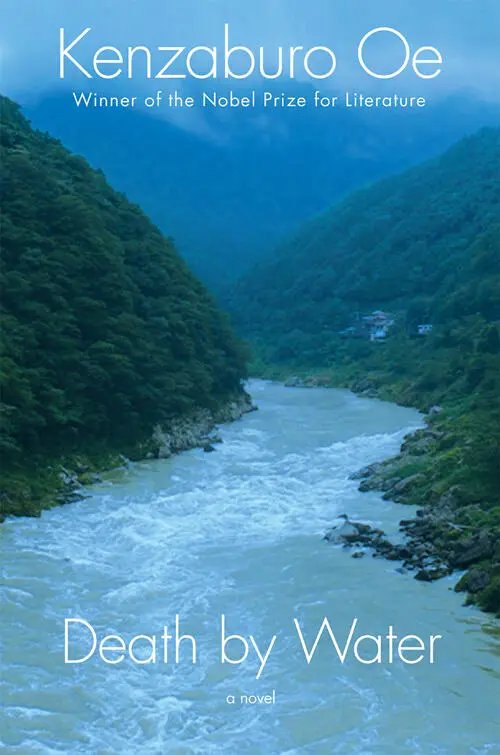
- Название:Death by Water
- Автор:
- Издательство:Grove/Atlantic, Inc.
- Жанр:
- Год:2015
- ISBN:9780802190871
- Рейтинг книги:3 / 5. Голосов: 1
-
Избранное:Добавить в избранное
- Отзывы:
-
Ваша оценка:
Death by Water: краткое содержание, описание и аннотация
Предлагаем к чтению аннотацию, описание, краткое содержание или предисловие (зависит от того, что написал сам автор книги «Death by Water»). Если вы не нашли необходимую информацию о книге — напишите в комментариях, мы постараемся отыскать её.
, his recurring protagonist and literary alter-ego returns to his hometown village in search of a red suitcase fabled to hold documents revealing the details of his father’s death during WWII: details that will serve as the foundation for his new, and final, novel.
Since his youth, renowned novelist Kogito Choko planned to fictionalize his father’s fatal drowning in order to fully process the loss. Stricken with guilt and regret over his failure to rescue his father, Choko has long been driven to discover why his father was boating on the river in a torrential storm. Though he remembers overhearing his father and a group of soldiers discussing an insurgent scheme to stage a suicide attack on Emperor Mikado, Choko cannot separate his memories from imagination and his family is hesitant to reveal the entire story. When the contents of the trunk turn out to offer little clarity, Choko abandons the novel in creative despair. Floundering as an artist, he’s haunted by fear that he may never write his tour de force. But when he collaborates with an avant-garde theater troupe dramatizing his early novels, Kogito is revitalized by revisiting his formative work and he finds the will to continue investigating his father’s demise.
Diving into the turbulent depths of legacy and mortality,
is an exquisite examination of resurfacing national and personal trauma, and the ways that storytelling can mend political, social, and familial rifts.
Death by Water — читать онлайн бесплатно полную книгу (весь текст) целиком
Ниже представлен текст книги, разбитый по страницам. Система сохранения места последней прочитанной страницы, позволяет с удобством читать онлайн бесплатно книгу «Death by Water», без необходимости каждый раз заново искать на чём Вы остановились. Поставьте закладку, и сможете в любой момент перейти на страницу, на которой закончили чтение.
Интервал:
Закладка:
Daio continued to be a regular visitor, and in the spirit of sociability he and I would often join Ricchan at the table. Akari kept the volume on his music fairly low, and it never seemed to have an adverse effect on Ricchan’s concentration. By the same token Daio’s and my speaking voices, which had to be raised slightly to be heard over the music, didn’t seem to be an impediment to Akari’s listening pleasure. Noticing this, I was reminded of something Maki had once observed. When Akari was in listening-to-music mode, she said, his brain seemed to be in a separate realm than when he was speaking or hearing words.
As for my own brain, it was still completely devoid of ideas for a late-work book. I realized in retrospect that I had foolishly put all my creative eggs into the drowning-novel basket and hadn’t bothered to formulate a backup plan. Because I wasn’t working on anything in particular, I didn’t have to cleave to the kind of focused bibliographical list that normally accompanied my novel-writing process, so for once I was free to explore whatever caught my fancy on a given day. My current reading habits were shaped by a conscious continuo of self-restraint born of my fear that the Big Vertigo might pay me another unwelcome visit, so rather than poring over books in my study/bedroom it seemed to make more sense for me to wander downstairs, stretch out on the sofa, and browse through books at a leisurely pace.
It was while I was in this relaxed mode that some reading material I had requested from an editor friend in Tokyo— The Golden Bough: A Study in Magic and Religion, by James George Frazer — was delivered. My friend had kindly sent all twelve volumes of the Elibron Classics facsimile, published in 2005, of Macmillan’s 1920–1923 edition. Part of the reason I had wanted to get my hands on a complete set was so I could ascertain where the three volumes from the red leather trunk fit into the whole. I was also making frequent reference to the Japanese translations of several volumes of The Golden Bough’ s third edition. A certain publisher was in the process of issuing a translation of the entire set, and I had been receiving a complimentary copy of each volume as it came out (there was never any card, but I suspected that the gift had been arranged by a cultural anthropologist friend of mine), so I’d had those sent down here, too.
After my skirmishes with the Big Vertigo, instead of reading with maximum concentration for long stretches of time I fell into the habit of keeping a few books on the desk next to my bed and desultorily flipping through the pages whenever the mood struck me. But now that my conversations with Daio had led me to the Frazer books, my page-turning sessions had taken on a new intensity and focus. I was no longer merely browsing; I was on an active quest.
In keeping with this new resolve, I began to work my way through the three volumes of The Golden Bough I’d found in the red leather trunk, systematically parsing all the underlinings and marginal notes: the visible evidence of my father’s struggle, given his limited proficiency in English, to read these difficult books. (When I was paging through the books for the first time, back in Tokyo, I hadn’t paid any attention to these marks.) I didn’t find anything that would warrant being called marginalia, but there were a number of faint markings in hard-leaded colored pencil (primarily red and blue) — marks I suspected had been made in pencil rather than ink so they could eventually be erased.
Because the books had gotten wet in the river, many of the pages were stuck together and it was difficult to separate them without causing the old, brittle paper to tear or even disintegrate. Nonetheless, I could clearly see that some of the subtitles or subheadings had been lightly circled in colored pencil. At some point I realized the three books must have been a loan (if they had been a gift, the set would surely have been complete), but because my father had died unexpectedly they were never returned. It seemed safe to deduce that the barely legible notations had been made by the books’ original owner, perhaps as a way of letting my father know which segments that person considered especially significant.
If my assumption was correct (and I was confident it was), then the assiduous wielder of those colored pencils must have been the mentor whose name I had heard my father invoke in reverent tones on numerous occasions. Eureka, I thought. That’s it! These books had undoubtedly come from the so-called Kochi Sensei, who lived on the other side of Shikoku’s Sanmyaku mountain range: the same person my father had once gone to visit in search of knowledge, dragging Daio along with him. The pair had walked for many kilometers, following a route to the town of Kochi that followed the river and eventually fed into a road made famous in the mid-1860s by the Kochi-born samurai Ryoma Sakamoto. (As every Japanese schoolchild knows, Sakamoto traversed that roadway when he deserted his feudal clan to embark on a life of idealistic anti-shogunate political activism inspired by the democratic principles of the United States — a life cut short in 1867 when he was murdered by assassins at a lodging house in Kyoto.)
I began to probe in earnest, exploring the books in sequential order as I thought my father would have done. My goal was to replicate his experience as he attempted to read Frazer’s work in its original form, armed with nothing but a small, dog-eared copy of The Concise English-Japanese Dictionary (which I remembered having seen around the house), after his faithful disciple, Daio, had toted those heavy volumes home following their visit to the Kochi Sensei.
And what about the annotations? I was curious to see whether the Kochi Sensei had confined his explanations to the subheadings, or had commented on the text line by line. To my surprise, after a cursory flip through the pages (pausing only to peruse the headings and passages marked with red and blue pencil), it became clear why the Kochi Sensei had chosen these particular volumes as a means of furthering my father’s education. There was no doubt about it; the Kochi Sensei was using The Golden Bough’ s anthropological and folkloric principles as a metaphor for politics!
I was on the third day of skimming the entire Golden Bough when Ricchan ventured into the great room to bring me a cup of coffee. She set the ceramic mug on the filing cabinet near the sofa and said, “I guess whenever you feel like working on this project, you have to make several trips to lug all the books down from the study. That must be good exercise!”
“These are the books I found in the red leather trunk during my previous visit,” I explained. “I’ve been trying to figure out why my father was reading them, and how, and I think I’m close to finding some answers.”
“I’m aware that The Golden Bough has been translated into Japanese, but I’ve never read it,” Ricchan said. “If you’re at a good stopping point, would you mind giving me a crash course? Hang on, I’ll just go grab my own coffee.”
I gathered the relevant materials and laid them out on the L-shaped sofa between the end where I was sitting and the perpendicular segment where Ricchan took a seat when she returned from the kitchen, mug in hand.
“The Golden Bough is a scholarly work about folklore,” I began, “but it also provides practical insight into interpersonal dynamics, particularly as they pertain to the realm of politics. My father was using these books as a means for furthering his own political education, but he seems to have had a penchant for the literary aspects as well, and I’ve been intrigued by the discovery that he apparently enjoyed the text on an artistic level, too. Ricchan, you’ve probably heard Daio referring to my father as ‘Choko Sensei,’ and I’m guessing it might have struck you as odd. ‘Sensei’ is a vestigial title, left over from the time when my father was running an ultranationalistic training camp and Daio was one of his disciples. But recently, as Daio and I have been talking, something rather surprising has emerged. He told me that my father sometimes liked to ramble about political matters, tossing around hard-line terms such as nation-state, Greater East Asia Co-Prosperity Sphere, and so on. However, according to Daio, below the blustery ultranationalistic surface my father’s true nature, even at the age of fifty, was still that of a literature-besotted youth.
Читать дальшеИнтервал:
Закладка:
Похожие книги на «Death by Water»
Представляем Вашему вниманию похожие книги на «Death by Water» списком для выбора. Мы отобрали схожую по названию и смыслу литературу в надежде предоставить читателям больше вариантов отыскать новые, интересные, ещё непрочитанные произведения.



Обсуждение, отзывы о книге «Death by Water» и просто собственные мнения читателей. Оставьте ваши комментарии, напишите, что Вы думаете о произведении, его смысле или главных героях. Укажите что конкретно понравилось, а что нет, и почему Вы так считаете.