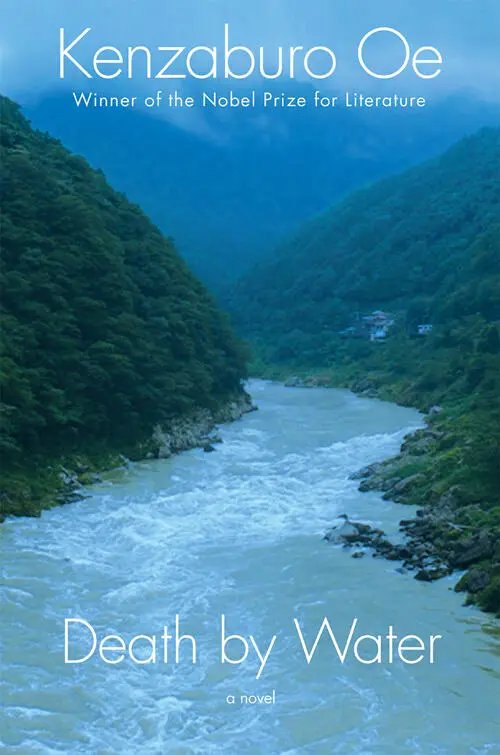
Kenzaburo Oe - Death by Water
Здесь есть возможность читать онлайн «Kenzaburo Oe - Death by Water» весь текст электронной книги совершенно бесплатно (целиком полную версию без сокращений). В некоторых случаях можно слушать аудио, скачать через торрент в формате fb2 и присутствует краткое содержание. Год выпуска: 2015, ISBN: 2015, Издательство: Grove/Atlantic, Inc., Жанр: Современная проза, на английском языке. Описание произведения, (предисловие) а так же отзывы посетителей доступны на портале библиотеки ЛибКат.
- Название:Death by Water
- Автор:
- Издательство:Grove/Atlantic, Inc.
- Жанр:
- Год:2015
- ISBN:9780802190871
- Рейтинг книги:3 / 5. Голосов: 1
-
Избранное:Добавить в избранное
- Отзывы:
-
Ваша оценка:
Death by Water: краткое содержание, описание и аннотация
Предлагаем к чтению аннотацию, описание, краткое содержание или предисловие (зависит от того, что написал сам автор книги «Death by Water»). Если вы не нашли необходимую информацию о книге — напишите в комментариях, мы постараемся отыскать её.
, his recurring protagonist and literary alter-ego returns to his hometown village in search of a red suitcase fabled to hold documents revealing the details of his father’s death during WWII: details that will serve as the foundation for his new, and final, novel.
Since his youth, renowned novelist Kogito Choko planned to fictionalize his father’s fatal drowning in order to fully process the loss. Stricken with guilt and regret over his failure to rescue his father, Choko has long been driven to discover why his father was boating on the river in a torrential storm. Though he remembers overhearing his father and a group of soldiers discussing an insurgent scheme to stage a suicide attack on Emperor Mikado, Choko cannot separate his memories from imagination and his family is hesitant to reveal the entire story. When the contents of the trunk turn out to offer little clarity, Choko abandons the novel in creative despair. Floundering as an artist, he’s haunted by fear that he may never write his tour de force. But when he collaborates with an avant-garde theater troupe dramatizing his early novels, Kogito is revitalized by revisiting his formative work and he finds the will to continue investigating his father’s demise.
Diving into the turbulent depths of legacy and mortality,
is an exquisite examination of resurfacing national and personal trauma, and the ways that storytelling can mend political, social, and familial rifts.
Death by Water — читать онлайн бесплатно полную книгу (весь текст) целиком
Ниже представлен текст книги, разбитый по страницам. Система сохранения места последней прочитанной страницы, позволяет с удобством читать онлайн бесплатно книгу «Death by Water», без необходимости каждый раз заново искать на чём Вы остановились. Поставьте закладку, и сможете в любой момент перейти на страницу, на которой закончили чтение.
Интервал:
Закладка:
Unaiko, who was evidently already feeling quite tipsy, gazed at me with a face that looked, as always, far younger than her years. “But, Mr. Choko,” she said, “didn’t you want to portray your father in the drowning novel as a man who set out on that flooded river while he was in full possession of his faculties?”
“Yes, I did, absolutely. And while I went on clinging to my childish naive conviction that my father was embarking on a hero’s journey, I also wanted to chronicle his ill-fated boat trip as part of a sequence of events that was supposed to culminate in some kind of paramilitary insurrection. My recurrent dream reflected the idealized perspective of the young boy who believed wholeheartedly that his father was on his way to commit a doomed act of heroism when he drowned. While my father was being tossed around by the current on the river bottom he would have flashed back over his entire life, the way people do when they’re drowning, and that was the story my novel was going to tell.”
Unaiko nodded and took another sip of shochu. “In Wipe My Tears Away the mother is skeptical all along, but the father is portrayed as someone who’s absolutely essential to the radical action the young officers are planning,” she said. “Clearly, the young boy regards his father as a kind of hero.”
“I wrote that book after I’d promised my mother that I would abandon my drowning novel,” I said. “I think my feelings of resentment are clearly evident in the surrealistic novella I ended up writing instead.”
“Even so, for me, the mother is the character who seems the most genuinely human at the conclusion of the story,” Unaiko mused. “She was the only one who dared to disagree when her son kept insisting his father had died a heroic death. Was she meant to come across as the only person who was rational about the whole situation?”
“No, when I wrote the novella I really wasn’t trying to imply that any one person had remained compos mentis while everyone else had completely lost their minds. All the characters in the book — the cancer-ridden father in his fertilizer-box chariot, the young boy wearing a fake military cap, the army officers belting out the German song at the top of their lungs — are supposed to be given equal weight.”
“Well, I know I’m not very sophisticated intellectually,” Unaiko said self-deprecatingly, “but I still can’t help wondering whether there was some underlying significance behind your decision. You came down here intending to work on your drowning novel; we all know how that turned out, but if you had actually managed to finish it, isn’t there a chance the book’s outcome would have been similar to that of The Day He Himself Shall Wipe My Tears Away ? No matter how many anecdotes you tell in the voice of the drowned narrator, that talking corpse is always going to be sucked into the whirlpool, right? I mean, for your purposes, there’s no other way for the story to end.
“The other night as you were listening to your mother’s tape, you finally realized that your father ran away because he was terrified about what might happen if he didn’t. And while he was attempting to flee into the storm, his little boat capsized and he drowned. Personally, I’ve been thinking that if you ever do write the drowning novel, instead of having a tragic anticlimax, it might be more interesting to fictionalize the narrative so your father somehow makes it to shore, eluding the dragnet of his police pursuers, and really does manage to carry out some kind of guerrilla action along with his wild-eyed partners in crime.
“Of course, even I know that no such event ever took place in 1945, during the days that followed Japan’s surrender. My thought, plot-wise, was that having an actual dramatic occurrence would be a refreshing change from your usual type of ambiguous, anticlimactic ending. Anyway, everything is moot now, since it looks as though you aren’t going to write the drowning novel after all. And really, isn’t that the ultimate anticlimax, in a way?”
Unaiko had a point, but I didn’t say anything in response. After an expectant moment, she continued: “Asa felt awful when she saw how downhearted you were about not finding the information you needed to complete your book. It was almost as if she thought she owed you an apology for handing over the trunk in the first place, since she already knew how that whole operation was going to turn out. But I guess she realized that it was what it was, as they say, and there was nothing she could do about it.
“I think Asa was simply trying to force her seventysomething brother — who had created a falsely heroic image of his drowned father, and who was still having recurrent dreams about something that happened one night when he was ten years old — to face reality. What I’m trying to say is, I think she was just trying to bring you back to your senses, for your own good.”
Unaiko held her glass up for a refill and I silently obliged. “I helped Asa restore your mother’s tape to a listenable state, so naturally I feel a measure of responsibility as well,” she went on. “From what I’ve heard, your father was far from being an active or essential participant in the insurgency scheme. It sounds to me as though he was nothing more than a country bumpkin who became so alarmed about what his sketchy cohorts were planning that he felt compelled to run away as fast as his little boat would carry him.”
So how did I respond to this crescendo of confrontation from my clearly intoxicated companion? Did I get angry and make a scene, like an ill-behaved old man? No, I was the perfect picture of serenity, sitting there surrounded by the vibrant sounds of the forest while my mood oscillated wildly between an irrepressible urge to laugh and a descent into infinite melancholy. I felt oddly salubrious, and I didn’t even feel the need to refill my own cup.
Toward the end of the evening Masao Anai joined us, and I got the impression that he was accustomed to playing designated driver when Unaiko had been out drinking. The curious thing was that when my outspoken dinner companion finally vanished into the night, leaving me in peace, I was genuinely sorry to see her go.
3
The next day Masao Anai came by to deliver a late breakfast, explaining that Unaiko was still in bed recovering from a hangover. While I was eating, Masao gazed out at the back garden, staring intently at the round stone engraved with the linked poems my mother and I had written. After a moment he started talking, saying Unaiko had asked him, as her emissary, to raise a question she had neglected to broach the night before.
Some time ago, Masao told me, he had run into a college friend who was now teaching Japanese at a local high school, and they had renewed their acquaintance. As a result of subsequent discussions, the Caveman Group initiated a visiting-artist program wherein the theater troupe would choose works of modern literature, turn them into dramatic readings, and then go around giving interactive performances at junior high schools and high schools in the area. They had been working on a new program as part of an integrated learning curriculum for the upcoming school semester, and that was what Unaiko had wanted to discuss with me.
“Each forty-five-minute performance would be divided into two segments, or rounds,” Masao told me. “The first would present the story as a condensed dramatic reading, while the second segment would incorporate the students’ questions. The idea is that a lively debate would inevitably ensue, adding a dramatic aspect of its own.
“We’ve already done a number of presentations based on this model: Miyazawa’s Night of the Milky Way Railway, Tsubota’s Children in the Wind and The Four Seasons of Childhood, Akutagawa’s Kappa, and so on. This year we’ve had a request to do Soseki’s Kokoro, and we’re in the preliminary preparation stage of that project. One of our main actors will handle the role of Sensei, including his conversations and his suicide note, while another will be in charge of the external dialogues and internal monologues voiced by the narrator (whom we know only as ‘I’), and our younger members will be cast in the auxiliary roles. Right now we’re busy converting our condensed version of the book into a script for the dramatic reading, and an aspect of the process has been worrying Unaiko from the start.”
Читать дальшеИнтервал:
Закладка:
Похожие книги на «Death by Water»
Представляем Вашему вниманию похожие книги на «Death by Water» списком для выбора. Мы отобрали схожую по названию и смыслу литературу в надежде предоставить читателям больше вариантов отыскать новые, интересные, ещё непрочитанные произведения.

Обсуждение, отзывы о книге «Death by Water» и просто собственные мнения читателей. Оставьте ваши комментарии, напишите, что Вы думаете о произведении, его смысле или главных героях. Укажите что конкретно понравилось, а что нет, и почему Вы так считаете.