Kathleen Spivack - Unspeakable Things
Здесь есть возможность читать онлайн «Kathleen Spivack - Unspeakable Things» весь текст электронной книги совершенно бесплатно (целиком полную версию без сокращений). В некоторых случаях можно слушать аудио, скачать через торрент в формате fb2 и присутствует краткое содержание. Год выпуска: 2016, Издательство: Knopf, Жанр: Современная проза, на английском языке. Описание произведения, (предисловие) а так же отзывы посетителей доступны на портале библиотеки ЛибКат.
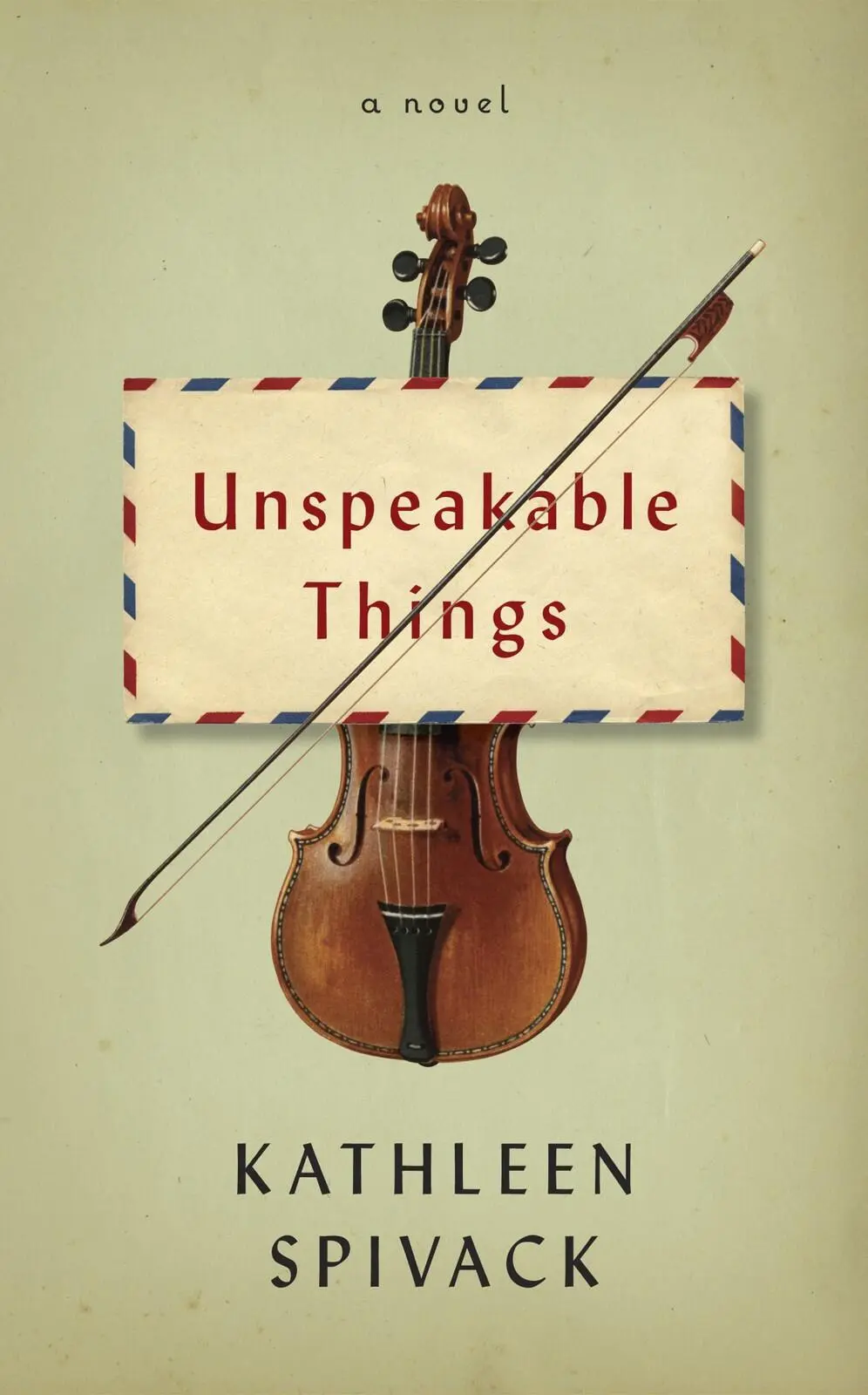
- Название:Unspeakable Things
- Автор:
- Издательство:Knopf
- Жанр:
- Год:2016
- ISBN:нет данных
- Рейтинг книги:4 / 5. Голосов: 1
-
Избранное:Добавить в избранное
- Отзывы:
-
Ваша оценка:
Unspeakable Things: краткое содержание, описание и аннотация
Предлагаем к чтению аннотацию, описание, краткое содержание или предисловие (зависит от того, что написал сам автор книги «Unspeakable Things»). Если вы не нашли необходимую информацию о книге — напишите в комментариях, мы постараемся отыскать её.
and
. A strange, haunting novel about survival and love in all its forms; about sexual awakenings and dark secrets; about European refugee intellectuals who have fled Hitler’s armies with their dreams intact and who have come to an elusive new (American) “can do, will do” world they cannot seem to find. A novel steeped in surreal storytelling and beautiful music that transports its half-broken souls — and us — to another realm of the senses.
The setting: the early 1940s, New York — city of refuge, city of hope, with the specter of a red-hot Europe at war.
At the novel’s center: Anna (known as the Rat), an exotic Hungarian countess with the face of an angel, beautiful eyes, and a seraphic smile, with a passionate intelligence, an exquisite ugliness, and the power to enchant. . Her second cousin Herbert, a former minor Austrian civil servant who believes in Esperanto and the international rights of man, wheeling and dealing in New York, powerful in the social sphere yet under the thumb of his wife, Adeline. . Michael, their missing homosexual son. . Felix, a German pediatrician who dabbles in genetic engineering, practicing from his Upper East Side office with his little dachshund, Schatzie, by his side. . The Tolstoi String Quartet, four men and their instruments, who for twenty years lived as one, playing the great concert halls of Europe, escaping to New York with their money sewn into the silk linings of their instrument cases. .
And watching them all: Herbert’s eight-year-old granddaughter, Maria, who understands from the furtive fear of her mother, and the huddled penury of their lives, and the sense of being in hiding, even in New York, that life is a test of courage and silence, Maria witnessing the family’s strange comings and goings, being regaled at night, when most are asleep, with the intoxicating, thrilling stories of their secret pasts. . of lives lived in Saint Petersburg. . of husbands being sent to the front and large, dangerous debts owed to the Tsar of imperial Russia, of late-night visits by coach to the palace of the Romanovs to beg for mercy and avoid execution. . and at the heart of the stories, told through the long nights with no dawn in sight, the strange, electrifying tale of a pact made in desperation with the private adviser to the Tsar and Tsarina — the mystic faith healer Grigory Rasputin (Russian for “debauched one”), a pact of “companionship” between Anna (the Rat) and the scheming Siberian peasant — turned — holy man, called the Devil by some, the self-proclaimed “only true Christ,” meeting night after night in Rasputin’s apartments, and the spellbinding, unspeakable things done there in the name of penance and pleasure. .
Unspeakable Things — читать онлайн бесплатно полную книгу (весь текст) целиком
Ниже представлен текст книги, разбитый по страницам. Система сохранения места последней прочитанной страницы, позволяет с удобством читать онлайн бесплатно книгу «Unspeakable Things», без необходимости каждый раз заново искать на чём Вы остановились. Поставьте закладку, и сможете в любой момент перейти на страницу, на которой закончили чтение.
Интервал:
Закладка:
He led Maria, who was in a sort of swoon, out of the office. As he opened the door, Maria’s mother stood up. “The child will be fine,” said Felix. “She will be good. Won’t you?” he said sharply, addressing the almost fainting girl. Wordlessly, Maria nodded.
“The child needs vitamins. You bring her to me each week. After that, we shall see.”
Maria shrank back onto the sofa. “I give her the injections, you know,” said Felix, standing above both mother and child. “It could be quite serious, this difficulty with the ears. We must take care.” Maria’s mother nodded, holding her daughter’s hand. “We do not want to operate,” Felix said more softly, as a warning.
“Is that not so?” he suddenly cried, stooping down once more to Maria’s level. He pinched her cheek. “Abracadabra,” he recited, beetling his brows at her. Deftly, he plucked a sugar cube out of thin air and tossed it to Schatzie, who snapped it up immediately with a satisfied smacking sound. “Ah, what have we here?” cried Felix now, And he held one immaculately cuffed wrist near Maria’s ear. Suddenly, there was a lollipop. “Bad girl, you hide this from Uncle Felix!” he exclaimed. Maria’s mother smiled, the first smile since they had entered.
“Now,” said Felix to Maria, “I want you to sit here with Schatzie and rest while I talk to your mama. Don’t move,” he warned her, fixing her with what Maria knew was a special glance.
“Just wait, my darling,” said Maria’s mother gently. “I won’t be long.” As she got up to follow Uncle Felix, she was already unbuttoning her coat.
“Come, my dearest little girl,” said Felix, extending his hand to her. “You shall see, all will be well. You must not worry about the money when I am here to help. And the child will be all right, you shall see.”
“Wait for me, darling,” Ilse said. “Just sit there. There’s a good girl. I must have a little talk alone with Uncle Felix now.” Maria leaned her head against the back of the couch, and with one hand she began to stroke the sags and folds in Schatzie’s neck. She held the lollipop in her other hand. Maria decided never to talk to her mother again.
Before Felix could close the heavy door between the waiting alcove and his examining table, Maria caught one more glimpse of the cold white table upon which she had lain, and the big yellowed screen that guarded the far corner of the room. She could no longer see her mother. But she saw her mother’s scarf, and then the good black wool coat as it was flung over the upper part of the screen. Maria closed her eyes. Felix shut the door with a heavy, muffled sound.
Maria wondered if her mother and Uncle Felix were talking about her in there. If so, what were they saying? Was she going to die? Terror gripped her heart. She felt sick and light-headed. Perhaps she was already dead. She looked around her, still feeling the dog’s warm, jowly skin, and then she saw the many faces of children. They all seemed to love Uncle Felix so. Maria knew she hated him. Perhaps she had died and gone to heaven with the other children. Maria thought that heaven was a place of love and forgiveness. Had these children forgiven Uncle Felix? Maria knew, from her dispassionate, detached position now, that these children, all of them, were also dead. Otherwise, how could they express such love and gratitude? Maria watched herself be dead. Her hands and feet felt cold, but she did not move. She sat there, waiting, waiting, until the big oak door opened once again. Her mother emerged, laughing, talking to Felix as she adjusted her coat and scarf.
“Ah, dear lady, it is I who am grateful,” said Felix as he ushered her out. He put something into her hand. Maria’s mother put her hand quickly into the coat pocket. Maria’s mother took the little, cold, dead hand of the dead Maria and the dead child floated whitely out of the office. Before too long, they were on the street, and the cold air burned against Maria’s face. She was dead; she did not want to feel the air. She did not want to smell the cold, sooty, greasy smell of it as it entered her nostrils. Dead people were cold, Maria knew, and so it was all right to be cold. But not to smell things.
Felix shut the heavy decorated door after they had left. He was ready once again to make his notes. His next little patient would be coming soon, after Felix had his nice lunch of thick bread and butter and sausage, and after Schatzie had her bowl of dog food.
“Come, my darling,” said Maria’s mother, walking more quickly, happily. There was a spring in her step, a careless hopefulness. “Now we go home. And I make you a nice lunch. Philip will be waiting for us,” she went on cheerfully, babbling into the unlistening ears of Maria, who tried to shut out her mother’s hateful voice. “Won’t that be lovely, a little soup? And then I must go to work. But soon you will be in your nice bed with your nice books. And you will feel much better.”
Maria’s body burned, but she shut herself off from herself and floated up into the sooty sky. There, assembled with all the little children in white dresses, she looked down at her mother with pity, as if from a great height. From now on, she would be dead. But she would still sit in judgment on her mother and others. And when God came on Judgment Day to ask her opinion, she would tell God what had really happened. In her mind, however, God and the SS were confused. Maria knew she must never tell anything — ever — to anyone. Or else they would all — her whole family, including even little Philip — be put into the camps. And then they would die in the ovens and become smoke. Black smoke, streaming out of chimneys. She thought of little Philip burning, his small body twisting, shrieking. She could never bear that, not even if she herself were tortured. Maria knew that life was a test, a test of courage and silence. She had always understood that, although her parents had tried to shelter her, perhaps, from this understanding. But she knew something from the whispers around her, the mutterings of the walls, the imprecations of the elevator girl, and the absences of her father. She knew from the furtive fear of her mother, from the huddled penury of their lives, and from the sense of being always in hiding, even here in New York.
Maria thought only her grandfather could match — in fact, surpass — her in cunning secrecy. She was brave; she would save her family one day by her silence. They were all in her power, Maria knew, her power and God’s. For if she said only one word of what she knew, the Nazis — or God — would find them all instantly, smoke them out like a helpless nest of mice.
No, Maria would never tell anyone anything, not even God, whatever happened to her. Not even her father. Where was he? It was a secret. Maria resolved to be dead at least until her father came back. Then she would hold his hand ever so tightly. But still, she would never tell. She would practice being dead as long as she could.
Chapter 6 AND THEN HE DID
Feverish, Maria tried to adapt her body to fit around that of the Rat’s in her cot. Anna took up so little room that after the first night, Maria did not notice the lack of space; she fitted her small bones around the curved ones of the Rat. Maria was to find comfort in the frilled nightgown of the Rat, the sweet, faint smell of the Rat’s cologne, and, of course, the Rat’s low, thrilling voice. No longer did Maria have terrible dreams; no longer did she feel herself alone. Terror abated when the Rat came into her bed. They lay together through the long nights, when, with no heat and no dawn in sight, the Rat warmed them both with her stories. The Rat talked throughout Maria’s childhood. She talked while the others slept, while the thin snores rose in the silence of the room. Anna whispered to Maria in bed, her words inevitable and continuous as the flakes of first snow, falling upon the Rat’s adopted Russia.
Читать дальшеИнтервал:
Закладка:
Похожие книги на «Unspeakable Things»
Представляем Вашему вниманию похожие книги на «Unspeakable Things» списком для выбора. Мы отобрали схожую по названию и смыслу литературу в надежде предоставить читателям больше вариантов отыскать новые, интересные, ещё непрочитанные произведения.









Обсуждение, отзывы о книге «Unspeakable Things» и просто собственные мнения читателей. Оставьте ваши комментарии, напишите, что Вы думаете о произведении, его смысле или главных героях. Укажите что конкретно понравилось, а что нет, и почему Вы так считаете.