Kathleen Spivack - Unspeakable Things
Здесь есть возможность читать онлайн «Kathleen Spivack - Unspeakable Things» весь текст электронной книги совершенно бесплатно (целиком полную версию без сокращений). В некоторых случаях можно слушать аудио, скачать через торрент в формате fb2 и присутствует краткое содержание. Год выпуска: 2016, Издательство: Knopf, Жанр: Современная проза, на английском языке. Описание произведения, (предисловие) а так же отзывы посетителей доступны на портале библиотеки ЛибКат.
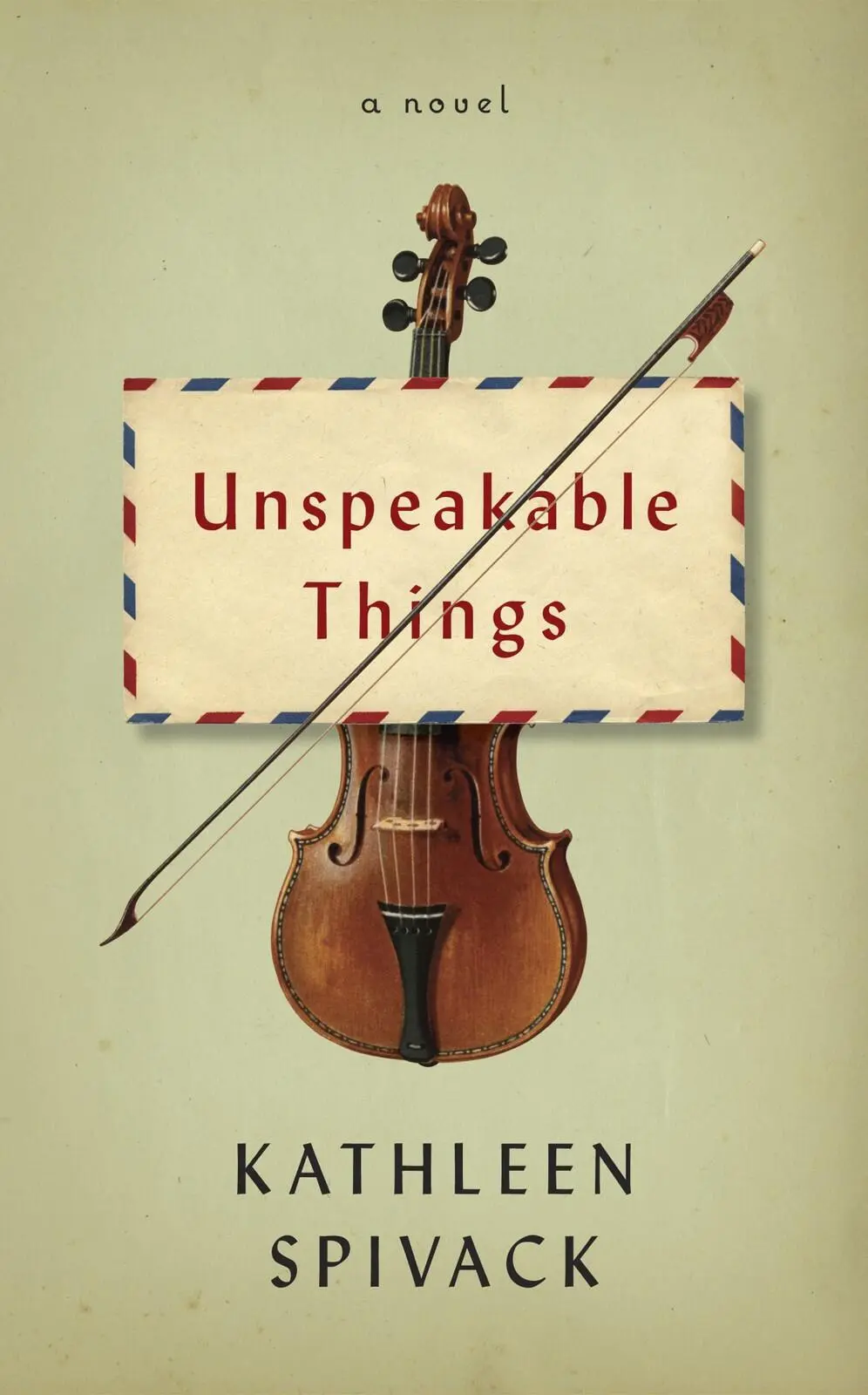
- Название:Unspeakable Things
- Автор:
- Издательство:Knopf
- Жанр:
- Год:2016
- ISBN:нет данных
- Рейтинг книги:4 / 5. Голосов: 1
-
Избранное:Добавить в избранное
- Отзывы:
-
Ваша оценка:
Unspeakable Things: краткое содержание, описание и аннотация
Предлагаем к чтению аннотацию, описание, краткое содержание или предисловие (зависит от того, что написал сам автор книги «Unspeakable Things»). Если вы не нашли необходимую информацию о книге — напишите в комментариях, мы постараемся отыскать её.
and
. A strange, haunting novel about survival and love in all its forms; about sexual awakenings and dark secrets; about European refugee intellectuals who have fled Hitler’s armies with their dreams intact and who have come to an elusive new (American) “can do, will do” world they cannot seem to find. A novel steeped in surreal storytelling and beautiful music that transports its half-broken souls — and us — to another realm of the senses.
The setting: the early 1940s, New York — city of refuge, city of hope, with the specter of a red-hot Europe at war.
At the novel’s center: Anna (known as the Rat), an exotic Hungarian countess with the face of an angel, beautiful eyes, and a seraphic smile, with a passionate intelligence, an exquisite ugliness, and the power to enchant. . Her second cousin Herbert, a former minor Austrian civil servant who believes in Esperanto and the international rights of man, wheeling and dealing in New York, powerful in the social sphere yet under the thumb of his wife, Adeline. . Michael, their missing homosexual son. . Felix, a German pediatrician who dabbles in genetic engineering, practicing from his Upper East Side office with his little dachshund, Schatzie, by his side. . The Tolstoi String Quartet, four men and their instruments, who for twenty years lived as one, playing the great concert halls of Europe, escaping to New York with their money sewn into the silk linings of their instrument cases. .
And watching them all: Herbert’s eight-year-old granddaughter, Maria, who understands from the furtive fear of her mother, and the huddled penury of their lives, and the sense of being in hiding, even in New York, that life is a test of courage and silence, Maria witnessing the family’s strange comings and goings, being regaled at night, when most are asleep, with the intoxicating, thrilling stories of their secret pasts. . of lives lived in Saint Petersburg. . of husbands being sent to the front and large, dangerous debts owed to the Tsar of imperial Russia, of late-night visits by coach to the palace of the Romanovs to beg for mercy and avoid execution. . and at the heart of the stories, told through the long nights with no dawn in sight, the strange, electrifying tale of a pact made in desperation with the private adviser to the Tsar and Tsarina — the mystic faith healer Grigory Rasputin (Russian for “debauched one”), a pact of “companionship” between Anna (the Rat) and the scheming Siberian peasant — turned — holy man, called the Devil by some, the self-proclaimed “only true Christ,” meeting night after night in Rasputin’s apartments, and the spellbinding, unspeakable things done there in the name of penance and pleasure. .
Unspeakable Things — читать онлайн бесплатно полную книгу (весь текст) целиком
Ниже представлен текст книги, разбитый по страницам. Система сохранения места последней прочитанной страницы, позволяет с удобством читать онлайн бесплатно книгу «Unspeakable Things», без необходимости каждый раз заново искать на чём Вы остановились. Поставьте закладку, и сможете в любой момент перейти на страницу, на которой закончили чтение.
Интервал:
Закладка:
“I was only sixteen, just a little older than you are now,” the Rat began, fondly stroking Maria’s hair back from her forehead. “But I was already married. My father had sold me, or perhaps I should say he had bought me a husband. A fine husband, handsome, well connected. But a poor husband. Oh, I did not know it at the time. But he was poor. And weak, too.” The Rat paused, her voice trailing off into the shadows.
“And I went away with him — oh, I did not want to go. But I went nevertheless.
“They sent me away, to Russia. To Saint Petersburg, where I lived with my husband. And his mother. And, of course, the whole household. And I had to learn their ways.”
From the first, the Count did not touch the Rat. He liked her dowry. Anna was a meal ticket for this impoverished branch of the noble family. But he found women ugly, and the marriage had been only an agreed-upon front for his other, darker desires. Her intelligence repelled him further. He did not care about her deformity, since he never intended to have anything to do with her other than to mollify his mother. “We had no wedding night,” the Rat told Maria. Night after night, Anna lay alone in her room while the Count amused himself elsewhere. Anna accepted this, and did not expect otherwise. “Perhaps he had a mistress. Perhaps he was at cards….”
Maria knew better than to interrupt. She lay beside the Rat, staring into the dark. “He went to the theater; sometimes I went with him.” Anna was silent then at the memory of it. “He was repelled by me. And so,” she continued, “I lived with his family. It was wild and savage; I enjoyed it. And then finally I had the children. His mother had spoken to him, you see.”
“You must try to do something with the girl,” his mother had protested as the debts mounted. “We want the family name to continue.”
The Count went out and got drunk, came home, and mounted the Rat from behind. A few gestures, a stifled cry, a booted leg hastily thrown over her hyphenated body. Two or three plunges in the dark; there, it was finished. This much he would do for his mother. And when it was finished, tears — his. “Forgive me, my little Anna,” the Count sobbed. “Can you forgive me?” But it was his fellow officers from whom he was asking forgiveness. One in particular — his immediate subordinate, who had instructed him how to do it in the first place. He bit his lip. He would do this for three nights, approaching her in the dark, thinking of Vanek, and then, when he had thought enough, mounting her in a violent fury until he had spent his seed. Anna knew enough to cooperate, never to cry out, never to feel anything. To respond in any way would have seemed to her the ultimate treachery. Each time, when it was over, her husband collapsed and sobbed on her hunchbacked body in disgust. He pulled out of her without a word and left immediately, going to the barracks at once to drink himself further into a stupor. Was this how men behaved with their wives? Anna was disgusted, but she stroked his hair as he bent and kissed her hand before going. “Of course. Yes. Shh. Go; don’t worry.”
This happened exactly three times. Three children. Anna, embarrassed by her pain, stifled her cries. It was humiliating, the whole procedure. But the children were beautiful, each one emerging from her torn body. She clutched them to her, precious things. After that, she didn’t mind that her husband was never there. She watched with pride as her three children grew.
“And then, one day, my husband was sent to the front.” Like other younger wastrel sons, the Count had a career — or rather, that which passed for a career — in the military. He was an officer for the Tsar, and his manners were brutish enough to command any number of wretches having the misfortune to serve under him.
“I was not sorry to see him go,” the Rat told Maria. “We had the usual farewell scene. But we both knew it was a farce.” Upon saying good-bye to his three children, all under the age of five, the Count allowed his real emotions to show for a moment. His mustache quivered. When he embraced his old mother, he burst into tears. He had done all she had asked of him. Anna observed all this, dry-eyed.
“Life at home went on as usual. Mama was aging, becoming more impossible. I tried to please her. I couldn’t. The children grew, did the usual things. I was happy, peaceful. We didn’t hear from him for a long time, this husband of mine. After a while, I began to forget him. I was happy, alone with the children, and I realized I was never made for marriage after all.”
After a year, still no word came back from the Count. But one day, Anna opened the door to a man whom she recognized as one of the Count’s servants. He handed her an envelope with the Count’s seal upon it. “The bearer of this message can be trusted. I rely upon your generosity,” she read. “Your husband is in danger. He must have money immediately,” the servant told her.
The Rat stepped back. “Money?”
“He has lost everything,” the servant replied.
“My dear little wife,” the Count had written. “All is lost. By the time you read this, your unhappy husband will be…”
Anna scanned what appeared to be a deathbed farewell. The Count had thrown away everything in gambling. Anna’s money, their house and lands, even the house in the country had been lost in the endless gaming to which at last the addicted Count confessed. “It is a debt to the Tsar,” he wrote. “If I don’t pay it, I shall be shot. I beg of you, my dear Anna, to send me money immediately. I promise you I shall never gamble again.”
“And so,” continued the Rat, stroking Maria’s hair absently, “I sold everything I had. My furs and jewels, everything. But it was not enough.”
A month later, the Tsar’s bailiffs came to the door. “Give me a week,” Anna pleaded. “I shall go to the Tsar himself and throw myself at his feet. I shall beg for mercy.”
The next day, while the children were asleep and the Count’s mother was still in bed, the Rat made her way by coach to the palace. Attendants led her upstairs and through a series of rooms and magnificent hallways. Enormous doors shut behind her and finally she was taken into a large study. At the window stood a hooded figure, pondering the sadness of Russia as he looked pensively outward. Anna stood before him and waited, her head bent.
The figure turned. “So, my dear Countess,” the man said. “You have come for mercy.”
The Rat shuddered. She had never seen eyes like that. Anna sank to her knees. “Holy Father,” she murmured.
The man came forward and lifted her to her feet. “Countess,” he said, “you come on your knees to me?” His voice had a sarcastic timbre that echoed through the cramped bones of her body. It spread out like ripples in the room. “You come on your knees? And you would like something from me?” The voice was insidious, hypnotizing. “Good,” he said. “Now, my child, look at me.” The command caused Anna to raise her head until her eyes met those of the apparition.
“And then I knew.” Anna shuddered, burrowing her head in Maria’s hair. “I was in the presence not of the Tsar, but of Rasputin.”
The Monk reached out one finger and touched the Rat’s cheek. “Tell me, my child,” he commanded. “What is it you want?”
“Save us, Holiness.” The Rat burst into tears. “Save us.”
The gaunt figure listened, immobile. He looked into the eyes of the Rat. “My dear lady, I already know everything,” he replied slowly in his thrilling voice. “Trouble yourself no longer. I will pay your husband’s gambling debts. All of them. You and your children do not have to cry any longer.”
The Rat gasped.
“But I shall ask of you only one little thing in return.”
Читать дальшеИнтервал:
Закладка:
Похожие книги на «Unspeakable Things»
Представляем Вашему вниманию похожие книги на «Unspeakable Things» списком для выбора. Мы отобрали схожую по названию и смыслу литературу в надежде предоставить читателям больше вариантов отыскать новые, интересные, ещё непрочитанные произведения.








Обсуждение, отзывы о книге «Unspeakable Things» и просто собственные мнения читателей. Оставьте ваши комментарии, напишите, что Вы думаете о произведении, его смысле или главных героях. Укажите что конкретно понравилось, а что нет, и почему Вы так считаете.