Kathleen Spivack - Unspeakable Things
Здесь есть возможность читать онлайн «Kathleen Spivack - Unspeakable Things» весь текст электронной книги совершенно бесплатно (целиком полную версию без сокращений). В некоторых случаях можно слушать аудио, скачать через торрент в формате fb2 и присутствует краткое содержание. Год выпуска: 2016, Издательство: Knopf, Жанр: Современная проза, на английском языке. Описание произведения, (предисловие) а так же отзывы посетителей доступны на портале библиотеки ЛибКат.
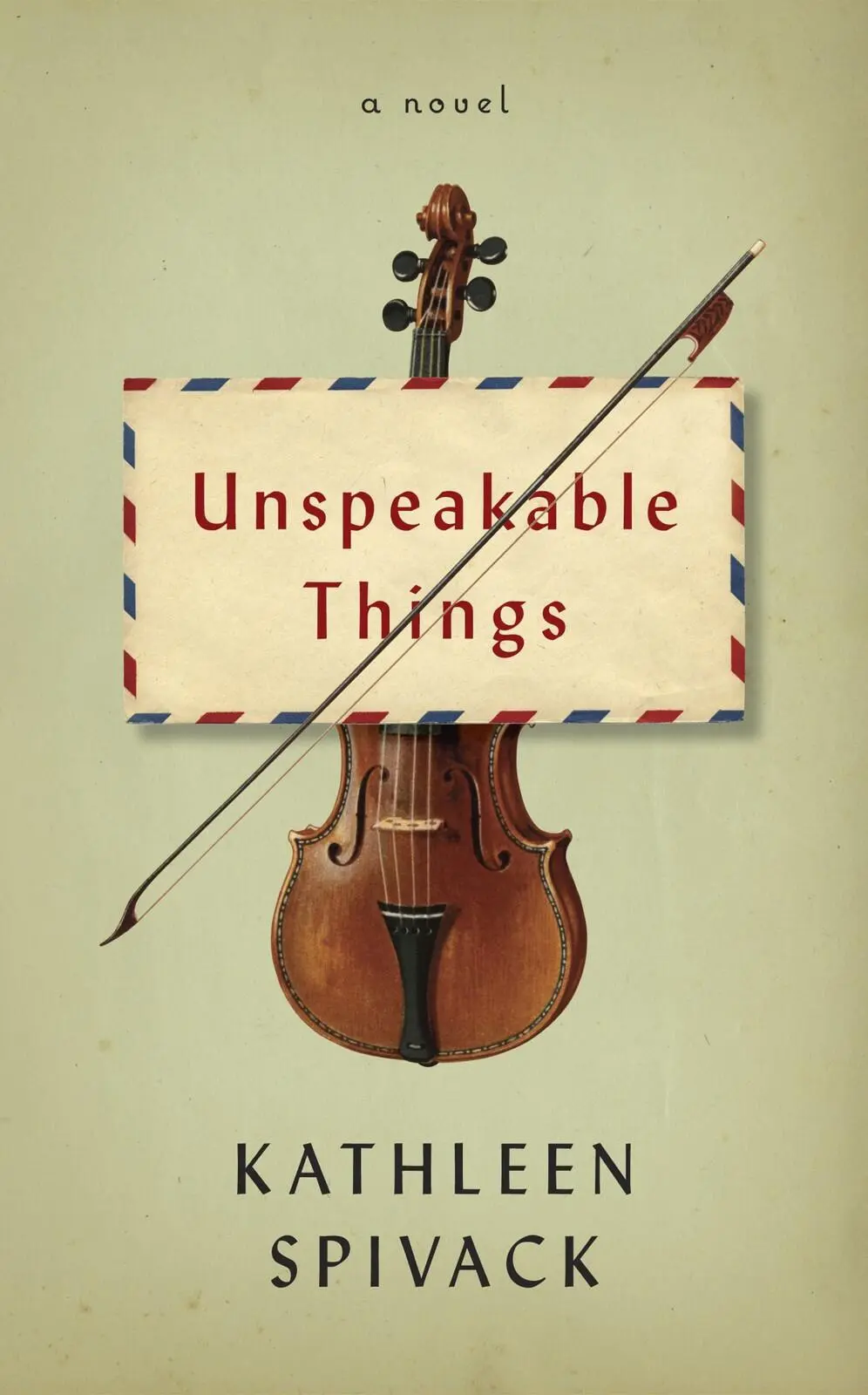
- Название:Unspeakable Things
- Автор:
- Издательство:Knopf
- Жанр:
- Год:2016
- ISBN:нет данных
- Рейтинг книги:4 / 5. Голосов: 1
-
Избранное:Добавить в избранное
- Отзывы:
-
Ваша оценка:
Unspeakable Things: краткое содержание, описание и аннотация
Предлагаем к чтению аннотацию, описание, краткое содержание или предисловие (зависит от того, что написал сам автор книги «Unspeakable Things»). Если вы не нашли необходимую информацию о книге — напишите в комментариях, мы постараемся отыскать её.
and
. A strange, haunting novel about survival and love in all its forms; about sexual awakenings and dark secrets; about European refugee intellectuals who have fled Hitler’s armies with their dreams intact and who have come to an elusive new (American) “can do, will do” world they cannot seem to find. A novel steeped in surreal storytelling and beautiful music that transports its half-broken souls — and us — to another realm of the senses.
The setting: the early 1940s, New York — city of refuge, city of hope, with the specter of a red-hot Europe at war.
At the novel’s center: Anna (known as the Rat), an exotic Hungarian countess with the face of an angel, beautiful eyes, and a seraphic smile, with a passionate intelligence, an exquisite ugliness, and the power to enchant. . Her second cousin Herbert, a former minor Austrian civil servant who believes in Esperanto and the international rights of man, wheeling and dealing in New York, powerful in the social sphere yet under the thumb of his wife, Adeline. . Michael, their missing homosexual son. . Felix, a German pediatrician who dabbles in genetic engineering, practicing from his Upper East Side office with his little dachshund, Schatzie, by his side. . The Tolstoi String Quartet, four men and their instruments, who for twenty years lived as one, playing the great concert halls of Europe, escaping to New York with their money sewn into the silk linings of their instrument cases. .
And watching them all: Herbert’s eight-year-old granddaughter, Maria, who understands from the furtive fear of her mother, and the huddled penury of their lives, and the sense of being in hiding, even in New York, that life is a test of courage and silence, Maria witnessing the family’s strange comings and goings, being regaled at night, when most are asleep, with the intoxicating, thrilling stories of their secret pasts. . of lives lived in Saint Petersburg. . of husbands being sent to the front and large, dangerous debts owed to the Tsar of imperial Russia, of late-night visits by coach to the palace of the Romanovs to beg for mercy and avoid execution. . and at the heart of the stories, told through the long nights with no dawn in sight, the strange, electrifying tale of a pact made in desperation with the private adviser to the Tsar and Tsarina — the mystic faith healer Grigory Rasputin (Russian for “debauched one”), a pact of “companionship” between Anna (the Rat) and the scheming Siberian peasant — turned — holy man, called the Devil by some, the self-proclaimed “only true Christ,” meeting night after night in Rasputin’s apartments, and the spellbinding, unspeakable things done there in the name of penance and pleasure. .
Unspeakable Things — читать онлайн бесплатно полную книгу (весь текст) целиком
Ниже представлен текст книги, разбитый по страницам. Система сохранения места последней прочитанной страницы, позволяет с удобством читать онлайн бесплатно книгу «Unspeakable Things», без необходимости каждый раз заново искать на чём Вы остановились. Поставьте закладку, и сможете в любой момент перейти на страницу, на которой закончили чтение.
Интервал:
Закладка:
Felix opened the small refrigerator beneath the counter. His jars lay in their opaque darkness, small bits and pieces swimming in fluid. Felix regarded them gravely, then shut the refrigerator again. Schatzie sighed and shifted position, waiting outside the laboratory door. The laboratory was the one place she was not allowed to go, although Felix was carefully cultivating, in a small dish, some specks of Schatzie’s dander.
In another dish, a small section of Schatzie’s tail, a very small, scrupulously clean bit of tail tissue, lay in its formaldehyde, ready for regeneration. Felix had taken this bit from Schatzie under local anesthetic; the dog had not even felt it. It was only when Felix had shaved the dog’s tail preparatory to the incision that Schatzie, feeling slightly shorn and humiliated, had turned and regarded Felix with reproachful eyes. Felix, before he anesthetized the shaved tail, had washed that part of Schatzie so tenderly that the dog had finally sighed with pleasure. Felix was skillful; the anesthetic had worn off quickly, and Schatzie was her old happy self again, wagging the bare thing with its little Band-Aid on it. Now the hair had grown back. But the piece of Schatzie lay in Felix’s cell bank, ready to be immortal. A superdog. With a supertail.
Felix believed in regeneration, the creation of the whole organism from its smallest part. For this reason, he had collected body parts, which he was storing until he could finally discover the secret of growing whole ones again.
His jars were full of mysterious things. The closet smelled strangely: formaldehyde, vinegar, and a kind of protein broth that Felix made himself over a hot plate and fed to the body parts. It was part oatmeal, part liverwurst. The tissues thrived in their milky jars, and seemed to thrash and swim when he dropped the mixture in.
Felix surveyed his collection happily. All seemed healthy, in good condition. “Rest, my little ones,” he said, preparing his mixture carefully and filling an eyedropper. The gruel had to be fresh each evening, he had discovered. He had killed an ear by feeding it old gruel. Now he was more careful, and the results, he thought, were good.
Felix’s main goal was the study and propagation of genius. What was genius? How could one ensure its survival? How could one produce it? What happened to the bodies of dead geniuses? Did their genes die with them, or could the cells, the genetic code, somehow be preserved? Felix devoted many hours to the study of these questions.
Felix had managed to preserve a piece of skin from Marthe’s neck. “One never knows,” he had thought in his practical way. “There might come a time when I will need it again.” There she lay in her jar. But Felix was not sure he would want Marthe again, even though he wept for her occasionally. Felix liked to weep; he liked the slow, soft letting go of tears: so warm. He liked to weep for Marthe; it made him feel tender, almost sexual. Thinking of her sadly aroused him.
But Marthe was not, had never been, a genius. Her regeneration would have to wait. Felix had more important things to do.
Felix coveted a piece of Herbert, that wily rascal, to round out his collection. He respected Herbert a great deal. It was too bad Herbert was misguided, but perhaps with some genetic engineering that could be changed. Felix had not yet figured out how to get Herbert’s consent to donate his tissue. He meant to talk to him, but somehow Felix quailed before the prospect. Best, he thought, would be a section from Herbert’s scalp. It was liver-spotted already. Felix might be able to convince him he had skin cancer, offer to remove it. He smiled to himself. That might do. After all, the family trusted him.
He had been present at the birth of Ilse, as a medical student assisting Marthe’s father. Marthe’s father had been called away, and it had been Felix who had, in fact, delivered the baby. Not only that, he had also delivered Ilse of Maria, a very strange little girl indeed. But an interesting one. They had every right to be grateful to him, grateful even for their lives, which he, Felix, had breathed into them. How strange that they had found themselves in New York after all these years.
Herbert had much to thank Felix for, if only he were to think about it, but Herbert was stubborn and strong; in his own way a great, a very great man indeed. There was something magic about the man, powerful; a great negotiator, a man of principle. Even in Felix’s youth, Herbert, “Herr Hofrat,” was legendary. Felix was not fit to touch the hem of his greatcoat. Yes. The man should be preserved, thought Felix. He belonged in the collection.
Felix squirted a little red dye onto the slide before him, adjusting the cover slip with a delicate hand, and bent once more to the microscope. He thought he saw the cells wiggle. He had learned to be patient. Regeneration might take a bit of time.
Each month, Felix received a shipment from Europe, jars carefully packed in dry ice, and delivered (emergency, Red Cross) by airplane and then by ambulance to his door. Carefully, lovingly, Felix opened these packages, cradling the jars in his hand. Someone had written on them, identifying the parts. So far, he had managed to collect a bit of the brain of Rolfe Kahn, the physicist whom the Nazis had managed to collect for him. That was his best specimen so far.
Also among his choicest prospects was the left eye of Oswald Herten, the painter. (Felix would have preferred the right eye, which had the better vision, but that had somehow been lost in transit.) He had a scrap of bone from Lenhard Weisen, the famous German Jewish runner who had appeared briefly, during the Olympic Games, but who then had somehow mysteriously disappeared. He had a fragment of thigh from another half-Jewish high jumper; the tip of the earlobe of Heinz Werner, a composer; a few cells from the nose of a famous — now dead — literary critic; and various scraps of body parts of assorted European playwrights, artists, and writers, all of dubious origin, all disappeared now. His network had been good.
His source of supply was his dear old childhood friend who had remained in Austria throughout the unfortunate war. Felix remembered their discussions during medical school. Helmut had always believed in the concept of the “master race,” perhaps even more than had Felix himself. Helmut had even tried to dissuade Felix, sometimes strenuously, from marrying Marthe. Perhaps he had been right. Marthe had proved nervous, neurasthenic. Helmut himself had never married.
“Ours is a fine and manly friendship,” Felix told himself, thinking of Helmut, his earnest face and keen eyes. It was an intellectual meeting of the minds that endured far beyond any feeling for women.
Helmut was the last person he had seen at the station. Helmut had gripped Felix’s hand in his own and looked deeply into his eyes in a firm, manly way when Felix left. “God be with you!” Helmut had shouted after the departing train. Now the two doctors maintained a clandestine correspondence, a brief scientific notation smuggled in with the jars. Felix recognized Helmut’s writing on the labels.
“My friend, my dear friend,” he thought sentimentally. And tears welled up in his eyes. He wondered when he would see his friend again. Perhaps after all these troubles were over. Felix waited for a sign that he could return to Europe once again. Meanwhile, he rejoiced in Helmut’s important position in the Party. Together, they were participating in a great new experiment, the thing they had always dreamed of: the creation of a better, purer society. This, this new society created from the old, would be their true progeny, the child they would create together finally. Felix knew Helmut, in his laboratory in Austria, felt exactly the same. He pictured his friend also bending over a microscope, carrying out his experiments, making his notations on reproduction.
Читать дальшеИнтервал:
Закладка:
Похожие книги на «Unspeakable Things»
Представляем Вашему вниманию похожие книги на «Unspeakable Things» списком для выбора. Мы отобрали схожую по названию и смыслу литературу в надежде предоставить читателям больше вариантов отыскать новые, интересные, ещё непрочитанные произведения.










Обсуждение, отзывы о книге «Unspeakable Things» и просто собственные мнения читателей. Оставьте ваши комментарии, напишите, что Вы думаете о произведении, его смысле или главных героях. Укажите что конкретно понравилось, а что нет, и почему Вы так считаете.