Kathleen Spivack - Unspeakable Things
Здесь есть возможность читать онлайн «Kathleen Spivack - Unspeakable Things» весь текст электронной книги совершенно бесплатно (целиком полную версию без сокращений). В некоторых случаях можно слушать аудио, скачать через торрент в формате fb2 и присутствует краткое содержание. Год выпуска: 2016, Издательство: Knopf, Жанр: Современная проза, на английском языке. Описание произведения, (предисловие) а так же отзывы посетителей доступны на портале библиотеки ЛибКат.
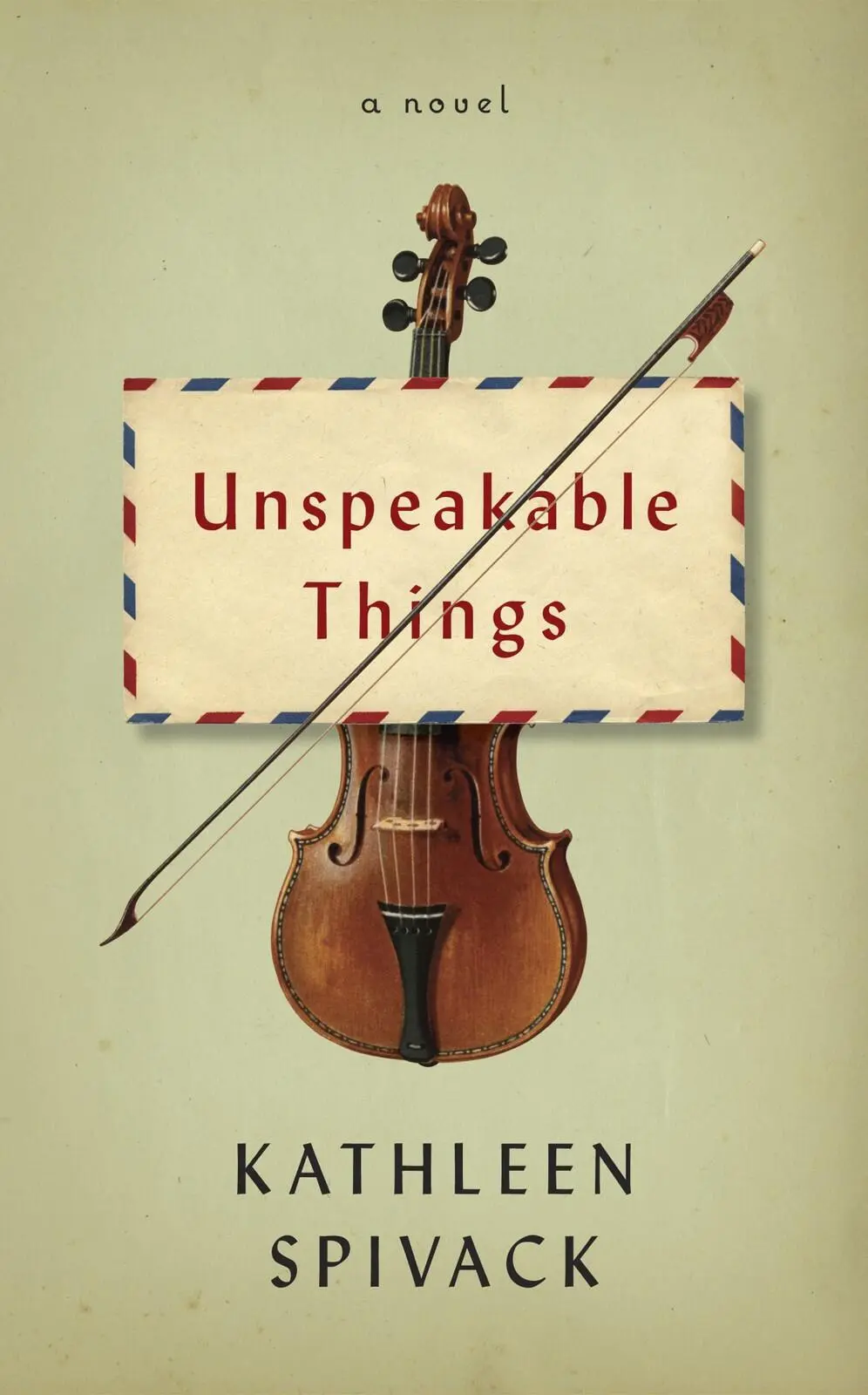
- Название:Unspeakable Things
- Автор:
- Издательство:Knopf
- Жанр:
- Год:2016
- ISBN:нет данных
- Рейтинг книги:4 / 5. Голосов: 1
-
Избранное:Добавить в избранное
- Отзывы:
-
Ваша оценка:
Unspeakable Things: краткое содержание, описание и аннотация
Предлагаем к чтению аннотацию, описание, краткое содержание или предисловие (зависит от того, что написал сам автор книги «Unspeakable Things»). Если вы не нашли необходимую информацию о книге — напишите в комментариях, мы постараемся отыскать её.
and
. A strange, haunting novel about survival and love in all its forms; about sexual awakenings and dark secrets; about European refugee intellectuals who have fled Hitler’s armies with their dreams intact and who have come to an elusive new (American) “can do, will do” world they cannot seem to find. A novel steeped in surreal storytelling and beautiful music that transports its half-broken souls — and us — to another realm of the senses.
The setting: the early 1940s, New York — city of refuge, city of hope, with the specter of a red-hot Europe at war.
At the novel’s center: Anna (known as the Rat), an exotic Hungarian countess with the face of an angel, beautiful eyes, and a seraphic smile, with a passionate intelligence, an exquisite ugliness, and the power to enchant. . Her second cousin Herbert, a former minor Austrian civil servant who believes in Esperanto and the international rights of man, wheeling and dealing in New York, powerful in the social sphere yet under the thumb of his wife, Adeline. . Michael, their missing homosexual son. . Felix, a German pediatrician who dabbles in genetic engineering, practicing from his Upper East Side office with his little dachshund, Schatzie, by his side. . The Tolstoi String Quartet, four men and their instruments, who for twenty years lived as one, playing the great concert halls of Europe, escaping to New York with their money sewn into the silk linings of their instrument cases. .
And watching them all: Herbert’s eight-year-old granddaughter, Maria, who understands from the furtive fear of her mother, and the huddled penury of their lives, and the sense of being in hiding, even in New York, that life is a test of courage and silence, Maria witnessing the family’s strange comings and goings, being regaled at night, when most are asleep, with the intoxicating, thrilling stories of their secret pasts. . of lives lived in Saint Petersburg. . of husbands being sent to the front and large, dangerous debts owed to the Tsar of imperial Russia, of late-night visits by coach to the palace of the Romanovs to beg for mercy and avoid execution. . and at the heart of the stories, told through the long nights with no dawn in sight, the strange, electrifying tale of a pact made in desperation with the private adviser to the Tsar and Tsarina — the mystic faith healer Grigory Rasputin (Russian for “debauched one”), a pact of “companionship” between Anna (the Rat) and the scheming Siberian peasant — turned — holy man, called the Devil by some, the self-proclaimed “only true Christ,” meeting night after night in Rasputin’s apartments, and the spellbinding, unspeakable things done there in the name of penance and pleasure. .
Unspeakable Things — читать онлайн бесплатно полную книгу (весь текст) целиком
Ниже представлен текст книги, разбитый по страницам. Система сохранения места последней прочитанной страницы, позволяет с удобством читать онлайн бесплатно книгу «Unspeakable Things», без необходимости каждый раз заново искать на чём Вы остановились. Поставьте закладку, и сможете в любой момент перейти на страницу, на которой закончили чтение.
Интервал:
Закладка:
Scooping up Schatzie, Felix had stood beside the train that was to carry them both away from Europe. Mentally, he made a photograph of himself at that moment. In the foreground, he placed the large trunk. Next to it in the station, Felix himself, a small man, with Schatzie squeezed, unprotesting, under his arm. In his eye, the monocle glared, a manic disk. Felix bit down fiercely on his cigar, and with his free hand, he fingered the gold watch, the one Marthe’s father had given him when he had entered practice with the older physician. Then the train came; the doors opened, and Felix and Schatzie had to be helped in. It was only then that emotion overcame him, misting the monocle, which he removed, putting it into his vest pocket, where it rested beside his stethoscope for the rest of the long journey.
Now in Manhattan, a new life, an empty life. But the doorbell rang, signaling the arrival of the first of the children. It was tonsils; Felix already knew that. “Come, Schatzie.” He sighed, putting the dog down. He went down the long hall to the large carved door, opening it slowly. Schatzie lumbered behind him. “Guten Morgen,” Felix said, opening his door to the small patient, who stood solemnly beside its mother.
“Oh, Herr Doktor, we are so grateful!” The mother, upon seeing Felix, immediately began to gush with relief.
“Not at all, dear lady, not at all.” Felix forestalled her with a warning gesture. He moved closer to the little boy, who was just his height. “Well,” demanded Felix suddenly, lifting one bushy eyebrow, “have you been a bad boy, hmm?”
The little boy shrank back, clutching his mother’s hand tightly. “Noooo,” he ventured tentatively.
“No, Uncle Felix,” said Felix, immediately correcting the child. The boy complied. “Good,” said Felix, leading the way into the examining room. “ Komm, Schatzie,” Schatzie trotted behind obediently. The child and his mother followed.
Felix staggered suddenly. “Ach,” he cried. “Bad child, bad child! What have you done to Uncle Felix?” The boy cringed, but the mother smiled down at him indulgently. “Don’t be afraid, Hans,” her smile seemed to say.
“You see, you are breaking my leg!” cried Felix to the child in a fierce voice. “Now it is I who am sick! Are you going to fix my leg, hmm?” Hans pressed back against his mother, all of his own physical suffering forgotten as he contemplated the figure of this contorted man, sagging to the ground, clutching Hans’s body and gibbering, tongue lolling, as he staggered against him.
“Now you must help Uncle Felix, bad boy,” Felix said. “Ach, ach, how it hurts!” Felix fell on the floor of his examining room, his leg cramped against him. Schatzie nuzzled her master’s prone body, bewildered. She licked him a couple of times. Hans watched this, his round eyes even rounder. “It hurts!” Felix cried. “Now, Hans,” he commanded the boy, “you must help your poor old Uncle Felix.” He stretched out a hand to Hans, who, terrified, refused to take it. “Come, you bad boy,” Felix cried. “It is you who broke my leg. Now you must fix it.” The boy, pushed forward by his mother, tentatively touched Felix’s arm. “Ach!” Felix sprang to his feet, and before the surprised eyes of the child and his mother, he bounded about the room, although still managing to drag one leg behind.
Suddenly, he swooped down upon the boy. “Now open your mouth!” he commanded. “Say ‘Ahh.’ ” Felix set the child upon the examining table, screwed his monocle to his eye, reached for the stethoscope, took out a tongue depressor, and peered down the child’s throat, all in one motion. He appeared to thrust his bushy head all the way into the boy’s gullet.
“ ‘Ahhh,’ ” said the boy, as if his life depended on it. “ ‘Aaah.’ ”
Felix snapped the tongue depressor in two and went for the child’s ears. All this happened so quickly that Hans never thought to utter a sound. Felix threw Schatzie a sugar cube and reached for the stethoscope that dangled around his neck. He took out his gold pocket watch and counted to himself, breathing in a stentorian fashion. “Bad boy, bad boy!” Felix said to himself. Schatzie licked his pant leg.
“Now, Hans,” Felix said briskly when he had finished, “you will be a good boy from now on, hmm?” He bent down and pressed his nose against Hans’s, fixing the child in his gaze. “No more troubles for Mutter, hmm?” Hans, terrified, nodded.
“That’s better,” said Felix, straightening up. “First you will take my medicine. You will be good, and then you will give me a nice picture. Ja? A nice picture for my walls.”
Hans looked around him and above, as far as he could see, to the grave and smiling photos of children looking down at him.
“Of course,” Hans’s mother said encouragingly. “Of course you shall have a picture.”
“And you, you must get dressed,” said Felix to the child. “And then you shall sit in my nice room outside with Schatzie and wait for Mutter, hmm?” Felix looked significantly at the far corner of his office, far from the examining table, where a large screen cut off the final third of the room. The ceilings were high, with decorated moldings at the top. Paint was peeling, and the radiators muttered. But the room was nice and warm. Hans wondered vaguely what was behind the screen. Felix snapped his fingers and Schatzie emerged from the corner, wagging her entire fat body. Deftly, Felix pulled a dog candy from out of a sleeve, and with the other, he plucked a lollipop from Hans’s ear. He held the lollipop in the air. “You see, this has been the problem all along!” he declared. “Bad boy, why do you not tell Uncle Felix you hide candy in your ear!”
Hans’s mother clapped her hands with delight, as if to encourage the jollity, and Hans managed a wan, unwilling smile. “Bad boy, bad boy,” chanted Felix, and he gave the child the lollipop.
“Schatzie, come!” he commanded, snapping his fingers once more, and the dog waddled heavily toward the waiting room. “Hans!” The child walked obediently behind the dog, casting reluctant backward glances at his mother as he went. “Mutti will only be a little while,” said Felix. He looked significantly at Hans’s mother, at the screen that hid the couch with the silken cover, and motioned the child out. “Sit, Schatzie! Sit, Hans!”
Hans’s mother was already unbuttoning her coat, fumbling with the too-small buttonholes. “Now, Hans,” warned Felix, “if you are a bad boy, Uncle Felix will know.” He raised his voice suddenly, sharply. “Sit,” he commanded. Both Hans and Schatzie sat on the little sofa outside of the examining room, next to the umbrella stand, their round eyes looking up at Felix as he wagged a reproving finger at them both. Hans put the lollipop in his mouth and tasted it carefully. He put his other arm around the dog.
“The child will be fine, dear woman,” Felix said to Hans’s mother, carefully shutting the large oak door to his office. Hans’s mother made an imploring gesture toward her son, but Felix raised one gnarled hand as if to forestall her words. “Come with me, dear lady, now,” he commanded, leading her behind the screen. “It is only a question of medicine,” he said. “The child will be fine, I assure you.”
After Hans and his mother had left, Felix sat down once again at his big desk to make a few notes for himself. He scribbled hastily, blotted the paper quickly, and unlocked his desk drawer, placing the note inside. Once again he pulled out the papers he had stolen from Herbert’s cot, then held them up to the green-shaded light, as if light would reveal what understanding could not. But he could make no sense of the notes. “P5, k3,” he read. Felix snarled, flinging the notes back into the drawer. He shoved them into the back and locked the desk again.
Читать дальшеИнтервал:
Закладка:
Похожие книги на «Unspeakable Things»
Представляем Вашему вниманию похожие книги на «Unspeakable Things» списком для выбора. Мы отобрали схожую по названию и смыслу литературу в надежде предоставить читателям больше вариантов отыскать новые, интересные, ещё непрочитанные произведения.











Обсуждение, отзывы о книге «Unspeakable Things» и просто собственные мнения читателей. Оставьте ваши комментарии, напишите, что Вы думаете о произведении, его смысле или главных героях. Укажите что конкретно понравилось, а что нет, и почему Вы так считаете.