Kathleen Spivack - Unspeakable Things
Здесь есть возможность читать онлайн «Kathleen Spivack - Unspeakable Things» весь текст электронной книги совершенно бесплатно (целиком полную версию без сокращений). В некоторых случаях можно слушать аудио, скачать через торрент в формате fb2 и присутствует краткое содержание. Год выпуска: 2016, Издательство: Knopf, Жанр: Современная проза, на английском языке. Описание произведения, (предисловие) а так же отзывы посетителей доступны на портале библиотеки ЛибКат.
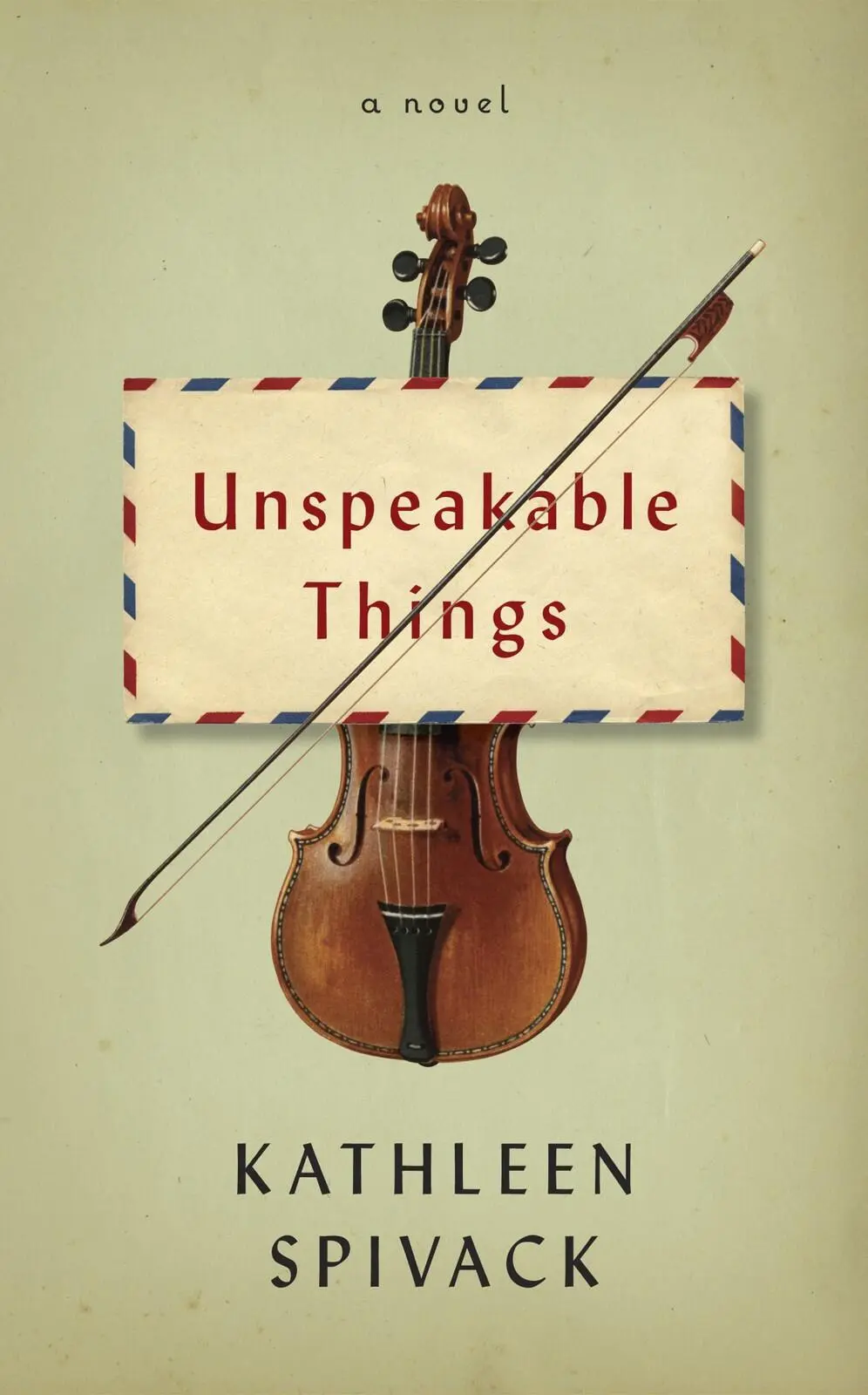
- Название:Unspeakable Things
- Автор:
- Издательство:Knopf
- Жанр:
- Год:2016
- ISBN:нет данных
- Рейтинг книги:4 / 5. Голосов: 1
-
Избранное:Добавить в избранное
- Отзывы:
-
Ваша оценка:
Unspeakable Things: краткое содержание, описание и аннотация
Предлагаем к чтению аннотацию, описание, краткое содержание или предисловие (зависит от того, что написал сам автор книги «Unspeakable Things»). Если вы не нашли необходимую информацию о книге — напишите в комментариях, мы постараемся отыскать её.
and
. A strange, haunting novel about survival and love in all its forms; about sexual awakenings and dark secrets; about European refugee intellectuals who have fled Hitler’s armies with their dreams intact and who have come to an elusive new (American) “can do, will do” world they cannot seem to find. A novel steeped in surreal storytelling and beautiful music that transports its half-broken souls — and us — to another realm of the senses.
The setting: the early 1940s, New York — city of refuge, city of hope, with the specter of a red-hot Europe at war.
At the novel’s center: Anna (known as the Rat), an exotic Hungarian countess with the face of an angel, beautiful eyes, and a seraphic smile, with a passionate intelligence, an exquisite ugliness, and the power to enchant. . Her second cousin Herbert, a former minor Austrian civil servant who believes in Esperanto and the international rights of man, wheeling and dealing in New York, powerful in the social sphere yet under the thumb of his wife, Adeline. . Michael, their missing homosexual son. . Felix, a German pediatrician who dabbles in genetic engineering, practicing from his Upper East Side office with his little dachshund, Schatzie, by his side. . The Tolstoi String Quartet, four men and their instruments, who for twenty years lived as one, playing the great concert halls of Europe, escaping to New York with their money sewn into the silk linings of their instrument cases. .
And watching them all: Herbert’s eight-year-old granddaughter, Maria, who understands from the furtive fear of her mother, and the huddled penury of their lives, and the sense of being in hiding, even in New York, that life is a test of courage and silence, Maria witnessing the family’s strange comings and goings, being regaled at night, when most are asleep, with the intoxicating, thrilling stories of their secret pasts. . of lives lived in Saint Petersburg. . of husbands being sent to the front and large, dangerous debts owed to the Tsar of imperial Russia, of late-night visits by coach to the palace of the Romanovs to beg for mercy and avoid execution. . and at the heart of the stories, told through the long nights with no dawn in sight, the strange, electrifying tale of a pact made in desperation with the private adviser to the Tsar and Tsarina — the mystic faith healer Grigory Rasputin (Russian for “debauched one”), a pact of “companionship” between Anna (the Rat) and the scheming Siberian peasant — turned — holy man, called the Devil by some, the self-proclaimed “only true Christ,” meeting night after night in Rasputin’s apartments, and the spellbinding, unspeakable things done there in the name of penance and pleasure. .
Unspeakable Things — читать онлайн бесплатно полную книгу (весь текст) целиком
Ниже представлен текст книги, разбитый по страницам. Система сохранения места последней прочитанной страницы, позволяет с удобством читать онлайн бесплатно книгу «Unspeakable Things», без необходимости каждый раз заново искать на чём Вы остановились. Поставьте закладку, и сможете в любой момент перейти на страницу, на которой закончили чтение.
Интервал:
Закладка:
“And Ilse? Is she working now?” asked Adeline.
“Yes,” said Herbert. “She has a good job now.”
“She was never good enough for our family,” Adeline hissed, rearing back. “She was never good enough for David. And what’s more, the girl isn’t even Jewish.”
“No,” said Herbert. “But she is a good girl. She works hard.”
“And common,” sneered Adeline. “David could have done much better.” Both thought of their elder son, the good one.
“Michael,” the steam pipes started to whisper again.
Herbert’s head hurt; his eardrums whirled in a blackness of pain. He thought they would burst. “Stop it immediately!” he shouted aloud. Somehow, he was standing on his feet, a small scrunched figure beside his wife’s iron bed. “Stop it!”
Adeline shrank back, her dark eyes regarding him with surprise. “But my darling,” she began in a coaxing voice, “I did not mean…I only meant…” The room receded back into its rightful form. “I am sure Ilse does a good job,” she said grudgingly. Her voice became conciliatory. “Sit down, my darling Herbert.”
Herbert’s head cleared and he saw his family united as they once had been: David and Michael played together in a large walled garden under the linden trees. And Adeline, beautiful and proud, gathered the little boys to her and kissed them tenderly. She played the piano; she sang. The boys ran off again, grew up. David in Berlin, Michael at home in Vienna. Then something happened, but he had forgotten what.
The music swelled. The sounds of the children playing drifted up from the garden. The fragrance of linden trees in June was like white sleep. In their bedroom, the shutters were open. The scent of the flowering trees entered the windows of the large house and fell like petals on the bed.
“My darling,” Adeline sighed to him from her pillow.
Herbert kissed her beautiful mouth; he stroked her hair. Lowering his body onto hers, he wondered at so much tenderness. Then he remembered something again. His brother. The one she had wanted to marry after all. Only, something had happened there, too. His brother had married somebody else, a nice, common girl. Leni liked to collect mushrooms, Herbert remembered. She was a good cook. A nice, dull girl.
“Die Linden, die Linden,” sang Adeline in a white dress. There were flowers in the room, flowers in her hair. Two little boys played in a pool of sunlight next to her skirts.
Herbert parted the body of his wife and slowly entered her velvet. She opened, receiving him. He pressed his lips to her mouth as she struggled to tell him something. Something about the children perhaps. “Not now,” he wanted to tell her. Everything could wait.
But the room reorganized itself with a sudden white clapping sound. “Herbert!” screamed Adeline. “You haven’t been listening! Did you hear what I said?” She stared at him, panting, with large terrified eyes. “What are you doing? Don’t you see they are killing me here?”
Probing evening fingers of cold were clawing their way into the room, and Herbert shifted slightly in the scratchy overcoat. He was sweating even though it was cold — a chill sweat, as if he were becoming ill. Heavily, he got up from his sitting position next to her. He uncramped himself slowly in the isolate dark. “I must go now,” he said to her. “It is getting late and I must go.”
“Herbert, I am so frightened,” burst out Adeline.
“You are right,” he said to her sadly. “You would have been happier with my brother.”
“Don’t leave me,” Adeline pleaded.
“But my darling, I’ll be back tomorrow. You know that,” he said in a soft, coaxing voice, as if to a child: the child she had become.
“I am nothing,” he thought, and a great weight fell onto his heart.
Chapter 5 THE GOOD DOKTOR
A drum roll, a tympani, a clanging together of garbage can lids heralded the start of a new day. Dr. Felix sat in his office on New York’s Upper East Side. He surveyed the loving photographs inscribed to him that beamed down from the walls. Beside him, his little dachshund, Schatzie, sat soberly, her jowls grizzling and quivering as she waited for her master to feed her just one more lump of sugar before the day actually began. “Hush, mein Liebchen, ” said Felix, reproving the dog, and at the same time stroking the folds of her flesh, so silky, furred with a fringe of black and white hairs. Schatzie licked his hand.
Felix surveyed the crumpled papers he held, papers taken from under Herbert’s mattress, reading and rereading them. “Knight to a2,” he read. “Pawn 3 to d5.” He threw the papers down in frustration. “Aach!” Chess moves! That was all they were! Herbert planning out chess moves, playing against himself, as always. And for that, Felix had risked discovery. He was fed up. And yet, what if this was code? “Hmmm, Schatzie. What do you think?” The dog nuzzled Felix’s hand with a spongy, plush nose.
Every day for the past week, Felix had sat in his office, waiting for the children. And each day, in mounting frustration, he read and reread the papers he had salvaged from Herbert’s cot, trying to find the secrets that lay within the careful handwriting. But it was to no avail. Felix sighed to himself and put the papers back in the little upper drawer of the desk, locking it firmly and putting the key in his pocket again. He offered the dog another sugar lump, and Schatzie, groaning slightly, struggled to her feet and wagged her stump of a tail.
In the examining room and in the entryway that led to it, photographs of children looked down at Felix and his current patients. Their sweet little faces and unblinking dark eyes stared out at the world. “For my beloved Uncle Felix.” “To Felix with all my love,” “Dear Felix, how will I ever forget you?” The words were written again and again over the bottom of the photographs, usually in elegant upward loops, sometimes with a trailing line beneath the sentiments. The handwriting on the pictures was like flowers, decorating the elaborate costumes of the children, the white dresses, the silken curls, the little boys in suits, sailor or otherwise, the girls in white lace dresses with intricate sleeves and wide sashes. All stared soulfully out of the silver frames that guarded them, watching Felix at work every day as he cared for children, the children of America. “The children of America,” thought Felix. But they were in truth very like the children of Europe, for they were, most of them, the same children. Only less elegant, less graceful, less courteous. For these were the children of Europeans in America, those who had managed to survive. And a sorry lot they were.
Felix scratched his bushy head, where the gray hairs sprouted like Struwwelpeter’s. He consulted his watch yet again, taking it out of the pocket where it lay and screwing his monocle to his eye in order to regard it better. He had the impression time stopped here in New York. The apartment was silent, the floors creaked on their own, and pipes hissed. But Felix was lonely. If it were not for Schatzie, he realized, he would have given up long ago. He tried not to think of Marthe, and of what had befallen her. It was his own fault. His father had warned him not to marry a Jew.
Marthe’s father had been a doctor, Felix’s teacher. And Marthe had been beautiful and rich. “Rich,” thought Felix sadly. So he had married the daughter and gotten the father’s practice as well. Until the war: Hitler, and everything had changed. Felix tried not to think about Marthe, but the more he tried not to think of her, the more she came into his mind. Finally, he saw himself pushing her away and leaving Vienna, where he had spent so many happy and lucrative years. Felix, leaving the day after Marthe had been taken, had packed hastily. From the medical practice, he took only the photographs, but there was a special trunk of research equipment, microscope and slides and jars, which he packed and took with him as well.
Читать дальшеИнтервал:
Закладка:
Похожие книги на «Unspeakable Things»
Представляем Вашему вниманию похожие книги на «Unspeakable Things» списком для выбора. Мы отобрали схожую по названию и смыслу литературу в надежде предоставить читателям больше вариантов отыскать новые, интересные, ещё непрочитанные произведения.











Обсуждение, отзывы о книге «Unspeakable Things» и просто собственные мнения читателей. Оставьте ваши комментарии, напишите, что Вы думаете о произведении, его смысле или главных героях. Укажите что конкретно понравилось, а что нет, и почему Вы так считаете.