Chimamanda Adichie - Americanah
Здесь есть возможность читать онлайн «Chimamanda Adichie - Americanah» весь текст электронной книги совершенно бесплатно (целиком полную версию без сокращений). В некоторых случаях можно слушать аудио, скачать через торрент в формате fb2 и присутствует краткое содержание. Год выпуска: 2013, Издательство: Knopf, Жанр: Современная проза, на английском языке. Описание произведения, (предисловие) а так же отзывы посетителей доступны на портале библиотеки ЛибКат.
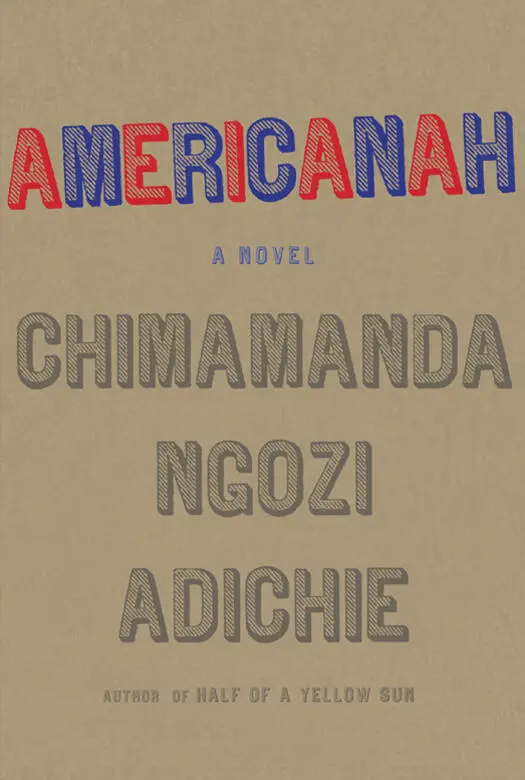
- Название:Americanah
- Автор:
- Издательство:Knopf
- Жанр:
- Год:2013
- ISBN:нет данных
- Рейтинг книги:4 / 5. Голосов: 1
-
Избранное:Добавить в избранное
- Отзывы:
-
Ваша оценка:
Americanah: краткое содержание, описание и аннотация
Предлагаем к чтению аннотацию, описание, краткое содержание или предисловие (зависит от того, что написал сам автор книги «Americanah»). Если вы не нашли необходимую информацию о книге — напишите в комментариях, мы постараемся отыскать её.
, a dazzling new novel: a story of love and race centered around a young man and woman from Nigeria who face difficult choices and challenges in the countries they come to call home.
As teenagers in a Lagos secondary school, Ifemelu and Obinze fall in love. Their Nigeria is under military dictatorship, and people are leaving the country if they can. Ifemelu — beautiful, self-assured — departs for America to study. She suffers defeats and triumphs, finds and loses relationships and friendships, all the while feeling the weight of something she never thought of back home: race. Obinze — the quiet, thoughtful son of a professor — had hoped to join her, but post-9/11 America will not let him in, and he plunges into a dangerous, undocumented life in London.
Years later, Obinze is a wealthy man in a newly democratic Nigeria, while Ifemelu has achieved success as a writer of an eye-opening blog about race in America. But when Ifemelu returns to Nigeria, and she and Obinze reignite their shared passion — for their homeland and for each other — they will face the toughest decisions of their lives.
Fearless, gripping, at once darkly funny and tender, spanning three continents and numerous lives,
is a richly told story set in today’s globalized world: Chimamanda Ngozi Adichie’s most powerful and astonishing novel yet.
Americanah — читать онлайн бесплатно полную книгу (весь текст) целиком
Ниже представлен текст книги, разбитый по страницам. Система сохранения места последней прочитанной страницы, позволяет с удобством читать онлайн бесплатно книгу «Americanah», без необходимости каждый раз заново искать на чём Вы остановились. Поставьте закладку, и сможете в любой момент перейти на страницу, на которой закончили чтение.
Интервал:
Закладка:
“Maybe,” his mother said, noncommittal, and shot an eyebrow-raise of accusation at Ifemelu, as though to say she knew very well who had turned her son into a pathetic race warrior. Ifemelu smiled a small, victorious smile.
And yet. Once, they visited his aunt, Claire, in Vermont, a woman who had an organic farm and walked around barefoot and talked about how connected to the earth it made her feel. Did Ifemelu have such an experience in Nigeria? she asked, and looked disappointed when Ifemelu said her mother would slap her if she ever stepped outside without shoes. Claire talked, throughout the visit, about her Kenyan safari, about Mandela’s grace, about her adoration for Harry Belafonte, and Ifemelu worried that she would lapse into Ebonics or Swahili. As they left her rambling house, Ifemelu said, “I bet she’s an interesting woman if she’d just be herself. I don’t need her to over-assure me that she likes black people.”
And Curt said it was not about race, it was just that his aunt was hyperaware of difference, any difference.
“She would have done the exact same thing if I had turned up with a blond Russian,” he said.
Of course his aunt would not have done the same thing with a blond Russian. A blond Russian was white, and his aunt would not feel the need to prove that she liked people who looked like the blond Russian. But Ifemelu did not tell Curt this because she wished it were obvious to him.
When they walked into a restaurant with linen-covered tables, and the host looked at them and asked Curt, “Table for one?” Curt hastily told her the host did not mean it “like that.” And she wanted to ask him, “How else could the host have meant it?” When the strawberry-haired owner of the bed-and-breakfast in Montreal refused to acknowledge her as they checked in, a steadfast refusal, smiling and looking only at Curt, she wanted to tell Curt how slighted she felt, worse because she was unsure whether the woman disliked black people or liked Curt. But she did not, because he would tell her she was overreacting or tired or both. There were, simply, times that he saw and times that he was unable to see. She knew that she should tell him these thoughts, that not telling him cast a shadow over them both. Still, she chose silence. Until the day they argued about her magazine. He had picked up a copy of Essence from the pile on her coffee table, on a rare morning that they spent in her apartment, the air still thick with the aroma of the omelets she had made.
“This magazine’s kind of racially skewed,” he said.
“What?”
“Come on. Only black women featured?”
“You’re serious,” she said.
He looked puzzled. “Yeah.”
“We’re going to the bookstore.”
“What?”
“I need to show you something. Don’t ask.”
“Okay,” he said, unsure what this new adventure was but eager, with that childlike delight of his, to participate.
She drove to the bookstore in the Inner Harbor, took down copies of the different women’s magazines from the display shelf, and led the way to the café.
“Do you want a latte?” he asked.
“Yes, thanks.”
After they settled down on the chairs, paper cups in front of them, she said, “Let’s start with the covers.” She spread the magazines on the table, some on top of the others. “Look, all of them are white women. This one is supposed to be Hispanic, we know this because they wrote two Spanish words here, but she looks exactly like this white woman, no difference in her skin tone and hair and features. Now, I’m going to flip through, page by page, and you tell me how many black women you see.”
“Babe, come on,” Curt said, amused, leaning back, paper cup to his lips.
“Just humor me,” she said.
And so he counted. “Three black women,” he said, finally. “Or maybe four. She could be black.”
“So three black women in maybe two thousand pages of women’s magazines, and all of them are biracial or racially ambiguous, so they could also be Indian or Puerto Rican or something. Not one of them is dark. Not one of them looks like me, so I can’t get clues for makeup from these magazines. Look, this article tells you to pinch your cheeks for color because all their readers are supposed to have cheeks you can pinch for color. This tells you about different hair products for everyone —and ‘everyone’ means blonds, brunettes, and redheads. I am none of those. And this tells you about the best conditioners — for straight, wavy, and curly. No kinky. See what they mean by curly? My hair could never do that. This tells you about matching your eye color and eye shadow — blue, green, and hazel eyes. But my eyes are black so I can’t know what shadow works for me. This says that this pink lipstick is universal, but they mean universal if you are white because I would look like a golliwog if I tried that shade of pink. Oh, look, here is some progress. An advertisement for foundation. There are seven different shades for white skin and one generic chocolate shade, but that is progress. Now, let’s talk about what is racially skewed. Do you see why a magazine like Essence even exists?”
“Okay, babe, okay, I didn’t mean for it to be such a big deal,” he said.
That evening, Ifemelu wrote a long e-mail to Wambui about the bookstore, the magazines, the things she didn’t tell Curt, things unsaid and unfinished. It was a long e-mail, digging, questioning, unearthing. Wambui replied to say, “This is so raw and true. More people should read this. You should start a blog.”
Blogs were new, unfamiliar to her. But telling Wambui what happened was not satisfying enough; she longed for other listeners, and she longed to hear the stories of others. How many other people chose silence? How many other people had become black in America? How many had felt as though their world was wrapped in gauze? She broke up with Curt a few weeks after that, and she signed on to WordPress, and her blog was born. She would later change the name, but at first she called it Raceteenth or Curious Observations by a Non-American Black on the Subject of Blackness in America . Her first post was a better-punctuated version of the e-mail she had sent to Wambui. She referred to Curt as “The Hot White Ex.” A few hours later, she checked her blog stats. Nine people had read it. Panicked, she took down the post. The next day, she put it up again, modified and edited, ending with words she still so easily remembered. She recited those words now, at the dinner table of the French and American couple, while the Haitian poet stared, arms folded.
The simplest solution to the problem of race in America? Romantic love. Not friendship. Not the kind of safe, shallow love where the objective is that both people remain comfortable. But real deep romantic love, the kind that twists you and wrings you out and makes you breathe through the nostrils of your beloved. And because that real deep romantic love is so rare, and because American society is set up to make it even rarer between American Black and American White, the problem of race in America will never be solved.
“Oh! What a wonderful story!” the French host said, her palm placed dramatically on her chest, looking around the table, as though to seek a response. But everyone else remained silent, their eyes averted and unsure.
A Michelle Obama Shout-Out Plus Hair as Race Metaphor
White Girlfriend and I are Michelle Obama groupies. So the other day I say to her — I wonder if Michelle Obama has a weave, her hair looks fuller today, and all that heat every day must damage it. And she says — you mean her hair doesn’t grow like that? So is it me or is that the perfect metaphor for race in America right there? Hair. Ever notice makeover shows on TV, how the black woman has natural hair (coarse, coily, kinky, or curly) in the ugly “before” picture, and in the pretty “after” picture, somebody’s taken a hot piece of metal and singed her hair straight? Some black women, AB and NAB, would rather run naked in the street than come out in public with their natural hair. Because, you see, it’s not professional, sophisticated, whatever, it’s just not damn normal. (Please, commenters, don’t tell me it’s the same as a white woman who doesn’t color her hair.) When you DO have natural Negro hair, people think you “did” something to your hair. Actually, the folk with the Afros and dreads are the ones who haven’t “done” anything to their hair. You should be asking Beyoncé what she’s done. (We all love Bey but how about she show us, just once, what her hair looks like when it grows from her scalp?) I have natural kinky hair. Worn in cornrows, Afros, braids. No, it’s not political. No, I am not an artist or poet or singer. Not an earth mother either. I just don’t want relaxers in my hair — there are enough sources of cancer in my life as it is. (By the way, can we ban Afro wigs at Halloween? Afro is not costume, for God’s sake.) Imagine if Michelle Obama got tired of all the heat and decided to go natural and appeared on TV with lots of woolly hair, or tight spirally curls. (There is no knowing what her texture will be. It is not unusual for a black woman to have three different textures on her head.) She would totally rock but poor Obama would certainly lose the independent vote, even the undecided Democrat vote.
Читать дальшеИнтервал:
Закладка:
Похожие книги на «Americanah»
Представляем Вашему вниманию похожие книги на «Americanah» списком для выбора. Мы отобрали схожую по названию и смыслу литературу в надежде предоставить читателям больше вариантов отыскать новые, интересные, ещё непрочитанные произведения.







Обсуждение, отзывы о книге «Americanah» и просто собственные мнения читателей. Оставьте ваши комментарии, напишите, что Вы думаете о произведении, его смысле или главных героях. Укажите что конкретно понравилось, а что нет, и почему Вы так считаете.