Chimamanda Adichie - Americanah
Здесь есть возможность читать онлайн «Chimamanda Adichie - Americanah» весь текст электронной книги совершенно бесплатно (целиком полную версию без сокращений). В некоторых случаях можно слушать аудио, скачать через торрент в формате fb2 и присутствует краткое содержание. Год выпуска: 2013, Издательство: Knopf, Жанр: Современная проза, на английском языке. Описание произведения, (предисловие) а так же отзывы посетителей доступны на портале библиотеки ЛибКат.
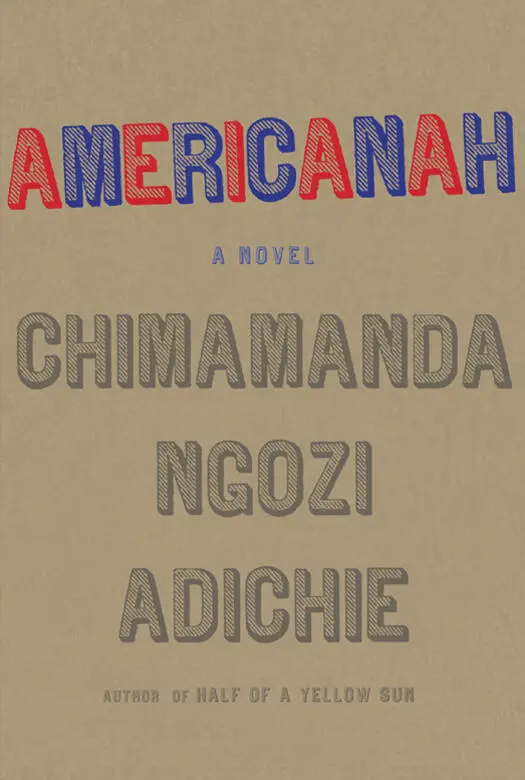
- Название:Americanah
- Автор:
- Издательство:Knopf
- Жанр:
- Год:2013
- ISBN:нет данных
- Рейтинг книги:4 / 5. Голосов: 1
-
Избранное:Добавить в избранное
- Отзывы:
-
Ваша оценка:
Americanah: краткое содержание, описание и аннотация
Предлагаем к чтению аннотацию, описание, краткое содержание или предисловие (зависит от того, что написал сам автор книги «Americanah»). Если вы не нашли необходимую информацию о книге — напишите в комментариях, мы постараемся отыскать её.
, a dazzling new novel: a story of love and race centered around a young man and woman from Nigeria who face difficult choices and challenges in the countries they come to call home.
As teenagers in a Lagos secondary school, Ifemelu and Obinze fall in love. Their Nigeria is under military dictatorship, and people are leaving the country if they can. Ifemelu — beautiful, self-assured — departs for America to study. She suffers defeats and triumphs, finds and loses relationships and friendships, all the while feeling the weight of something she never thought of back home: race. Obinze — the quiet, thoughtful son of a professor — had hoped to join her, but post-9/11 America will not let him in, and he plunges into a dangerous, undocumented life in London.
Years later, Obinze is a wealthy man in a newly democratic Nigeria, while Ifemelu has achieved success as a writer of an eye-opening blog about race in America. But when Ifemelu returns to Nigeria, and she and Obinze reignite their shared passion — for their homeland and for each other — they will face the toughest decisions of their lives.
Fearless, gripping, at once darkly funny and tender, spanning three continents and numerous lives,
is a richly told story set in today’s globalized world: Chimamanda Ngozi Adichie’s most powerful and astonishing novel yet.
Americanah — читать онлайн бесплатно полную книгу (весь текст) целиком
Ниже представлен текст книги, разбитый по страницам. Система сохранения места последней прочитанной страницы, позволяет с удобством читать онлайн бесплатно книгу «Americanah», без необходимости каждый раз заново искать на чём Вы остановились. Поставьте закладку, и сможете в любой момент перейти на страницу, на которой закончили чтение.
Интервал:
Закладка:
Comments came from people with similar stories and people saying she was wrong, from men asking her to put up a photo of herself, from black women sharing success stories of online dating, from people angry and from people thrilled. Some comments amused her, because they were wildly unconnected to the subject of the post. Oh fuck off , one wrote. Black people get everything easy. You can’t get anything in this country unless you’re black. Black women are even allowed to weigh more . Her recurring post “Mish Mash Friday,” a jumble of thoughts, drew the most clicks and comments each week. Sometimes she wrote some posts expecting ugly responses, her stomach tight with dread and excitement, but they would draw only tepid comments. Now that she was asked to speak at roundtables and panels, on public radio and community radio, always identified simply as The Blogger, she felt subsumed by her blog. She had become her blog. There were times, lying awake at night, when her growing discomforts crawled out from the crevices, and the blog’s many readers became, in her mind, a judgmental angry mob waiting for her, biding their time until they could attack her, unmask her.
Open Thread: For All the Zipped-Up Negroes
This is for the Zipped-Up Negroes, the upwardly mobile American and Non-American Blacks who don’t talk about Life Experiences That Have to Do Exclusively with Being Black. Because they want to keep everyone comfortable. Tell your story here. Unzip yourself. This is a safe space.
CHAPTER 34
Her blog brought Blaine back into her life. At the Blogging While Brown convention in Washington, D.C., during the meet-and-greet on the first day, the hotel foyer crowded with people saying hello to others in nervously overbright voices, she had been talking to a makeup blogger, a thin Mexican-American woman wearing neon eyeshadow, when she looked up and felt herself still and quake, because standing a few delicate feet from her, in a small circle of people, was Blaine. He was unchanged, except for the black-framed eyeglasses. Just as she remembered him on the train: tall and easy-limbed. The makeup blogger was talking about beauty companies always sending free stuff to Bellachicana , and the ethics of it, and Ifemelu was nodding, but was truly alert only to the presence of Blaine, and to him easing himself away from his circle, and moving towards her.
“Hi!” he said, peering at her name tag. “So you’re the Non-American Black? I love your blog.”
“Thank you,” she said. He didn’t remember her. But why should he? It had been so long since the meeting on the train, and neither of them knew then what the word “blog” meant. It would amuse him to know how much she had idealized him, how he had become a person made not of flesh but of little crystals of perfection, the American man she would never have. He turned to say hello to the makeup blogger and she saw, from his name tag, that he wrote a blog about the “intersection of academia and popular culture.”
He turned back to her. “So are your mall visits in Connecticut still going okay? Because I still grow my own cotton.”
For a moment, her breath stalled, and then she laughed, a dizzying, exhilarating laugh, because her life had become a charmed film in which people found each other again. “You remember!”
“I’ve been watching you from the other end of the room. I couldn’t believe it when I saw you.”
“Oh my God, what has it been, like ten years?”
“About that. Eight?”
“You never called me back,” she said.
“I was in a relationship. It was troubled even then, but it lasted much longer than it should have.” He paused, with an expression that she would come to know well, a virtuous narrowing of his eyes that announced the high-mindedness of their owner.
E-mails and phone calls between Baltimore and New Haven followed, playful comments posted on each other’s blogs, heavy flirting during late-night calls, until the day in winter when he came to her door, his hands sunk into the pockets of his tin-colored peacoat and his collar sprinkled with snow like magic dust. She was cooking coconut rice, her apartment thick with spices, a bottle of cheap merlot on her counter, and Nina Simone playing loudly on her CD. The song “Don’t Let Me Be Misunderstood” guided them, only minutes after he arrived, across the bridge from flirting friends to lovers on her bed. Afterwards, he propped himself up on his elbow to watch her. There was something fluid, almost epicene, about his lean body, and it made her remember that he had told her he did yoga. Perhaps he could stand on his head, twist himself into unlikely permutations. When she mixed the rice, now cold, in the coconut sauce, she told him that cooking bored her, and that she had bought all these spices only the day before, and had cooked because he was visiting. She had imagined them both with ginger on their lips, yellow curry licked off her body, bay leaves crushed beneath them, but instead they had been so responsible, kissing in the living room and then her leading him to her bedroom.
“We should have done things more improbably,” she said.
He laughed. “I like cooking, so there will be many opportunities for the improbable.” But she knew that he was not the sort of person to do things improbably. Not with his slipping on of the condom with such slow and clinical concentration. Later, when she came to know of the letters he wrote to Congress about Darfur, the teenagers he tutored at the high school on Dixwell, the shelter he volunteered at, she thought of him as a person who did not have a normal spine but had, instead, a firm reed of goodness.

IT WAS AS IF because of their train meeting years ago, they could bypass several steps, ignore several unknowns, and slide into an immediate intimacy. After his first visit, she went back to New Haven with him. There were weeks that winter, cold and sunny weeks, when New Haven seemed lit from within, frosted snow clinging on shrubs, a festive quality to a world that seemed inhabited fully only by her and Blaine. They would walk to the falafel place on Howe Street for hummus, and sit in a dark corner talking for hours, and finally emerge, tongues smarting with garlic. Or she would meet him at the library after his class, where they sat in the café, drinking chocolate that was too rich, eating croissants that were too grainily whole wheat, his clutch of books on the table. He cooked organic vegetables and grains whose names she could not pronounce — bulgur, quinoa — and he swiftly cleaned up as he cooked, a splatter of tomato sauce wiped up as soon as it appeared, a spill of water immediately dabbed at. He frightened her, telling her about the chemicals that were sprayed on crops, the chemicals fed to chickens to make them grow quickly, and the chemicals used to give fruits perfect skin. Why did she think people were dying of cancer? And so before she ate an apple, she scrubbed it at the sink, even though Blaine only bought organic fruit. He told her which grains had protein, which vegetables had carotene, which fruits were too sugary. He knew about everything; she was intimidated by this and proud of this and slightly repelled by this. Little domesticities with him, in his apartment on the twentieth floor of a high-rise near the campus, became gravid with meaning — the way he watched her moisturize with cocoa butter after an evening shower, the whooshing sound his dishwasher made when it started — and she imagined a crib in the bedroom, a baby inside it, and Blaine carefully blending organic fruits for the baby. He would be a perfect father, this man of careful disciplines.
Читать дальшеИнтервал:
Закладка:
Похожие книги на «Americanah»
Представляем Вашему вниманию похожие книги на «Americanah» списком для выбора. Мы отобрали схожую по названию и смыслу литературу в надежде предоставить читателям больше вариантов отыскать новые, интересные, ещё непрочитанные произведения.










Обсуждение, отзывы о книге «Americanah» и просто собственные мнения читателей. Оставьте ваши комментарии, напишите, что Вы думаете о произведении, его смысле или главных героях. Укажите что конкретно понравилось, а что нет, и почему Вы так считаете.