Chimamanda Adichie - Americanah
Здесь есть возможность читать онлайн «Chimamanda Adichie - Americanah» весь текст электронной книги совершенно бесплатно (целиком полную версию без сокращений). В некоторых случаях можно слушать аудио, скачать через торрент в формате fb2 и присутствует краткое содержание. Год выпуска: 2013, Издательство: Knopf, Жанр: Современная проза, на английском языке. Описание произведения, (предисловие) а так же отзывы посетителей доступны на портале библиотеки ЛибКат.
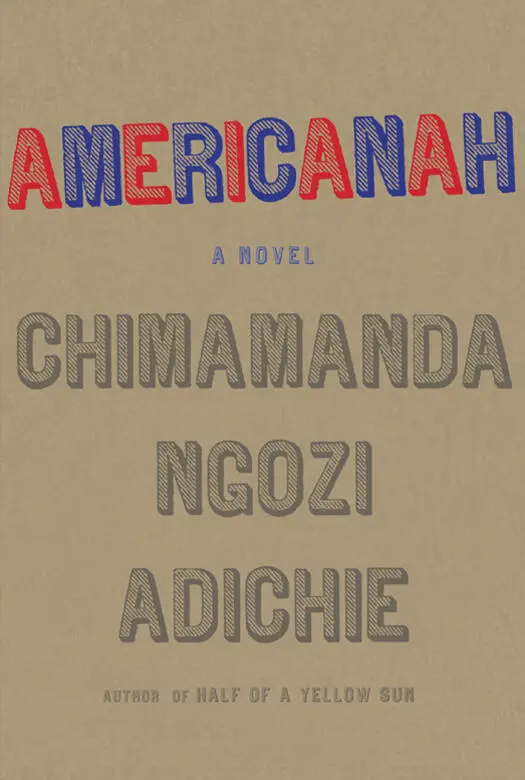
- Название:Americanah
- Автор:
- Издательство:Knopf
- Жанр:
- Год:2013
- ISBN:нет данных
- Рейтинг книги:4 / 5. Голосов: 1
-
Избранное:Добавить в избранное
- Отзывы:
-
Ваша оценка:
Americanah: краткое содержание, описание и аннотация
Предлагаем к чтению аннотацию, описание, краткое содержание или предисловие (зависит от того, что написал сам автор книги «Americanah»). Если вы не нашли необходимую информацию о книге — напишите в комментариях, мы постараемся отыскать её.
, a dazzling new novel: a story of love and race centered around a young man and woman from Nigeria who face difficult choices and challenges in the countries they come to call home.
As teenagers in a Lagos secondary school, Ifemelu and Obinze fall in love. Their Nigeria is under military dictatorship, and people are leaving the country if they can. Ifemelu — beautiful, self-assured — departs for America to study. She suffers defeats and triumphs, finds and loses relationships and friendships, all the while feeling the weight of something she never thought of back home: race. Obinze — the quiet, thoughtful son of a professor — had hoped to join her, but post-9/11 America will not let him in, and he plunges into a dangerous, undocumented life in London.
Years later, Obinze is a wealthy man in a newly democratic Nigeria, while Ifemelu has achieved success as a writer of an eye-opening blog about race in America. But when Ifemelu returns to Nigeria, and she and Obinze reignite their shared passion — for their homeland and for each other — they will face the toughest decisions of their lives.
Fearless, gripping, at once darkly funny and tender, spanning three continents and numerous lives,
is a richly told story set in today’s globalized world: Chimamanda Ngozi Adichie’s most powerful and astonishing novel yet.
Americanah — читать онлайн бесплатно полную книгу (весь текст) целиком
Ниже представлен текст книги, разбитый по страницам. Система сохранения места последней прочитанной страницы, позволяет с удобством читать онлайн бесплатно книгу «Americanah», без необходимости каждый раз заново искать на чём Вы остановились. Поставьте закладку, и сможете в любой момент перейти на страницу, на которой закончили чтение.
Интервал:
Закладка:
He was led into a room, bunk beds pushed forlornly against the walls. Three men were already there. One, from Djibouti, said little, lying and staring at the ceiling as though retracing the journey of how he had ended up at a holding facility in Manchester Airport. Two were Nigerian. The younger sat up on his bed eternally cracking his fingers. The older paced the small room and would not stop talking.
“Bros, how did they get you?” he asked Obinze, with an instant familiarity that Obinze resented. Something about him reminded Obinze of Vincent. Obinze shrugged and said nothing to him; there was no need for courtesies simply because they shared a cell.
“Is there anything I could have to read, please?” Obinze asked an immigration officer when she came to lead the man from Djibouti out to see a visitor.
“Read,” she repeated, eyebrows raised.
“Yes. A book or a magazine or a newspaper,” Obinze said.
“You want to read,” she said, and on her face, a contemptuous amusement. “Sorry. But we’ve got a TV room and you’re allowed to go there and watch telly after lunchtime.”
In the TV room, there was a group of men, many of them Nigerians, talking loudly. The other men sat around slumped into their own sorrows, listening to the Nigerians trade their stories, sometimes laughing, sometimes self-pitying.
“Ah this na my second time. The first time I come with different passport,” one of them said.
“Na for work wey they get me o.”
“E get one guy wey they deport, him don come back get him paper. Na him wey go help me,” another said.
Obinze envied them for what they were, men who casually changed names and passports, who would plan and come back and do it over again because they had nothing to lose. He didn’t have their savoir faire; he was soft, a boy who had grown up eating corn flakes and reading books, raised by a mother during a time when truth telling was not yet a luxury. He was ashamed to be with them, among them. They did not have his shame and even this, too, he envied.

IN DETENTION, he felt raw, skinned, the outer layers of himself stripped off. His mother’s voice on the phone was almost unfamiliar, a woman speaking a crisp Nigerian English, telling him, calmly, to be strong, that she would be in Lagos to receive him, and he remembered how, years ago, when General Buhari’s government stopped giving essential commodities, and she no longer came home with free tins of milk, she had begun to grind soybeans at home to make milk. She said soy milk was more nutritious than cow milk and although he refused to drink the grainy fluid in the morning, he watched her do so with an uncomplaining common sense. It was what she showed now, over the phone, telling him she would come and pick him up, as though she had always nursed the possibility of this, her son in detention, waiting to be removed from a country overseas.
He thought a lot about Ifemelu, imagining what she was doing, how her life had changed. She had once told him, in university, “You know what I admired most about you in secondary school? That you never had a problem saying ‘I don’t know.’ Other boys pretended to know what they didn’t know. But you just had this confidence and you could always admit that you didn’t know something.” He had thought it an unsual compliment, and had cherished this image of himself, perhaps because he knew it was not entirely true. He wondered what she would think if she knew where he was now. She would be sympathetic, he was sure, but would she also, in a small way, be disappointed? He almost asked Iloba to contact her. It would not be difficult to find her; he already knew she lived in Baltimore. But he did not ask Iloba. When Iloba visited him, he talked about lawyers. They both knew that there was no point, but still Iloba talked about lawyers. He would sit across from Obinze, rest his head on his hand, and talk about lawyers. Obinze wondered if some of the lawyers existed only in Iloba’s mind. “I know one lawyer in London, a Ghanaian, he represented this man with no papers, the man was almost on a plane home, and the next thing we knew, the man was free. He now works in IT.” Other times, Iloba took comfort in stating what was obvious. “If only the marriage was just done before they came,” he said. “You know if they had come even one second after you were pronounced man and wife, they would not touch you?” Obinze nodded. He knew, and Iloba knew that he knew. On Iloba’s last visit, after Obinze told him that he was being moved to Dover the next day, Iloba began to cry. “Zed, this was not supposed to happen like this.”
“Iloba, why are you talking rubbish? Stop crying, my friend,” Obinze said, pleased to be in a position to pretend strength.
And yet when Nicholas and Ojiugo visited, he disliked how strenuously they tried to be positive, to pretend, almost, as though he was merely ill in hospital and they had come to visit him. They sat across from him, the bare cold table between them, and talked about the mundane, Ojiugo speaking a little too quickly, and Nicholas saying more in an hour than Obinze had heard him say in weeks: Nne had been accepted into the National Children’s Orchestra, Nna had won yet another prize. They brought him money, novels, a bag of clothes. Nicholas had shopped for him, and most of the clothes were new and in his size. Ojiugo often asked, “But are they treating you well? Are they treating you well?” as though the treatment was what mattered, rather than the blighted reality of it all, that he was in a holding center, about to be deported. Nobody behaved normally. They were all under the spell of his misfortune.
“They are waiting for seats on a flight to Lagos,” Obinze said. “They’ll keep me in Dover until there’s a seat available.”
Obinze had read about Dover in a newspaper. A former prison. It felt surreal, to be driven past the electronic gates, the high walls, the wires. His cell was smaller, colder, than the cell in Manchester and his cellmate, another Nigerian, told him that he was not going to allow himself to be deported. He had a hardened, fleshless face. “I will take off my shirt and my shoes when they try to board me. I will seek asylum,” he told Obinze. “If you take off your shirt and your shoes, they will not board you.” He repeated this often, like a mantra. From time to time he farted loudly, wordlessly, and from time to time he sank to his knees in the middle of their tiny cell, hands raised up to the heavens, and prayed. “Father Lord, I praise your name! Nothing is too much for you! I bless your name!” His palms were deeply etched with lines. Obinze wondered what atrocities those hands had seen. He felt suffocated in that cell, let out only to exercise and to eat, food that brought to mind a bowl of boiled worms. He could not eat; he felt his body slackening, his flesh disappearing. By the day he was led into a van one early morning, a fuzz of hair, like carpet grass, had covered his entire jaw. It was not yet dawn. He was with two women and five men, all handcuffed, all bound for Nigeria, and they were marched, at Heathrow Airport, through security and immigration and onto the plane, while other passengers stared. They were seated at the very back, in the last row of seats, closest to the toilet. Obinze sat unmoving throughout the flight. He did not want his tray of food. “No, thank you,” he said to the flight attendant.
The woman next to him said eagerly, “Can I have his own?” She had been at Dover too. She had very dark lips and a buoyant, undefeated manner. She would, he was sure, get another passport with another name and try again.
As the plane began its descent into Lagos, a flight attendant stood above them and said loudly, “You cannot leave. An immigration officer will come to take charge of you.” Her face tight with disgust, as though they were all criminals bringing shame on upright Nigerians like her. The plane emptied out. Obinze looked through the window at an old jet standing in the mild late afternoon sun, until a uniformed man came walking down the aisle. His belly was large; it must have been a struggle to button up his shirt.
Читать дальшеИнтервал:
Закладка:
Похожие книги на «Americanah»
Представляем Вашему вниманию похожие книги на «Americanah» списком для выбора. Мы отобрали схожую по названию и смыслу литературу в надежде предоставить читателям больше вариантов отыскать новые, интересные, ещё непрочитанные произведения.








Обсуждение, отзывы о книге «Americanah» и просто собственные мнения читателей. Оставьте ваши комментарии, напишите, что Вы думаете о произведении, его смысле или главных героях. Укажите что конкретно понравилось, а что нет, и почему Вы так считаете.