Boualem Sansal - The German Mujahid
Здесь есть возможность читать онлайн «Boualem Sansal - The German Mujahid» весь текст электронной книги совершенно бесплатно (целиком полную версию без сокращений). В некоторых случаях можно слушать аудио, скачать через торрент в формате fb2 и присутствует краткое содержание. Год выпуска: 2009, Издательство: Europa Editions, Жанр: Современная проза, на английском языке. Описание произведения, (предисловие) а так же отзывы посетителей доступны на портале библиотеки ЛибКат.
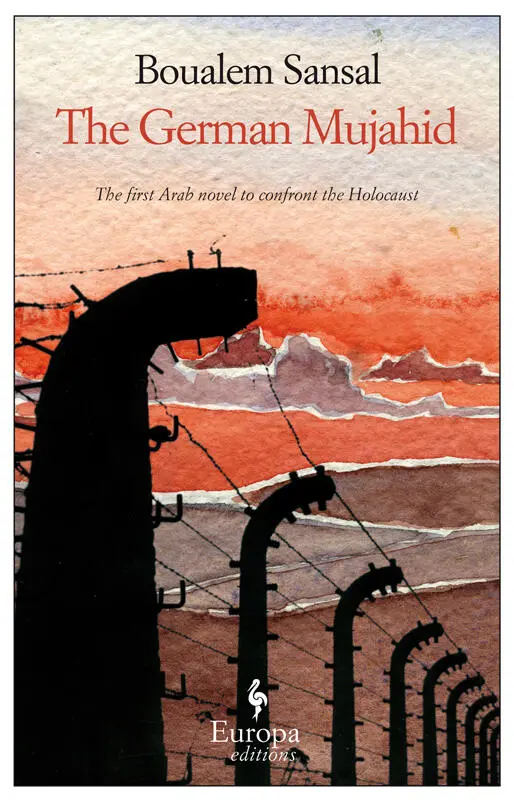
- Название:The German Mujahid
- Автор:
- Издательство:Europa Editions
- Жанр:
- Год:2009
- ISBN:нет данных
- Рейтинг книги:4 / 5. Голосов: 1
-
Избранное:Добавить в избранное
- Отзывы:
-
Ваша оценка:
The German Mujahid: краткое содержание, описание и аннотация
Предлагаем к чтению аннотацию, описание, краткое содержание или предисловие (зависит от того, что написал сам автор книги «The German Mujahid»). Если вы не нашли необходимую информацию о книге — напишите в комментариях, мы постараемся отыскать её.
is a heartfelt reflection on guilt and the harsh imperatives of history.
The two brothers Schiller, Rachel and Malrich, couldn't be more dissimilar. They were born in a small village in Algeria to a German father and an Algerian mother, and raised by an elderly uncle in one of the toughest ghettos in France. But there the similarities end. Rachel is a model immigrant — hard working, upstanding, law-abiding. Malrich has drifted. Increasingly alienated and angry, his future seems certain: incarceration at best. Then Islamic fundamentalists murder the young men's parents in Algeria and the event transforms the destinies of both brothers in unexpected ways. Rachel discovers the shocking truth about his family and buckles under the weight of the sins of his father, a former SS officer. Now Malrich, the outcast, will have to face that same awful truth alone.
Banned in the author's native Algeria for of the frankness with which it confronts several explosive themes, The German Mujahid is a truly groundbreaking novel. For the first time, an Arab author directly addresses the moral implications of the Shoah. But this richly plotted novel also leaves its author room enough to address other equally controversial issues; Islamic fundamentalism and Algeria's "dirty war" of the early 1990s, for example or the emergence of grim Muslim ghettos in France's low-income housing projects. In this gripping novel, Boualem Sansal confronts these and other explosive questions with unprecedented sincerity and courage.
The German Mujahid — читать онлайн бесплатно полную книгу (весь текст) целиком
Ниже представлен текст книги, разбитый по страницам. Система сохранения места последней прочитанной страницы, позволяет с удобством читать онлайн бесплатно книгу «The German Mujahid», без необходимости каждый раз заново искать на чём Вы остановились. Поставьте закладку, и сможете в любой момент перейти на страницу, на которой закончили чтение.
Интервал:
Закладка:
This is the nature of great tragedies, they hatch in the bowels of the earth, one day a small crack appears, at night you hear a rumbling and wonder whether it might be an earthquake, then just when you begin to think there may be hope, the world caves in and crumbles into rubble. An immense column of pain rises into the sky. Silence falls and with it a colossal emptiness. You are shocked, crushed, shattered, your dignity is torn from you and you slump into prostration, into autism, one step closer to the end. This is where I was now, in utter darkness, 9.0 on the Richter scale and, insofar as I was able to see in an abyss, I was alone. More alone than anyone in the world. In saner moments, I told myself that all this suffering stemmed from the fact that I was some strange dreamer, a fool in a world of recurring nightmares, clinging to the idea of a simple, graceful, everlasting life. But more often, like dear Adolph sitting in front of his poisonous schnapps, I thought nothing at all: dreams, life, harmony, simplicity were words that no longer meant anything to me. What right did I have to use such words knowing how my father had flouted them? I was in a strange position. Excruciatingly painful. Utterly devastating. I was inside the skin, inside the skeletal monotony of the concentration camp prisoner waiting for the end, and I was inside my father’s skin, jealous of his vocation which brought about that end. In me, these two extremes had come together for the worse. Like the jaws of a vise.
Ophélie’s lawyer came by. A pretty tubby little woman who seemed to have asthma. Or maybe she panted and wheezed to impress her clients and alarm the opposition. Her cheeks were perfectly pink, her breasts so white they could blind oncoming traffic. She gave me a fiercely professional smile and offhandedly asked me to sign some papers. I did as she asked, not bothering to read them and said to her, “You don’t have to give me the silent treatment, it’s only fair that everything goes to my future ex-wife. I would be grateful if you would intercede on my behalf, I’d like to stay in the house until I can find a place somewhere far away from here.” She promised she would, and gave me a sympathetic smile. On that note we went our separate ways, each happy with the outcome.
I must have done everything mechanically. I don’t remember anything. One morning, I found myself at Roissy Airport clutching a boarding pass for Frankfurt, carrying a small rucksack with a change of clothes, papa’s military service record and the big notebook I’ve been carrying around with me since. . since April 1994, or maybe a little later, since Aïn Deb, when the thing entered into me.
As I was going through security, I wondered, why Frankfurt? It was only once I was on the plane that I remembered. According to his military record, Hans Schiller studied Chemical Engineering at the Johann Wolfgang Goethe-Universität, in Frankfurt am Main. The rest I had deduced or discovered from my research. I read that it was in the laboratories of the industrial chemical group IG Farben, with the support of the Johann Wolfgang Goethe-Universität, under the direction of the sinister Nebe, head of Einsatzgruppe B, that they had developed Zyklon B, the poison used in the gas chambers. From the moment I found out, I couldn’t help but wonder whether papa, who had just finished his degree at the time, was somehow involved in the research and in the endless arguments that the proposal to gas camp prisoners had triggered among the dignitaries, the intellectuals and the bleeding hearts of the Third Reich. The problem they were fretting over was this: having decided to gas the Lebensunwertes Leben —Jews and other Minderwertige Leute , the mentally handicapped, the ill, the gypsies, the homosexuals — should the procedure be humane, or were the results all that mattered? The first approach, the humane solution, called for the use of odourless gas, or, better still, prussic acid, which has a sweet smell, something IG Farben produced in industrial quantities for agricultural and domestic purposes, for fumigating grain stores and for domestic rat poison. Those being gassed would feel nothing, would not know they were dying, at a certain point they would simply drop like flies and it would all be over. This would be the most humane way to kill them, eine der humansten Tötungsarten . Moreover, it would spare their killers much of the horror of the work. But it turned out that this method posed a serious risk to German soldiers and those who operated the gas chambers, the Sonderkommado —camp prisoners who were subjected to the torment of having to remove the bodies of their brothers and take them to the crematoria — since they might venture into the chambers after a batch of killings and be poisoned without realising it. Others — and these were the people who won the argument — were in favour of making the gas highly irritating by the addition of an odorant— warnstoff —which would alert them to any residual gas in the chambers or to any leaks when handling gas canisters. The choice, they maintained, was between the soldier and the prisoner, between the safety of the former and the comfort of the latter. The problem having been formulated in such a way that it led naturally, humanely, to favouring their own, they decided this would be the wisest course of action. Those being gassed would suffer terribly, but since the eventual intention was to kill them and burn their bodies, this minor inconvenience hardly mattered and was morally acceptable. To placate more sensitive souls, they decided on a ruse: those taken to the gas chambers would be told that they were going to shower, this way they would be happy and grateful. But this is the sort of ploy you can only use once. Word quickly spread in the camps, everyone knew everything. Eventually, this hollow promise was reserved for those newly arrived: the worthless, the old, the children, the pregnant women, the sick and the handicapped who would be only too happy to believe it.
I read that tests had been carried out on human subjects in Frankfurt and in one of the suburbs which no longer exists. Experiments were carried out on groups of five, groups of ten, on standardized groups — all men, all women and all children — and on mixed groups: families — father, mother, son, daughter, grandmother, even the maid if she was Jewish or a little soft in the head. The purpose of the experiments being to determine how much gas was needed in both cases to kill quickly and efficiently. Since lung capacity differed from one subject to another, it was possible to establish a correlation between the volume of air inhaled and the time taken before death ensued, taking into account natural disparities, such as the fact that though a baby inhales less air than an adult, being considerably weaker, it takes less gas to kill it. It’s the story of Galileo when, before an audience of stunned prelates, he demonstrated that, whether light or heavy, bodies free fall at an identical speed which is, therefore, independent of their mass. An adult is resilient but inhales considerably more air than a baby, but the baby is physically weaker. In the end, death comes to both at the same time. These experiments demonstrated that people could be gassed in groups without regard to sex, age or physical condition. Whether by bullet, by rope or by gas chamber, they died just the same. There was no need to separate prisoners into groups, something of an advantage in a mass extermination. The problem, however, remained a complex one with many variables — the stress levels of the subject, the dosage, the shape and size of the gas chambers, the skill of those operating them, etc. There were fears that, though life and death are abstract concepts, the supernatural and the religious might produce unwelcome thoughts in the minds of those operating the chambers, there was talk of the rabbi’s curse, of avenging ghosts, of strange miracles. A production-line process, they concluded, would put paid to such nonsense by giving each individual worker the impression that he was performing only the most innocuous task in the extermination process. Just as in a firing squad, every soldier is free to believe that he fired the blank. A production-line approach was applied to every stage of the process, from the rounding up of the Jews, through their arrest and transportation, to the burning of the bodies in the camps. The link does not know it is part of the chain. We are not all equal in the face of death, a breeze may be enough to kill one man, while another, no bigger, no stronger, no more intelligent, may survive an earthquake. It falls to the Machine to equalize our relationship with death. A means therefore had to be found to take into account the principal variables. Calculating devices were created to make the process easier for a workforce that was not especially bright. By turning a dial to the number of people packed into the chamber, and moving a slider to the volume of the chamber in cubic metres, it was possible to read off the quantity of Zyklon B necessary; this quantity was further refined by setting one slider to the temperature of the chamber and another to the initial figure for the quantity of Zyklon B. In warm weather, say 25 °C, death could be guaranteed for 95 percent of the subjects in a thirty-minute period. In cold weather, however — below 5 °C — the mass of air is stationary, gas disperses poorly and productivity is negatively affected, making it necessary to repeat the procedure or increase the quantity of Zyklon B, either of which represented a waste of the Reich’s time and money. A loss of ten minutes and three Reichsmarks per subject may seem insignificant, but with some ten million subjects marked out for death, the shortfall would amount to 100 million minutes and 30 million Reichsmarks , an unacceptable folly for a country already involved in an otherwise profitable world war.
Читать дальшеИнтервал:
Закладка:
Похожие книги на «The German Mujahid»
Представляем Вашему вниманию похожие книги на «The German Mujahid» списком для выбора. Мы отобрали схожую по названию и смыслу литературу в надежде предоставить читателям больше вариантов отыскать новые, интересные, ещё непрочитанные произведения.







Обсуждение, отзывы о книге «The German Mujahid» и просто собственные мнения читателей. Оставьте ваши комментарии, напишите, что Вы думаете о произведении, его смысле или главных героях. Укажите что конкретно понравилось, а что нет, и почему Вы так считаете.