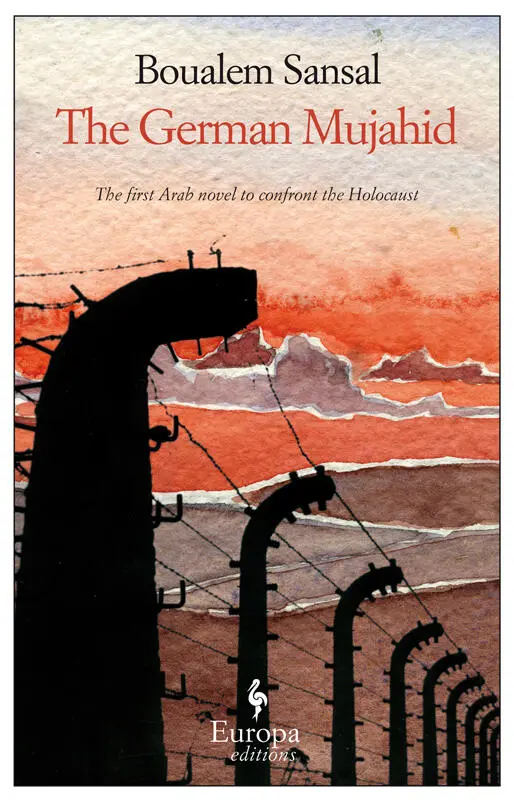
Boualem Sansal - The German Mujahid
Здесь есть возможность читать онлайн «Boualem Sansal - The German Mujahid» весь текст электронной книги совершенно бесплатно (целиком полную версию без сокращений). В некоторых случаях можно слушать аудио, скачать через торрент в формате fb2 и присутствует краткое содержание. Год выпуска: 2009, Издательство: Europa Editions, Жанр: Современная проза, на английском языке. Описание произведения, (предисловие) а так же отзывы посетителей доступны на портале библиотеки ЛибКат.
- Название:The German Mujahid
- Автор:
- Издательство:Europa Editions
- Жанр:
- Год:2009
- ISBN:нет данных
- Рейтинг книги:4 / 5. Голосов: 1
-
Избранное:Добавить в избранное
- Отзывы:
-
Ваша оценка:
The German Mujahid: краткое содержание, описание и аннотация
Предлагаем к чтению аннотацию, описание, краткое содержание или предисловие (зависит от того, что написал сам автор книги «The German Mujahid»). Если вы не нашли необходимую информацию о книге — напишите в комментариях, мы постараемся отыскать её.
is a heartfelt reflection on guilt and the harsh imperatives of history.
The two brothers Schiller, Rachel and Malrich, couldn't be more dissimilar. They were born in a small village in Algeria to a German father and an Algerian mother, and raised by an elderly uncle in one of the toughest ghettos in France. But there the similarities end. Rachel is a model immigrant — hard working, upstanding, law-abiding. Malrich has drifted. Increasingly alienated and angry, his future seems certain: incarceration at best. Then Islamic fundamentalists murder the young men's parents in Algeria and the event transforms the destinies of both brothers in unexpected ways. Rachel discovers the shocking truth about his family and buckles under the weight of the sins of his father, a former SS officer. Now Malrich, the outcast, will have to face that same awful truth alone.
Banned in the author's native Algeria for of the frankness with which it confronts several explosive themes, The German Mujahid is a truly groundbreaking novel. For the first time, an Arab author directly addresses the moral implications of the Shoah. But this richly plotted novel also leaves its author room enough to address other equally controversial issues; Islamic fundamentalism and Algeria's "dirty war" of the early 1990s, for example or the emergence of grim Muslim ghettos in France's low-income housing projects. In this gripping novel, Boualem Sansal confronts these and other explosive questions with unprecedented sincerity and courage.
The German Mujahid — читать онлайн бесплатно полную книгу (весь текст) целиком
Ниже представлен текст книги, разбитый по страницам. Система сохранения места последней прочитанной страницы, позволяет с удобством читать онлайн бесплатно книгу «The German Mujahid», без необходимости каждый раз заново искать на чём Вы остановились. Поставьте закладку, и сможете в любой момент перейти на страницу, на которой закончили чтение.
Интервал:
Закладка:
I don’t know why, but I thought about that Jewish joke: Moishe is lying on his bed kvetching, tossing and turning like a devil in a baptismal font. It’s after midnight and he has promised to pay back the money he owes his friend Jacob by noon. Moishe hasn’t got any money. He imagines himself disgraced, thrown out of the merchants association, vilified by the rabbi. His tossing and turning wakes his wife and she asks, “Moishe, what is it?” “I owe Jacob twenty roubles,” he tells her, “but I have no money. What shall I do?” “Is that all?” his wife says then gets up and bangs on the wall and shouts for all the neighbours to hear, “Jacob! My Moishe still owes you twenty roubles? Well, he isn’t giving them back!” then climbs back into bed and says to her flabbergasted husband, “Now go to sleep, let Jacob stay awake!”
The rest of the journey passed without incident. I picked up the newspaper and caught up on what was happening in the world: everywhere, with giant steps, war was gaining ground.
MALRICH’S DIARY, 31 OCTOBER 1996
I don’t understand Rachel. He really pisses me off. He talks like papa was a murderer or something, he bangs on about it, it’s insane. So what if Papa was in the SS? So what if he was posted to extermination camps? There’s no proof that he actually killed anyone. He guarded prisoners, that’s all. Not even that, they had the Kapos to do that — German convicts and deserters, Rachel says himself they were dogs, they’re the ones who guarded the prisoners, who beat and robbed and raped them, forced them to work, clubbed them to death and dragged them feet first, tossing them into the furnaces. Papa was a chemical engineer, not an executioner. He worked in some laboratory way outside the camp, he oversaw the preparation of chemicals, that’s all. He didn’t know what people were planning to do with them, how could he know? The gas chambers were run by the Sonderkommando , the death squads, the Einsatzgruppen , not the laboratory. Papa’s responsibility ended at the point of delivery. The trucks showed up, picked up the canisters, the paperwork was signed and the drivers drove off to God knows where. How could Rachel, who was so impressed by the way the Germans organised things, possibly think that the Bonzen would have had a scientist like papa working as a common killer, stoking furnaces, fuelling gas chambers, locking doors, turning levers, watching dials? Rachel and me are Hälfte-Deutsch , he knew as well as I do Germans are sticklers for regulations.
That’s what Papa was like, you didn’t joke around with him except when it was time for joking around. Rachel lost it, he forgot everything we learned. He was angry and upset and he let his imagination run away with him. He was sick to his stomach like I am whenever I think about us, about the Islamists slitting our parents’ throats in their sleep, about our godforsaken rathole of an estate, the people living there constantly harangued by the imam, surrounded by jihadists in djellebas and black jackets, with Kapos snapping at them like pitbulls, when I think about uncle Ali wasting away like a prisoner in a concentration camp and aunt Sakina who just waits, never surprised at anything, when I think about poor Nadia burned to death by the Emir. I think about my father. How did you get mixed up in this shit, papa? Did you know what was happening? You had to know something. In the camp, everyone eats together, the officers all in the officers’ mess, you talk about work, about the things that go wrong, brag about the stuff you’ve got done. Then there’s the meetings, you listen to the Führer’s speeches, read the official communiqués from Himmler himself, you talk deadlines, figures, technical problems, you bawl out the slackers, praise the high achievers, get this week’s orders. And there are the loudspeakers, those awful megaphones hanging over the prisoners’ heads, tormenting them, driving them insane, the unemotional voice drowning out the howling wind, forever ordering them to assemble, to submit, to surrender, spelling out the horror line by line, verse by verse, transforming a monstrous crime into the simple implementation of a policy. And in the evenings, after dinner and the obligatory toast to the Führer, everyone sits around the stove, relaxing, listening to music, playing cards, drinking, daydreaming, thinking about their families, talking about hunting trips and fishing trips with friends, about the battles being fought elsewhere. Eventually, they get round to talking about the camp, the stories, the jokes, the racketeering, the gossip, the horrible diseases, the pitiful scams, the prisoners who arrived that morning welcomed with full military fanfare, still clinging to hope, to their dignity, to their battered suitcases, apprehensive but not scared, still believing in God, in reason, in the impossibility of the incredible. Everything is fine, they’re thinking, as they line up outside the camp. They cling to the idea — as old as the world — that submissiveness will save them, will make their masters think well of them; the Bonzen look so powerful, so impressive that it’s impossible to imagine they could lack nobility, compassion. The sight of the pristine camp, the disciplined Kapos running it, reassures them, persuades them that death is not the certainty some pessimists predicted during the long, agonising journey in the cattle trucks, it is merely a possibility that can be evaded with a little luck, a little cunning, if they swallow their pride. The worst is over, they have been quickly separated into groups: men, women and babies, children, the old and the crippled, the beautiful girls like Nadia. They will not hold out for long. In a little while or maybe tomorrow at dawn, after disinfection, the worthless, the Lebensunwertes Leben , will be sent to the gas chambers. The able-bodied will be assigned to the Arbeitkommandos and the Strafarbeitkommandos , the brothels for the Kapos and I don’t know what else. The camp is just like our estate — everyone knows what’s going on, what people are doing, what they’re thinking, what they’re hiding. People gossip, they watch each other, they get together for parties, funerals, marches on the town hall, campaigns to clean up the stairwells, patrol the car parks. We all know who the Islamists are and what they’re planning, and we know the people who aren’t and what they’re afraid of. We know everything there is to know about each other. And at the same time we don’t know anything, we’re strangers, we think we know each other but we’re all living inside our own heads, we know what we think, but other people’s thoughts are vague or hearsay. On the estate, just like in the camps, people speak fifteen different languages and at least as many dialects, we can’t possibly understand all of them. We fake it, we mumble. Besides, we’ve got nothing to talk about except the weather, we say the same things we said yesterday, the same shit we’ll say anther thirty times by the end of the month. The people who live on the estate know where Paris is and the people who live in Paris know that the estate is somewhere in the suburbs — but what do we really know about each other? Nothing. We’re just shadows and rumours. Between us there’s a wall, barbed wire, watchtowers and minefields, fundamental prejudices, unimaginable realities. In the end, papa knew and didn’t know, that’s the truth of it. Rachel was my brother but I knew nothing about him and his diary is like a shield that stops me seeing him. Poor Rachel, who are you? Who was papa? Who am I? I get so fucking angry I want to scream, to cry. I’m trapped, the whole world disgusts me, I disgust myself. I’m losing my mind just like Rachel did. I hardly set foot outside the house anymore, I spend all day reading and rereading his diary, his books, or slumped in front of the TV, I go round and round in circles, cramps in my stomach. At night I go out and I walk and walk as far as I can. Alone. More alone than anyone in the world. Like Rachel. Like poor Rachel.
Читать дальшеИнтервал:
Закладка:
Похожие книги на «The German Mujahid»
Представляем Вашему вниманию похожие книги на «The German Mujahid» списком для выбора. Мы отобрали схожую по названию и смыслу литературу в надежде предоставить читателям больше вариантов отыскать новые, интересные, ещё непрочитанные произведения.





Обсуждение, отзывы о книге «The German Mujahid» и просто собственные мнения читателей. Оставьте ваши комментарии, напишите, что Вы думаете о произведении, его смысле или главных героях. Укажите что конкретно понравилось, а что нет, и почему Вы так считаете.