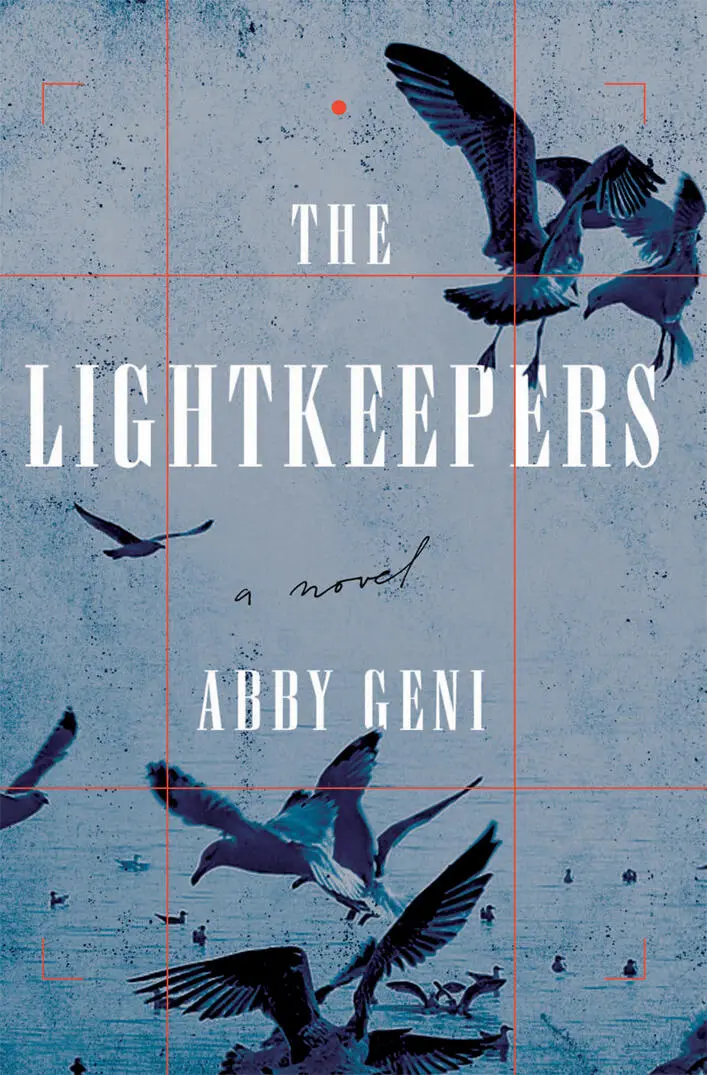
Abby Geni - The Lightkeepers
Здесь есть возможность читать онлайн «Abby Geni - The Lightkeepers» весь текст электронной книги совершенно бесплатно (целиком полную версию без сокращений). В некоторых случаях можно слушать аудио, скачать через торрент в формате fb2 и присутствует краткое содержание. Год выпуска: 2015, ISBN: 2015, Издательство: Counterpoint, Жанр: Современная проза, на английском языке. Описание произведения, (предисловие) а так же отзывы посетителей доступны на портале библиотеки ЛибКат.
- Название:The Lightkeepers
- Автор:
- Издательство:Counterpoint
- Жанр:
- Год:2015
- ISBN:9781619027497
- Рейтинг книги:4 / 5. Голосов: 1
-
Избранное:Добавить в избранное
- Отзывы:
-
Ваша оценка:
The Lightkeepers: краткое содержание, описание и аннотация
Предлагаем к чтению аннотацию, описание, краткое содержание или предисловие (зависит от того, что написал сам автор книги «The Lightkeepers»). Если вы не нашли необходимую информацию о книге — напишите в комментариях, мы постараемся отыскать её.
, we follow Miranda, a nature photographer who travels to the Farallon Islands, an exotic and dangerous archipelago off the coast of California, for a one-year residency capturing the landscape. Her only companions are the scientists studying there, odd and quirky refugees from the mainland living in rustic conditions; they document the fish populations around the island, the bold trio of sharks called the Sisters that hunt the surrounding waters, and the overwhelming bird population who, at times, create the need to wear hard hats as protection from their attacks.
Shortly after her arrival, Miranda is assaulted by one of the inhabitants of the islands. A few days later, her assailant is found dead, perhaps the result of an accident. As the novel unfolds, Miranda gives witness to the natural wonders of this special place as she grapples with what has happened to her and deepens her connection (and her suspicions) to her companions, while falling under the thrall of the legends of the place nicknamed “the Islands of the Dead.” And when more violence occurs, each member of this strange community falls under suspicion.
The Lightkeepers
The Lightkeepers — читать онлайн бесплатно полную книгу (весь текст) целиком
Ниже представлен текст книги, разбитый по страницам. Система сохранения места последней прочитанной страницы, позволяет с удобством читать онлайн бесплатно книгу «The Lightkeepers», без необходимости каждый раз заново искать на чём Вы остановились. Поставьте закладку, и сможете в любой момент перейти на страницу, на которой закончили чтение.
Интервал:
Закладка:
My belly button was in an odd condition. It seemed to be transforming from an innie to an outie, currently mid-reversal, like a shirt tangled in the drier. I palpated that nubble of flesh. I stepped closer to the mirror. The pigmentation of my whole body had begun to alter. My face was ferociously freckled now, my cheeks so crowded with maculae that I looked almost tanned. My nipples had darkened to the color of wood. Beneath my navel a brown line had appeared, tracing a path down to my pubic hair, bisecting the lower half of my abdomen. A term from a long-ago health class popped into my brain: linea negra. A classic indicator of pregnancy.
Trembling with shock and cold, I got dressed again.
Please help me. Just this once, Mom, help me. What am I going to do?
30
THERE IS A photograph of you that I used to keep on my night table. Framed against a sunlit prairie, you wore a red dress. Your limbs were lanky. Your hair was swept up in a messy bun. You looked as though you were about to smile — your eyes amused, your mouth pursed like a butterfly with its wings folded.
You were four months pregnant in the photo, though a casual observer might not have noticed this. In the snapshot, your sun-dress both concealed and enhanced the swell of your belly. The fabric worked like an optical illusion. It was the kind of garment that many women favor in the second trimester, the kind that makes everyone look a little bit pregnant, the kind that leaves strangers guessing.
As a child, I loved this picture for many reasons. Your expression, your elegant arms, the backdrop of greenery. But my favorite thing was the fact that it seemed to be an image of one person, yet was actually an image of three. My father had taken the snapshot. You and I were captured there through his eyes.
THE SEASONS HAVE begun to change. It is April, and the days are markedly longer, the sun lingering in the west every evening like the last guest at a party. There is a new perfume on the breeze. Galen has taken to throwing open the windows, letting in a wash of sweet wind. The chill does not bother him — and indeed, it does not bother me. I could bathe in that salty air. Lucy has been afflicted by spring fever, vacuuming the curtains and emptying the cupboards so she can scrub into the corners. She has been moving systematically through the house, wiping mold from the grout, batting cobwebs from the ceiling. (She seems to feel the need to clean wherever I happen to be. If I’m on the couch, she wants to beat the dust out of the cushions. If I’m in my bedroom, she wants to get in there and wash the windows, since she’s doing the whole upper floor.) The animals are changing too. The gray whales are migrating on. The elephant seals are nearing the end of their time here. Soon it will be Bird Season.
In Washington, D.C., the long, gentle spring has begun, I am sure. It has always been my favorite time of year there, the weather opening like a flower, petal by petal. Every day will be a degree or two warmer. The crocuses push up through the soil and burn like sparklers in the grass. Robins carol wildly in the mornings. The trees are studded with buds strewn across the wood like Christmas lights — and then, all at once, the leaves will open. One day the branches are bare, and the next they will be coated with raw green, as fine as tissue paper. The cherry blossoms, too, will begin to flourish, and this, in turn, will attract the seasonal migration of Japanese tourists, who will flood the streets for weeks at a time, reading their maps upside down and photographing oddities like squirrels and vandalism.
The spring brings out a puckish side of my father. After accomplishing the usual reorganization of his closets — sweaters and boots stowed away — he will make a few subtle changes to his appearance. He might start wearing silk ties to work, rather than the heavy woolen things he associates with cold weather. He might shave off his winter beard and let the full glory of his pink chin shine.
Recently I sent him a long-overdue postcard. SPRING, I wrote, in fat capital letters. That was all.
By my reckoning, I am five months pregnant. The past few weeks have been odd, to say the least. I have kept one hand planted on my belly at all times, tucked under the swing of my sweatshirt, verifying the reality of my situation. I have floated through the cabin in a daze, attending to no one and nothing around me. I have not taken a single photograph — except in dreams. I have left my cameras under my bed. I have climbed Lighthouse Hill, standing in the wet wind, staring toward California. I have found myself on the coast, looking for my lost-and-found seal pup. But I have been unable to distinguish between the dozens of little bodies lolling in the sunlight. The female elephant seals are gone. The males are nowhere to be found. The babies, abandoned, huddle together, gathering courage for the new life ahead.
Eventually I will tell someone. Maybe my father. Maybe Mick. None of the biologists are aware of my circumstances, I am certain. The men are oblivious by nature, and Lucy does not pay enough attention to me to have noticed a change; I am simply an obstruction in the path of her mop. For now, I intend to ponder the matter on my own. I will let my opinions arrange themselves with each shift of mood, dancing, falling, and resettling, like the beads in a kaleidoscope.
I often find myself holding still, head bowed, trying to sense the life inside. My stomach is warm. My womb is heavy, grounding me to earth. I feel as though I am coming back to myself. Not Melissa. Not Mel. Not mouse girl. Not the image on the camera screen. Not the woman in the mirror.
ON A CLOUDY morning, I made a decision. The biologists were out on Seal Watch. I saw them go, four figures marching down Marine Terrace, heading for the water. The sky looked as though it had been ironed improperly, a length of cloth rumpled here and there by bunches of crinkled gray. Galen was carrying a carton of gear. Mick was giving instructions with big gestures. Forest and Lucy had their heads close, as though sharing secrets. As soon as they were out of sight, I got to work.
I had not decided what to do about the baby. I had not decided whether to keep it. I had not made up my mind about adoption, termination, suicide, feticide. I was not sure if I had bonded with the fetus. I could not tell whether the glow in my chest came from panic or love or shock or heartburn. I had not decided whether to call Captain Joe to come fetch me. I had not settled the question of whether to summon a helicopter. I had not fully accepted that I was not dreaming, or altered beyond redemption, or trapped in the perspective of someone I could not trust. I had not decided whether to throw myself into the sea. I had not decided much of anything.
But I had made up my mind about Lucy’s pet.
In the kitchen, I found a plastic bucket. I filled this with tap water and carried it to the coffee table, setting it beside Oliver’s tank. Then I rummaged through the fridge until I found the crabmeat. As usual, the octopus was in stealth mode, nowhere to be seen. But I knew the drill. I tapped three times on the lid. I had often seen Lucy do this, signaling to the octopus that it was time to eat. At once a bubble of tawny skin erupted from the pebbled floor. Oliver’s arms were in motion, writhing and whirling, propelling him upward. His eyes poked out on stalks. I saw the horizontal bar of each pupil, the yellow iris. At this point, Lucy would usually open the small trap door and drop the crabmeat through the aperture.
I, however, removed the entire lid of the tank. For the first time, Oliver and I looked at each other face-to-face, with no screen or pane of glass between us. He turned an angry crimson. He was unsettled. No one had ever taken the lid off his cage before. Octopuses were too clever, too determined to escape; it wouldn’t be safe to leave the tank open, even briefly. I dropped the crabmeat with a splash. Oliver grabbed for it absentmindedly, his yellow eyes still fixed on me.
Читать дальшеИнтервал:
Закладка:
Похожие книги на «The Lightkeepers»
Представляем Вашему вниманию похожие книги на «The Lightkeepers» списком для выбора. Мы отобрали схожую по названию и смыслу литературу в надежде предоставить читателям больше вариантов отыскать новые, интересные, ещё непрочитанные произведения.












Обсуждение, отзывы о книге «The Lightkeepers» и просто собственные мнения читателей. Оставьте ваши комментарии, напишите, что Вы думаете о произведении, его смысле или главных героях. Укажите что конкретно понравилось, а что нет, и почему Вы так считаете.