T. Boyle - Water Music
Здесь есть возможность читать онлайн «T. Boyle - Water Music» весь текст электронной книги совершенно бесплатно (целиком полную версию без сокращений). В некоторых случаях можно слушать аудио, скачать через торрент в формате fb2 и присутствует краткое содержание. Год выпуска: 1983, ISBN: 1983, Издательство: Granta Books, Жанр: Современная проза, на английском языке. Описание произведения, (предисловие) а так же отзывы посетителей доступны на портале библиотеки ЛибКат.
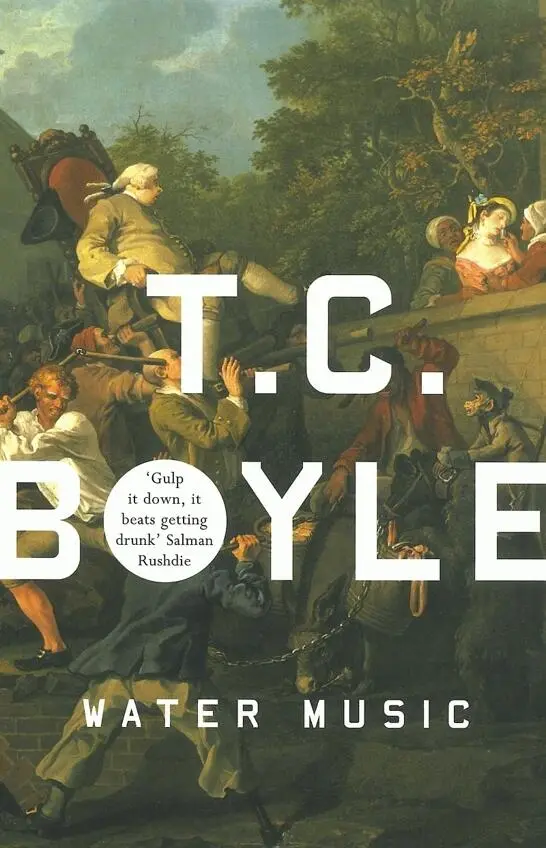
- Название:Water Music
- Автор:
- Издательство:Granta Books
- Жанр:
- Год:1983
- ISBN:9781862071551
- Рейтинг книги:3 / 5. Голосов: 1
-
Избранное:Добавить в избранное
- Отзывы:
-
Ваша оценка:
Water Music: краткое содержание, описание и аннотация
Предлагаем к чтению аннотацию, описание, краткое содержание или предисловие (зависит от того, что написал сам автор книги «Water Music»). Если вы не нашли необходимую информацию о книге — напишите в комментариях, мы постараемся отыскать её.
Water Music — читать онлайн бесплатно полную книгу (весь текст) целиком
Ниже представлен текст книги, разбитый по страницам. Система сохранения места последней прочитанной страницы, позволяет с удобством читать онлайн бесплатно книгу «Water Music», без необходимости каждый раз заново искать на чём Вы остановились. Поставьте закладку, и сможете в любой момент перейти на страницу, на которой закончили чтение.
Интервал:
Закладка:
The explorer rises, dusting at his clothes. He adjusts his tattered collar, fingercombs his beard and slicks back his eyebrows with spittle. But then he realizes that no one is paying the slightest bit of attention to him — all eyes are fixed on a new cynosure: the presents. The servant is hunched over them now, reverentially handing piece by precious piece to the masked man for his examination. First the silver salver. Then the table service for ten, a pair of ivory cufflinks. An umbrella. Ten plugs of tobacco and a jar of orange marmalade. A dozen inkwells, a corset, a wig. And finally, the pièce de résistance: a miniature of King George.
So taken is the presumptive monarch by the glitter and novelty of these gifts that he lets his defenses down: in a single fluid motion he slips the mask up over his head in order to enjoy a better perspective of them. The explorer is stunned. He’d expected a monster, but this fellow, with his quick sharp eyes and sleek little bulb of a head, is more like a ferret, a chicken thief, a sneaky skulking thing of tall grass and shadows. As the little man gingerly bites down on the silver salver, Mungo can’t help wondering about Eboe’s description of Mansong as a brute of a man with chins and bellies and a head like a melon. Could this fellow be an imposter?
It is then that the explorer becomes aware of the traffic between the throne and the screen in the corner. The original servant, abetted now by a smaller, shrunken, and if possible even more tentative colleague, is scurrying between throne and screen with the treasures. For the explorer, it is an epiphany. “Johnson,” he whispers. “You see that screen back there?”
“Shhhh.” Johnson looks edgy. “Don’t pay it no mind,” he hisses. “And whatever you do, don’t stare at it. Don’t even glance at it. That screen don’t exist. Get me?”
At that moment the second servant, a youngish man with a face as puckered and wrinkled as the foreleg of an iguana, sidles up to the explorer. Clenched in his hand, the umbrella. Shrinking back, he holds it out to Mungo at arm’s length. Then says something in Mandingo that sounds like “rub-a-dub-dub.” Mungo stares at him, blank.
“They want you to open the thing up for them,” Johnson prompts.
The umbrella is pink and nacreous, like the stuff of ladies’ underwear. An artist has rendered the Tower of London, in red and black, across the top. The explorer releases the catch, and unfurls the parasol with a flourish. This, he realizes too late, is a mistake. At the first rustle of silk, the servant backs off with a gasp; when the umbrella bursts into flower, pandemonium erupts. The guards drop their spears and bolt for the exit, the presumptive monarch grabs frantically for the mask and the white dog lunges for the explorer, while perhaps worst of all, there is a stricken cry from the corner as the screen topples with a rush of air. Behind the screen, now exposed for all to see, is a titanic bull of a man seated in the lotus position, his stomach like a medicine ball, broad skull bowed as he scribbles furiously in the dirt. Though the explorer has no way of realizing it, the big man’s scribbling represents the frantic geometry of voodoo — vectors and tangents, catenaries and triangles — charms to ward off evil. The potentate is terrified.
In the confusion, the explorer collapses the umbrella, more as a means of defending himself from the dog than as a gesture of conciliation. The effect is immediate and tranquilizing: the guards pause, elbow one another, grin sheepishly; the imposter calls off the dog with a single harsh command; the servants hurriedly reerect the fallen screen. Johnson has all the while been chattering away in Mandingo, too fast for the explorer’s grasp, but in a tone that seems reassuring, jocular even. Now he puts together a string of six or seven phrases, the whole thing timed as if leading up to a punchline. He breaks off with a hearty laugh, then nudges the explorer. “Heh-heh,” Mungo says.
The imposter, mask in hand, ducks his head twice and shows his teeth in a weird, strained facial expression partway between grimace and grin. He looks as if he’s just been punched in the bladder after watching a hundred fat women slip on banana peels. After donning the mask once again, he commands the servant to bring him the parasol. The servant handles it as if it were a sleeping cobra.
Five minutes later, the masked man is busily engaged in dipping his finger into the marmalade and emitting short cries of epicurean delight as he licks the goo from his fingertip, while from behind the screen can be heard the soft rustle of silk. From time to time the pink flash of the parasol shows itself coquettishly over the top of the screen. The dog is asleep, its muzzle buried in the portrait of King George, as if in olfactory contemplation of that great and distant monarch.
Finally, after a lengthy conference with the man behind the screen, the imposter steps forward and begins a rambling acceptance speech. The voice emanating from behind the mask is crisp and animated, but for all that the explorer finds the dialect difficult to follow. At first he makes a concerted effort at interpretation, pinning the words down one by one, translating them in his head, coming to understand that his homage has been accepted by the gracious and puissant Mansong, Mansa of Waboo, M’butta-butta, Wonda, and about two hundred other places. But he soon begins to develop a migraine from the sheer force of concentration all this requires, and after awhile simply assumes an interested expression and lets his mind wander. Ten minutes into the speech he is distracted from his mental peregrinations by a series of odd, muffled sounds which seem to be coming from the adjoining courtyard. Sounds of a scuffle perhaps, stifled cries, a sussurus that recalls a barnyard in Selkirk and the butchering of chickens for the pot. He taps Johnson’s shoulder. “What’s going on next door?“
Johnson’s eyes are pinned deep in their sockets. “Better you don’t know.”
“—the magnanimous Mansong—” drones the man in the mask.
“Tell me. That’s an order.”
“Well, they’re impressed.” Johnson glances up quickly, then looks down at his feet. The masked man drones on. “Mansong is disembowelin’ thirty-seven slaves in your honor.”
“Mother of God.” Nothing could prepare him for this. Nothing. He grits his teeth and tries to think of Scotland, of barbered hills, open white faces, safety and sanity. But there’s no time to think, the worry-worn servant at his elbow, holding out some sort of sack and a cup of dark liquid, wine or beer — and what do they want with him now?
“Take it,” Johnson hisses.
Shaken, the explorer reaches out for sack and cup.
“Fifty thousand cowrie shells,” Johnson whispers. “That’s enough cash to support a village like Dindikoo for the next ten years. Smile, you fool.
Nod and grin. That’s it.” Johnson is rubbing his hands together like a shopkeeper sitting down to his evening meal. “Now we can buy bed and board in any village up and down the river. Women. Beer. Meat. No more sleepin’ in the bushes.”
“But. . those damned bloody heathen aborigines are taking thirty-seven lives right under our noses — in our honor nonetheless. Thirty-seven rational beings. . Take the money and we condone it.”
“Hey, Mr. Park. This is no time to get sanctimonious. So long as we don’t wind up as number thirty-eight and thirty-nine I figure we’re doin’ just fine.”
The masked man seems to be winding down now, his phrases growing long and languorous; the explorer, shuddering at each gag and wheeze from the adjoining courtyard, picks up random phrases: “prosperous journey,” “too bad you can’t stay longer,” “riches untold — downriver.” Finally the little man throws off the mask. There is a cup in his hand. He raises it, as if saluting the explorer.
Читать дальшеИнтервал:
Закладка:
Похожие книги на «Water Music»
Представляем Вашему вниманию похожие книги на «Water Music» списком для выбора. Мы отобрали схожую по названию и смыслу литературу в надежде предоставить читателям больше вариантов отыскать новые, интересные, ещё непрочитанные произведения.











Обсуждение, отзывы о книге «Water Music» и просто собственные мнения читателей. Оставьте ваши комментарии, напишите, что Вы думаете о произведении, его смысле или главных героях. Укажите что конкретно понравилось, а что нет, и почему Вы так считаете.