T. Boyle - Water Music
Здесь есть возможность читать онлайн «T. Boyle - Water Music» весь текст электронной книги совершенно бесплатно (целиком полную версию без сокращений). В некоторых случаях можно слушать аудио, скачать через торрент в формате fb2 и присутствует краткое содержание. Год выпуска: 1983, ISBN: 1983, Издательство: Granta Books, Жанр: Современная проза, на английском языке. Описание произведения, (предисловие) а так же отзывы посетителей доступны на портале библиотеки ЛибКат.
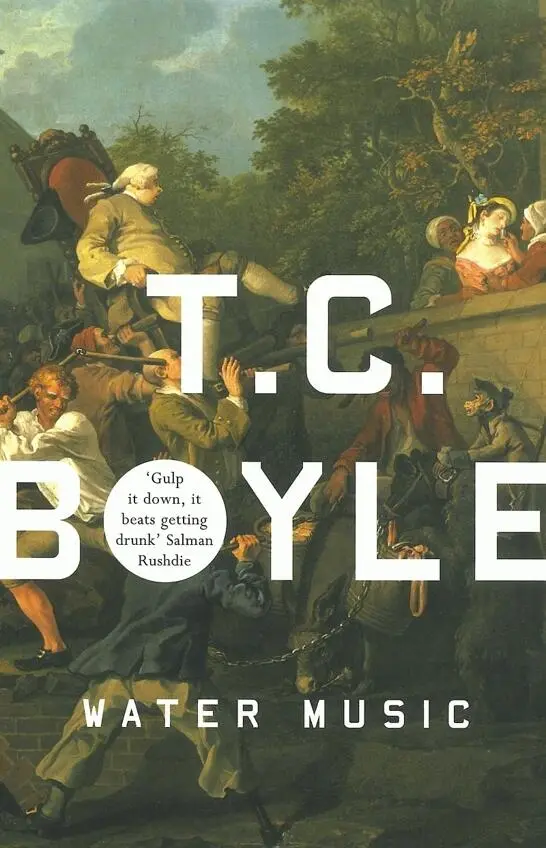
- Название:Water Music
- Автор:
- Издательство:Granta Books
- Жанр:
- Год:1983
- ISBN:9781862071551
- Рейтинг книги:3 / 5. Голосов: 1
-
Избранное:Добавить в избранное
- Отзывы:
-
Ваша оценка:
Water Music: краткое содержание, описание и аннотация
Предлагаем к чтению аннотацию, описание, краткое содержание или предисловие (зависит от того, что написал сам автор книги «Water Music»). Если вы не нашли необходимую информацию о книге — напишите в комментариях, мы постараемся отыскать её.
Water Music — читать онлайн бесплатно полную книгу (весь текст) целиком
Ниже представлен текст книги, разбитый по страницам. Система сохранения места последней прочитанной страницы, позволяет с удобством читать онлайн бесплатно книгу «Water Music», без необходимости каждый раз заново искать на чём Вы остановились. Поставьте закладку, и сможете в любой момент перейти на страницу, на которой закончили чтение.
Интервал:
Закладка:
“So now — you’ve got all those sins on your head?” Despite himself, somewhere deep in his superstitious soul, the explorer is beginning to feel the clutch of a nameless dread. Ghoulies and ghosties and things that go bump in the night.
“ ‘Cause I reached for it. Like a fool. And Eboe was just lyin’ there waitin’, holdin’ his breath — playin’ possum, the old artificer.” Johnson fiddles with his toga, sighs. “So now I’ve got to answer to Chakalla for every little broken taboo in the history of that godforsaken backwater hamlet. Every time a pregnant woman eats a egg or a boy copulates with a pangolin. Every time a young girl walks backward under a crescent moon, rubs her face with hoona sap or plucks her pubic hair with her right hand. And that’s just the start. Then there’s the bird taboos, the fecal taboos, the mandibular taboos. Did you know you’re not allowed to touch your chin with the index finger while sittin’ on the north side of a campfire?
“It all devolves on me now. Chakalla’s out to flay the sin out of my hide. If I can stay out of trouble till there’s nothin’ left of this damned bird but desiccated bone, I’ll live to dance on Eboe’s grave. If not — well, bury me deep.”
Their conversation is interrupted at this juncture by a shuffling sound on the far side of the gate. A moment later the gate cracks open and a servant pokes his head out. “Mansong can’t see you now. Come back next year.” And that’s that. The head disappears, the massive door begins to creak shut.
Mungo is dumbfounded, immobilized by surprise. But Johnson, always alert, springs forward and jams his foot in the door. “Look,” he says, fighting for ground, “we got to see the Mansa right away. This minute. It’s been a long, hard road and we figure we’re entitled to a little hospitality. Besides: we got presents for him.”
The servant’s head reappears. “Presents?” Lines break across his brow. “One minute, please,” he says before vanishing again. From behind the door, the sound of conferring voices. Minutes tick by. A pair of opalescent lizards chase one another up the wall. The explorer picks a bit of duckweed from his coat and looks forlornly at the sack of trade goods lashed to the nag’s concave back. “Lavish presents,” Johnson calls. “Exotic, magical things — fit for a god and a emperor.”
All at once the door swings back and the servant, shrunken with worry, gestures for them to enter. Guide and explorer step through the gate and into a walled courtyard bristling with armed guards. Giants, six and a half or seven feet tall, pectorals like iron, knives, spears, darts and arrows glinting out from the black shadows of their bodies. They wear loincloths of leopard skin, plumes and anklets of ostrich feathers. Any one of them could clear the floor of Parliament in thirty seconds flat.
But as the explorer brushes by, he notices that they avert their eyes and clutch at their saphies , thick lips moving as if in prayer. “Hot dog,” Johnson whispers, falling back on one of his arcane colonial expressions. “You’ve got them awestruck.”
Wringing his hands and tugging at lip and ear, the servant leads them through a succession of identical rooms, walkways and courtyards. The rooms are uniformly low of ceiling, decorated with a Persian rug or tapestry, reed mats on the floor, a tumble of earthenware pottery; the courtyards feature wispy palms, water troughs alive with weed and insect, caged birds, goats, chickens, lizards, dust. It seems as if they’ve been walking for miles. In and out of rooms, down pathways so narrow the explorer has to hug his shoulders. Through a courtyard with six palms, another with two. Eight chickens here, four there. Here a goat, there a cow. Finally, the servant, who has begun to quake like an epileptic at the onset of a seizure, motions for them to wait at the entrance of a long narrow walkway. They watch the pale flash of the soles of his feet as he hurries toward the point at which the walls seem to converge. They watch as he falls to his knees, presses his forehead to the earth. They hear themselves announced: white demon and black sorcerer.
The explorer stumbles twice and finds himself in an expansive courtyard, two or three times the size of the others. The whole is brooded over by an enormous snaking fig tree that casts a bit of shade in even the farthest corners. As he looks closer, the explorer is chilled to discover that the tree is festooned with human skulls, and a number of carved figures depicting unnatural acts: autofellatio, pederasty, the eating of excrement. The most arresting statue, its features greedily distorted, shows a pregnant woman with the multiple dugs of a dog either swallowing or regurgitating a serpent, which is in turn either swallowing or regurgitating the head of an infant.
At the base of the tree, obscured in deepest shadow, there is a sort of throne, rough-hewn wood with a glitter of paint. Beside the throne, a white dog lies asleep in a cloud of flies. When he turns to look behind him, the explorer sees that the narrow walkway is choked with armed guards, black giants identical to those who barred the front gate. He begins to feel somewhat ill at ease.
Suddenly a masked figure springs out from behind the tree with a primordial shriek. “Wo-ya-ya-yaaa!” the figure screams, pounding bare feet in the dust and brandishing a scepter topped with a polished skull. Mungo, taken by surprise, steps back a pace or two and finds himself standing in a low trough filled with a dark, nasty-looking liquid. There are splashes of it on his boots and the legs of his pants. Wet and red. Bloody red. And now suddenly the dog is on its feet, howling, yabbering, foam on its muzzle. “Wo-ya-ya-ya-yeee!” the masked man thunders, apocalyptic, whirling toward him in a blur of feather and bone, and now all at once the sound of drumming, doom-baba-doom, doom-baba-doom, and the guards taking up the refrain: “ya-ya, ya-ya, YEEE!” The explorer is stricken, paralyzed, his legs and feet encased in lead, inner voices screaming for self-preservation, exhorting him to run, flee, bolt, scratch, bite, kill.
But then a familiar hand closes round his elbow. “Stay cool,” Johnson whispers. “They’re terrified of you.”
Terrified? he thinks. Of me? Yet already the din has begun to subside, the guards chanting under their breath, the dog easing back on its haunches, the drumming a whisper. The masked man, swathed in fur and feather, settles into the throne and with a wave of the scepter commands silence. The explorer takes advantage of the lull to step from the trough, and Johnson, bowing low to the ground, approaches the man in the mask and spreads the gifts before him. Sunlight dapples the dust beneath the tree. The gifts, chosen in London by Sir Joseph Banks and calculated to win the savage heart, glow like the treasury of the gods. An appreciative gasp escapes one of the guards, but the man in the mask remains impassive, arms folded across his chest.
Johnson bows again, and then launches his presentation speech. “O Mansong, terror of mountain and plain, widowmaker, grappler with spirits and demiurges, vanquisher of eland and elephant, I present these strange and wonderful gifts to you in the name of my liege and protector, this mild, inoffensive and saintly white man, who has traveled immeasurable distances in order to prostrate himself before your eminence.” At the word “prostrate,” Johnson turns to the explorer and indicates the ground. Mungo falls to his knees, then stretches himself prone in the dust.
While lying there, nose to the ground, he becomes aware of an intermittent movement in the farthest recess of the courtyard. He concentrates on the movement, a blur of shuffling feet, and from the corner of his eye observes this: a screen of woven grass, black feet, fleshy toes wriggling beneath it. And there: the servant, looking harried, ducking behind the screen and then jerking back again, as if his head were on a string. He seems to be conferring with someone, a hidden presence, the articulator of those curled and bloated toes. Here’s another mystery, thinks Mungo, slightly feverish, somewhat fearful, totally lost in reverie. But then he becomes aware of Johnson’s voice, in English now, floating above him like a nest of hornets. “Okay,” a sting in the tone. “Okay, already. Get up.”
Читать дальшеИнтервал:
Закладка:
Похожие книги на «Water Music»
Представляем Вашему вниманию похожие книги на «Water Music» списком для выбора. Мы отобрали схожую по названию и смыслу литературу в надежде предоставить читателям больше вариантов отыскать новые, интересные, ещё непрочитанные произведения.






Обсуждение, отзывы о книге «Water Music» и просто собственные мнения читателей. Оставьте ваши комментарии, напишите, что Вы думаете о произведении, его смысле или главных героях. Укажите что конкретно понравилось, а что нет, и почему Вы так считаете.