T. Boyle - Water Music
Здесь есть возможность читать онлайн «T. Boyle - Water Music» весь текст электронной книги совершенно бесплатно (целиком полную версию без сокращений). В некоторых случаях можно слушать аудио, скачать через торрент в формате fb2 и присутствует краткое содержание. Год выпуска: 1983, ISBN: 1983, Издательство: Granta Books, Жанр: Современная проза, на английском языке. Описание произведения, (предисловие) а так же отзывы посетителей доступны на портале библиотеки ЛибКат.
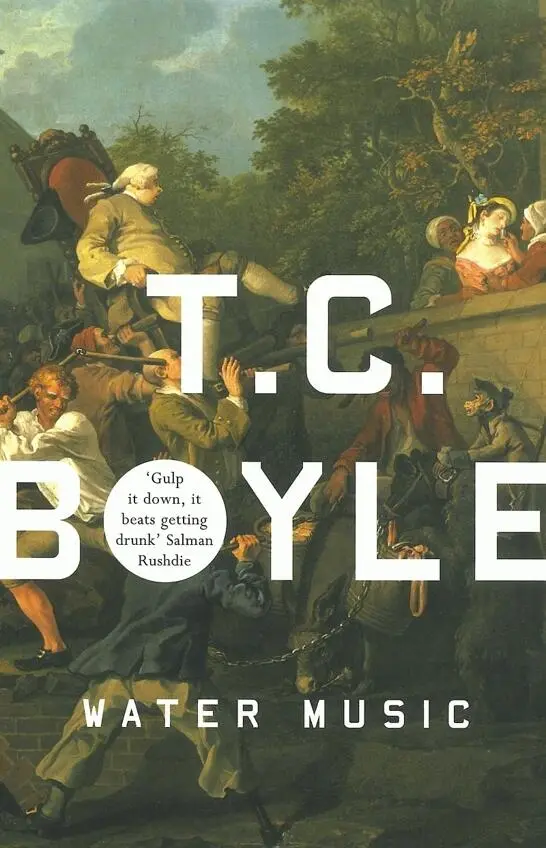
- Название:Water Music
- Автор:
- Издательство:Granta Books
- Жанр:
- Год:1983
- ISBN:9781862071551
- Рейтинг книги:3 / 5. Голосов: 1
-
Избранное:Добавить в избранное
- Отзывы:
-
Ваша оценка:
Water Music: краткое содержание, описание и аннотация
Предлагаем к чтению аннотацию, описание, краткое содержание или предисловие (зависит от того, что написал сам автор книги «Water Music»). Если вы не нашли необходимую информацию о книге — напишите в комментариях, мы постараемся отыскать её.
Water Music — читать онлайн бесплатно полную книгу (весь текст) целиком
Ниже представлен текст книги, разбитый по страницам. Система сохранения места последней прочитанной страницы, позволяет с удобством читать онлайн бесплатно книгу «Water Music», без необходимости каждый раз заново искать на чём Вы остановились. Поставьте закладку, и сможете в любой момент перейти на страницу, на которой закончили чтение.
Интервал:
Закладка:
She was kneading dough. She glanced up at him and was startled at the expression on his face. His head was bobbing, his ears wagging, while his impossible slippery grin hoisted his cheeks, dropped his nose and exposed his yellowed teeth like a row of tombstones. Suddenly it hit her: he was having an attack. She started up from her stool, hands white with flour: “Georgie — are you all right?”
He stood there, beaming, stuffed to bursting with the news and the rustle of paper behind his back. “Here,” he said, producing a package wrapped in brown paper, “for you. With all my love and esteem.”
She wiped her hands on her apron, grinning despite herself, and reached out for the package. “For me?” she said, tearing at the paper. She caught her breath. It was a book, leather cover, gilt lettering. Essays on the Microscope by George Adams the Younger, 1787. The latest word on microscopy. She threw her arms out for pure joy — but Gleg held up his lank palm.
Grinning still, trembling, bursting, an otter with a fish in his mouth, he produced a second package from behind his back. She tore off the paper.
A wooden box. Heavy. She took it to the counter and pried it open with a kitchen knife — the gleam of metal — could it be?
It was a new W. & S. Jones microscope, three times as powerful as her screwbarrel. “But Georgie, how—?”
“My aunt,” he said. “Auntie MacKinnon. She’s dead of the dropsy and left me a modest inheritance. Or rather,” his face was flushed, “left it to you — to do with as you wish. All I have is yours.”
Drums, there were drums beating in her chest. She spun round the room, skipping, then took hold of his frayed flapping sleeves and kissed him.
♦ ♦ ♦
And so, the bannocks are burned. It’s the fault of both of them really. She’d been up at first light, peering into the gilded aperture, overseeing a ballet of animalcules, hundreds to the head of a pin, whirling things, translucent, their edges furred with the shades of chromatic distortion. There were cylindrical things, and oblong things that propelled themselves with hairs or tails, things that joined and split and joined again. And then there were the amorphous things, looking as if they’d been dropped from a height, their boundaries crenellated, a great dark spot hovering over them like the yolk of a frying egg. How could they expect her to think of oatcakes and milk brose when she was lambent with the thrill of discovery?
Even now, at the breakfast table, Gleg patting his lips with the napkin and throwing her lovelorn glances, her father belching over his tea, she can’t put down her dog-eared copy of the Adams book. She wants one thing only: for them to get up and go off to their doctoring so she can be at peace with her sketchpads and her tools of surveillance.
Her father clears his throat, pushes his chair back from the table.
“Gleg,” he mutters, his voice thick with catarrh, “get out and harness the horses, will ye? We’ve got a call to make out Fowlshiels way.”
Gleg stands, awkward, his knee cracking the table like a hammerblow, then shuffles out the door.
There is sun now, tapering blades stabbing in over the curtains, setting the old man’s head afire. He sips at his tea, noisily. Then clears his throat again, a sound like the dredging of rivers. “I see Katlin Gibbie’s got herself nuptialed, eh?”
Ailie looks up from her book. “That’s right, father. It wasn’t two weeks ago that you yourself washed the bride’s feet, broke bannocks over her head, finished off a jug of whisky and danced a Highland reel atop her dining table singing ‘Hey tuttie taitie’ at the top of your lungs — if I’m not mistaken.”
The old man is grinning — gentle, paternal and boyish all at once. “I seem to recall something of the like.”
“So why do you ask?”
“Well —” he scratches at the bristle under his chin, locks his fingers and stretches, then looks her dead in the eye. “She was sixteen, wasn’t she?”
Ailie nods.
“You’re no gettin’ any younger, lass.”
“I know it, father.”
“There’s a young mon round here that dotes on every breath that passes your lips.”
She looks away, closes her book and lays it on the sideboard. When she turns back to him he’s still staring at her, sage and slow, patient and persuasive. Her voice catches in her throat. “I know it, father.”
♦ FROM THE EXPLORER’S NOTEBOOK♦
Immediately following the discovery of this storied and magnificent river, which is to my way of thinking in all respects superior to the Thames or even the Rhine, my factotum and I made our way to the palace of the local sovereign, Mansong of Bambarra. There we were greeted with a warmth and civility that made our hearts glad after grappling so long with inanition and the merciless depredations of the desert Moor. Though Mansong kept no lions on gilded chains, nor were his streets paved with that precious metal, his rooms and grounds were nonetheless the very picture of opulence. There were open courtyards in the Iberian style, flowing fountains and exotic gardens laden with every sort of fruit and bud imaginable. We were led through a succession of these courtyards to the inner sanctum itself, where Mansong awaited us.
The potentate was a big-boned man of cheerful countenance, seated on a golden throne and surrounded by his fierce elite guard, savages built like racehorses and standing six and a half or seven feet from the ground. I made my obeisance, and then presented him with the gifts I had carried with me from England. Of these, he seemed most taken with the portrait of his counterpart on the far side of the world, our own son of Hanover, His Majesty King George III. He sat and contemplated the face and figure of that august monarch for some time, his own features glowing with the incandescence of enlightenment.
After thanking me profusely, Mansong made me a munificent present in return, with his heartfelt hope that it would aid me in the pursuit of my quest for knowledge. He rose heavily from his throne, embraced me like a lost son, and handed me a leather sack filled to bursting with cowrie shells — over fifty thousand in all. Imagine my gratitude at so selfless a gesture on the part of this rude but true prince of the jungle, who had just given over a small fortune to me — a fortune that would allow me to pursue my journey upriver to Timbuctoo, and from thence to the termination of the mighty Niger itself!
Though he urged us to stay, offering up the most princely accommodations and a feast of loaves, viands and local delicacies his servants had prepared in anticipation of our coming, we were anxious to press on, and left that very night, after sharing a firm handclasp and a ceremonial drink.
♦ ALL THE KING’S MEN♦
“But this is the purest of bullshit,” says Johnson, handing the slip of paper back to the explorer. “A distortion and a lie. About the only thing that’s accurate is the seven-foot guards. And the cash.”
Mungo rides on in silence, something like a superior smirk tugging at his lip. He and Johnson have just passed the last sagging hut along the road out of Segu. They are headed for Kabba, four miles downriver, where they plan to purchase food and lodging for the night, and from there to make their way to Sansanding, a Moorish trading town on the road to Timbuctoo.
The immensity of the forest broods over them, dense and thick-ribbed, close as a glove. Colossal dripping leaves hang out over the path like greatcoats draped over sticks, there is a stench of decay, of muck, of slow heat and decomposition. Hidden things rush off in the vegetation as they approach. A hyrax screeches from its perch, leopards cough. It has begun to get dark.
Читать дальшеИнтервал:
Закладка:
Похожие книги на «Water Music»
Представляем Вашему вниманию похожие книги на «Water Music» списком для выбора. Мы отобрали схожую по названию и смыслу литературу в надежде предоставить читателям больше вариантов отыскать новые, интересные, ещё непрочитанные произведения.







Обсуждение, отзывы о книге «Water Music» и просто собственные мнения читателей. Оставьте ваши комментарии, напишите, что Вы думаете о произведении, его смысле или главных героях. Укажите что конкретно понравилось, а что нет, и почему Вы так считаете.