T. Boyle - Water Music
Здесь есть возможность читать онлайн «T. Boyle - Water Music» весь текст электронной книги совершенно бесплатно (целиком полную версию без сокращений). В некоторых случаях можно слушать аудио, скачать через торрент в формате fb2 и присутствует краткое содержание. Год выпуска: 1983, ISBN: 1983, Издательство: Granta Books, Жанр: Современная проза, на английском языке. Описание произведения, (предисловие) а так же отзывы посетителей доступны на портале библиотеки ЛибКат.
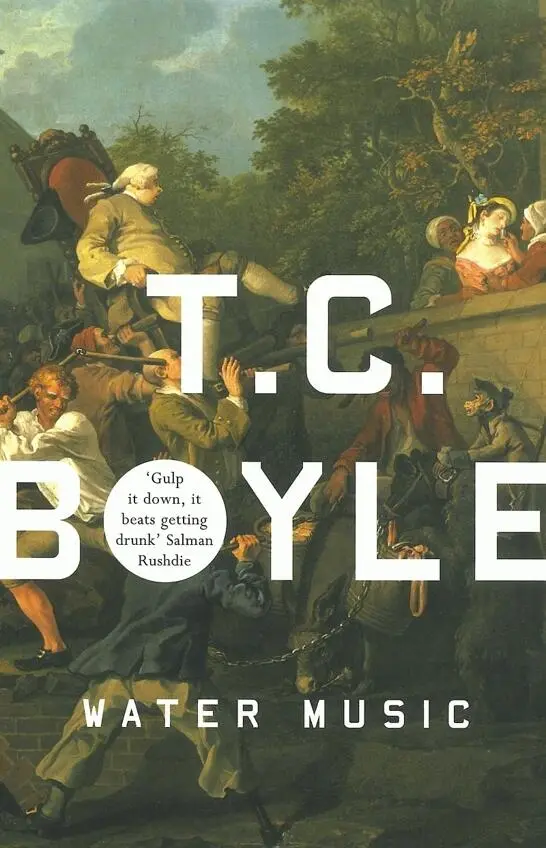
- Название:Water Music
- Автор:
- Издательство:Granta Books
- Жанр:
- Год:1983
- ISBN:9781862071551
- Рейтинг книги:3 / 5. Голосов: 1
-
Избранное:Добавить в избранное
- Отзывы:
-
Ваша оценка:
Water Music: краткое содержание, описание и аннотация
Предлагаем к чтению аннотацию, описание, краткое содержание или предисловие (зависит от того, что написал сам автор книги «Water Music»). Если вы не нашли необходимую информацию о книге — напишите в комментариях, мы постараемся отыскать её.
Water Music — читать онлайн бесплатно полную книгу (весь текст) целиком
Ниже представлен текст книги, разбитый по страницам. Система сохранения места последней прочитанной страницы, позволяет с удобством читать онлайн бесплатно книгу «Water Music», без необходимости каждый раз заново искать на чём Вы остановились. Поставьте закладку, и сможете в любой момент перейти на страницу, на которой закончили чтение.
Интервал:
Закладка:
Mungo stares numbly at his own hand. He is almost surprised to see that he is holding an identical cup. “Raise the cup,” Johnson coaches. There is a burbling sound from beyond the wall, a flatulent groan, as if the air had been forced from a mammoth bellows. “Drink!”
The explorer raises his cup as if toasting the little man in hyena skins. He puts it to his lips, the smell of it firing his nostrils, gamey, somehow reminiscent of moor and wood, out shooting with his father, the taste of it now, warm and faintly salt, roast beef, liver and duck: he doesn’t think, doesn’t want to think. Just drains the cup and wipes his mouth with the back of his hand.
♦ DIMINISHING RETURNS♦
Ailie Anderson lifts the teacup to her lips, vapor rising, the dark earthy aroma of pot-brewed coffee firing her nostrils. Like steamed acorns, she thinks, sipping. Or a good black stout. Some of the church elders have gotten up tracts against coffee, tracts that show how it leads to moral decay while it upsets the body’s equilibrium and tampers with the Lord’s design for the regulation of appetite, but she doesn’t pay them much mind. She likes her cup of a crisp morning. Likes the smell and the bitterness and the lift it gives her.
Gleg and her father, traditionalists, take tea with their bannocks and brose. The two of them are strangely silent this morning, as if they’ve been conspiring — they sit there, slumped over their saucers, champing at their oatcakes like horses in a stable. The resulting lipsmack, and the ring of a spoon in a cup, are the only sounds. Zander’s place is empty. He was up before sunrise, restless, out wandering the hills somewhere.
Gleg, as usual, had showered her with “good mornings” and semilascivious compliments on the fit of her dress, the color in her cheeks, the trim of her waist. But now, sleep in his eye, he’s settled down to the steady, serious business of cramming his maw. Her father, shaggy and unkempt, has emitted six syllables since taking his place at the table: “The bannocks is burnt, lass.” His head is bent to fork and plate in a way that strikes her as common, inappropriate to his station. A streak of scalp shows naked and pink through the white mass of his hair.
Yes, the bannocks are burned. She’ll be the first to admit it. She was distracted — and it’s his fault really. Two months back, when the sun was strewing wildflowers over the hills, he’d brought her back a present from Edinburgh. Something to amuse her, take her mind off the deeps of Africa and the tedious progression of days and weeks and months. He slipped through the front door, a smirk on his face, his right hand buried deep in the pocket of his greatcoat. She was a child again, his little girl. What is it, tell me?
It was a microscope. Wooden stand, brass cylinder, glass lens. Nothing to wear, nothing to eat. He hadn’t brought her a scarf, or a pendant, or a box of pralines. No news of fashions, no perfumes, not even a copy of The Lady’s Magazine or The Monthly Review . A microscope. She couldn’t hide her disappointment.
It sat in the front vestibule for two weeks. Gleg simpered after her, while her father seemed to encourage him. Her closest friend, Katlin Gibbie, married and moved to an outlying farm, and Zander became increasingly withdrawn, absorbed in his own problems. There had been no news of Mungo. She was bored. One afternoon she magnified a piece of newsprint and was astonished to see that each letter was composed of myriad black specks. A bit of thread was a boatman’s cable, the dog’s hair a thicket, a flea a monster. She ransacked the house, exploring everything she could lay her hands on — the weave of her skirts, the topography of a piece of rag paper, the impossible, delicate tension that held a drop of milk in suspension. Then she turned to the yard. Leaves, bark, the petals of roses, insects. She marveled at the grid of a fly’s wing, the downy froth that beads a moth’s antennae, the cruel cusp of an ant’s mandible. She tore spider webs from the eaves, plucked feathers from her doves. One morning she took a dace from the aquarium and pinned it down to examine the fine mesh of its scales, overlapping like waves on a beach. She was enthralled. The void Mungo had left began to diminish as the objects of her scrutiny grew beneath the lens. There was a center to her days. She watched it expand.
Her sketches, charcoal and ink, banished the walls. Here the veins of a leaf, there the whorls of a fingerprint. An eyelash like a spar, the minatory serrations of a beetle’s leg. She found a copy of Hooke’s Micrographia in her father’s library and devoured it as if it were a three-volume novel. Hooke had magnified a bit of cork and discovered its hidden superstructure: it was composed of tiny interlocking units, cubicles invisible to the eye, unsuspected by the imagination. Cells, he called them, because they reminded him of the compartments in a monastery. Ailie took the stopper from a bottle of port, sliced a wafer-thin shaving from it with her father’s razor, and screwed it into focus. She saw nothing but pits and fissures. That night she went to bed deflated, dreaming of worlds beyond the scope of the eye, beyond the scope of screwbarrel and lens, worlds ever smaller, worlds within worlds within worlds.
Then she discovered van Leeuwenhoek.
She came across a reference to his work in one of her father’s medical journals. Nearly a hundred years earlier, with the aid of the extraordinarily powerful lenses he ground himself, Leeuwenhoek had debunked the Aristotelian notion of spontaneous generation. He described the life cycles of the flea and the grain weevil, asserting that they arose from fertilized eggs rather than sand or grain itself, as had been previously supposed. As Francesco Redi had connected the growth of maggots and the eggs of houseflies, so Leeuwenhoek demonstrated that even the lowliest creatures, hardly visible to the naked eye themselves, similarly arose from creatures that had preceded them. For Ailie, who had labored for days making crude sketches of the fleas she plucked from beneath her dog’s collar, it was a revelation.
Her father’s library was spotty, but his old friend and colleague, Dr. Donald Dinwoodie of Kelso, had a complete set of the Royal Society’s Philsophical Transactions , to which Leeuwenhoek had contributed for the last fifty years of his life. Ailie packed her microscope and sketchpads, saddled the mare and rode the thirty miles to Kelso. She boarded with Dinwoodie for a month, poring over his books. Leeuwenhoek, she discovered, had seen “animalcules” teeming in a drop of water, the trembling globular components of human blood, the thrashing swarm of spermatozoa in the semen of insects, cattle and men. Worlds within worlds. Quaking with excitement, she went to the rain barrel, removed a vial of water and examined a drop of it beneath her lens. She saw nothing. Her simple apparatus didn’t have the power. She pricked her finger and scrutinized a drop of blood. Again, nothing. For the semen, she thought, she would wait for Mungo.
Back at Selkirk, she continued her studies, but her enthusiasm was waning. What was the sense? No one knew Leeuwenhoek’s secrets — how he had managed to grind lenses that magnified an object from fifty to three hundred times its actual size, or how he had enhanced that magnification with mirrors and lights to attain an even greater amplification. Her screwbarrel scope was a toy. She was disgusted. But then, one morning, Gleg had sidled into the kitchen, grinning like a frog, hands hidden behind his back. “I missed you,” he said, lingering over the syllables as if each were a slice of toast to be buttered. “My heart bled each morn at your absence, and swounded each even when the sun set without you.”
Читать дальшеИнтервал:
Закладка:
Похожие книги на «Water Music»
Представляем Вашему вниманию похожие книги на «Water Music» списком для выбора. Мы отобрали схожую по названию и смыслу литературу в надежде предоставить читателям больше вариантов отыскать новые, интересные, ещё непрочитанные произведения.






Обсуждение, отзывы о книге «Water Music» и просто собственные мнения читателей. Оставьте ваши комментарии, напишите, что Вы думаете о произведении, его смысле или главных героях. Укажите что конкретно понравилось, а что нет, и почему Вы так считаете.