T. Boyle - Water Music
Здесь есть возможность читать онлайн «T. Boyle - Water Music» весь текст электронной книги совершенно бесплатно (целиком полную версию без сокращений). В некоторых случаях можно слушать аудио, скачать через торрент в формате fb2 и присутствует краткое содержание. Год выпуска: 1983, ISBN: 1983, Издательство: Granta Books, Жанр: Современная проза, на английском языке. Описание произведения, (предисловие) а так же отзывы посетителей доступны на портале библиотеки ЛибКат.
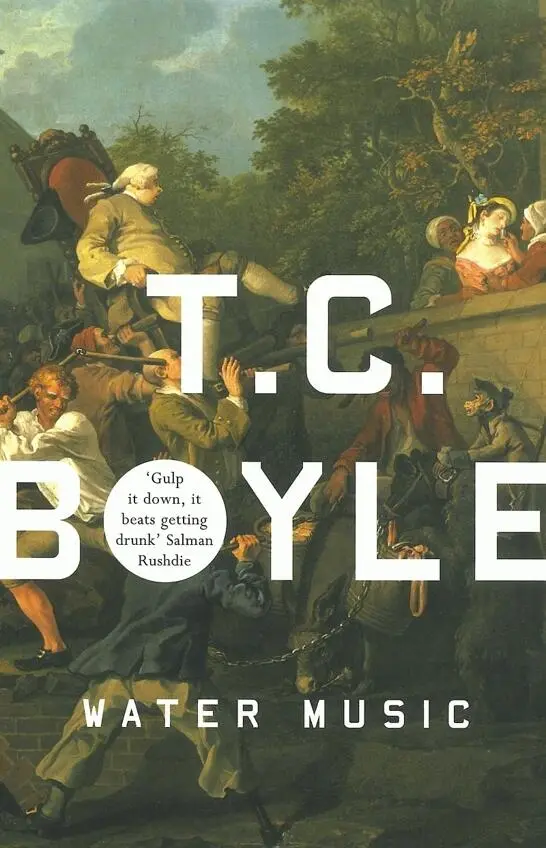
- Название:Water Music
- Автор:
- Издательство:Granta Books
- Жанр:
- Год:1983
- ISBN:9781862071551
- Рейтинг книги:3 / 5. Голосов: 1
-
Избранное:Добавить в избранное
- Отзывы:
-
Ваша оценка:
Water Music: краткое содержание, описание и аннотация
Предлагаем к чтению аннотацию, описание, краткое содержание или предисловие (зависит от того, что написал сам автор книги «Water Music»). Если вы не нашли необходимую информацию о книге — напишите в комментариях, мы постараемся отыскать её.
Water Music — читать онлайн бесплатно полную книгу (весь текст) целиком
Ниже представлен текст книги, разбитый по страницам. Система сохранения места последней прочитанной страницы, позволяет с удобством читать онлайн бесплатно книгу «Water Music», без необходимости каждый раз заново искать на чём Вы остановились. Поставьте закладку, и сможете в любой момент перейти на страницу, на которой закончили чтение.
Интервал:
Закладка:
Mansong jerks up, slapping the boys aside. “What?” he roars. The fans drop with a hiss as the bodyguards snatch up their spears, the birds fall silent, the royal swatters redouble their efforts. Mansong is up out of his hammock now, huge, terrible, champing his jaws like a river horse startled up from the muck. One bulbous fist is already closing round the messenger’s throat, the other poised to deliver a blow. “What are these lies?” he bellows.
“No lies — truth,” says the messenger, prostrating himself. “A demon, white as mother’s milk, burst through the gates of the city and threw himself into the river, curdling its waters. Then he hounded the people from the streets, chanting and jabbering in a harsh alien tongue. And now he has come to speak with you, Mansa.”
Mansong removes his foot from the back of the man’s neck. He suddenly looks as if he’s about to cry. “With me?” he whispers.
The prostrate messenger strains his eyes upward, as if consulting a note pinned to his forehead. “That’s what he says.”
“Jackal! You’re lying!” The foot comes down again, grinding the messenger’s cheek into the dirt. “You just got through telling me this demon speaks in a harsh alien tongue. How then can he ask to see me?”
The runner’s face is twisted out of proportion by the weight of Mansong’s foot, his lips puckered like the lips of a fish. “He speaks Mandingo.”
Mansong staggers back as if he’s been shot. Speaks Mandingo? It’s all up. They’ve sent a zombie from the nether world to take his throne. They’ll chain his ankles and lead him down through caverns in the earth, through the festering holes where the walking dead gibber and moan, down, ever deeper, to the world of shadows. He scans the faces of his bodyguards, men who could pull charging lions inside out, and sees terror in their eyes. He wants to run, hide himself, leave the country, burrow into the ground. “You say. . he’s out there. . now?”
“Yes, Mansa. Out there now.”
The potentate backs away, eyes rushing. The sun is gone, the fig tree, his guards — he can see nothing but the transparent figures of his victims, legions of them, disemboweled warriors, charred women, children holding out their severed limbs to him. “No!” he whispers, backpedaling still, his lips and tongue working, on the verge of crying out — shrieking till his throat goes raw, howling like the hidden hopeless things that die night after night in the black fastness of the jungle.
But at that moment a calm dignified little man steps into the courtyard, walking briskly. Businesslike, each step a minute lost, he strides up to the chief, a huge black object tucked under his arm. There is an air of expectancy about him, of intrigue, of upper-echelon wheelings and dealings. He could be a high-powered attorney, Secretary of Foreign Affairs, the Prime Minister. “Calm yourself, Mannie,” he says. “I’ll take charge here.”
His name is Wokoko, the tribal necromancer. He is dressed in a costume composed of the spare parts of a pack of hyenas — claws, teeth and matted yellow fur — and the feathers from a flock of marabous. The object under his arm is a carved wooden mask so relentlessly hideous in every detail as to put any ten demons in their place. With a snap of his fingers he orders half the guards to the front gate, then addresses the still-prostrate messenger. “Tell the demon,” he says, in his judicious tones, “that the omnipotent Mansong, throttler of the lion and tamer of the bull, cannot see him now. . he has a headache.”
♦ FIFTY THOUSAND COWRIES♦
Mansong’s palace is a rambling, haphazard structure built of notched timber and the rocklike red clay from which termites construct their mounds. The flow of the building is interrupted by an involuted series of walled walkways and courtyards. Tapering palms sway over these courtyards like antennae, and the crown of a huge sycamore fig can be seen rising in canopy from the center of the compound. Each of the buildings and interior walls has been whitewashed with a mixture of bone powder, starch and water. Inadequate to the task, the wash has left the walls a soft pastel pink; in places the red glares through in streaks like clawmarks in the flank of a sacrificial cow. The whole is enclosed behind a ten-foot wall of clay and pointed stakes surmounted by blue-black thorns an inch in length. There is only one gate. The door is made of fasces of bamboo lashed tightly together. It is three feet thick.
Explorer and guide have been standing before this gate for nearly three hours. At periodic intervals Johnson cups his hands to his mouth and delivers a stentorian plea to the effect that he is but a humble Mandingo from Dindikoo who has brought with him a harmless white man (hon-kee) from beyond Bambouk, the Jallonka Wilderness and the great salt sea, and that this white man has come expressly to pay obeisance to Mansong, slayer of lions and throttler of bulls, whose fame has blossomed like the spreading lotus until it has come to incorporate the wide world.
Thus far there has been no response.
The heat of course is oppressive. Nag and ass lie in the shade of the wall, bundles of bone. The explorer has been alternately shivering and sweating, his nose is running and his joints feel as if spikes have been driven into them. Johnson bats at flies.
“Tell me, Johnson,” the explorer begins conversationally, squatting now in the dust, “why is it that you feel compelled to wear that damned bit of carrion round your neck?”
The guinea hen has by this time lost its head and the remaining wing. Ribs, stippled with bits of pink flesh and blue vein, have begun to emerge from the mat of feathers, and maggots foam from the body cavity like paste squeezed from a tube. It would be redundant to talk of flies.
“Convention,” says Johnson.
“Convention?”
Johnson sighs. “It’s no big deal. When the Jarrans heard that Tiggitty Sego was advancin’ on them they went to Eboe. As village necromancer it was his duty to appease Chakalla, god of violated taboos, by assumin’ all the sins of the townspeople in the hope that Chakalla would then turn back Sego’s army. So Eboe he mixes his potions and mutters his incantations until all the sins of the village are transferred to the guinea hen. From there it’s child’s play: bleed the hen and hang it round your neck until the flesh drops off. And voilà: Sego is stopped in his tracks.”
The explorer looks as if he’s just swallowed a fork. “But you’re joking.
You don’t mean to say you believe all that mumbo jumbo?”
“No more unreasonable than believin’ in virgin births or ladders to heaven.”
“You mean — you question the Bible?” Mungo is shocked to his roots. Lord, they’re savages, he’s thinking. Dress them up, educate them, do what you will. Their minds are in the jungle.
Johnson remains silent, arms folded, eyes fixed on the gate.
“All right. If it’s so bloody effective, all this damned guinea hen business, then what happened at Jarra?”
“See for yourself: the hen ain’t rotted yet. Eboe was too late, that’s all. Simple as that.” He grins. “You know the old saw: a stitch in time—”
Mungo waves the back of his hand at him. “Okay. I’ll grant it all — black magic and witchcraft and the whole works. But you still haven’t answered me: why should you have to go around wearing the bloody thing?”
Johnson’s face falls. He looks like a hound caught slipping a chop from the table. “Well, I figured — well, you know, we was starvin’—”
“You don’t mean—?”
Johnson nods. “I was goin’ to cook it up with the mushrooms and tomberong berries and all. Shit: I thought he was dead. What harm would it have done?”
Читать дальшеИнтервал:
Закладка:
Похожие книги на «Water Music»
Представляем Вашему вниманию похожие книги на «Water Music» списком для выбора. Мы отобрали схожую по названию и смыслу литературу в надежде предоставить читателям больше вариантов отыскать новые, интересные, ещё непрочитанные произведения.






Обсуждение, отзывы о книге «Water Music» и просто собственные мнения читателей. Оставьте ваши комментарии, напишите, что Вы думаете о произведении, его смысле или главных героях. Укажите что конкретно понравилось, а что нет, и почему Вы так считаете.