T. Boyle - Water Music
Здесь есть возможность читать онлайн «T. Boyle - Water Music» весь текст электронной книги совершенно бесплатно (целиком полную версию без сокращений). В некоторых случаях можно слушать аудио, скачать через торрент в формате fb2 и присутствует краткое содержание. Год выпуска: 1983, ISBN: 1983, Издательство: Granta Books, Жанр: Современная проза, на английском языке. Описание произведения, (предисловие) а так же отзывы посетителей доступны на портале библиотеки ЛибКат.
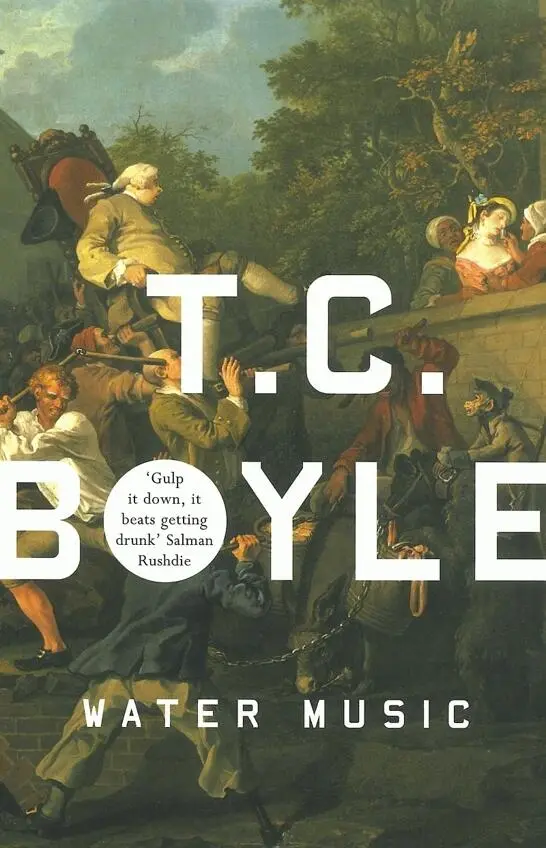
- Название:Water Music
- Автор:
- Издательство:Granta Books
- Жанр:
- Год:1983
- ISBN:9781862071551
- Рейтинг книги:3 / 5. Голосов: 1
-
Избранное:Добавить в избранное
- Отзывы:
-
Ваша оценка:
Water Music: краткое содержание, описание и аннотация
Предлагаем к чтению аннотацию, описание, краткое содержание или предисловие (зависит от того, что написал сам автор книги «Water Music»). Если вы не нашли необходимую информацию о книге — напишите в комментариях, мы постараемся отыскать её.
Water Music — читать онлайн бесплатно полную книгу (весь текст) целиком
Ниже представлен текст книги, разбитый по страницам. Система сохранения места последней прочитанной страницы, позволяет с удобством читать онлайн бесплатно книгу «Water Music», без необходимости каждый раз заново искать на чём Вы остановились. Поставьте закладку, и сможете в любой момент перейти на страницу, на которой закончили чтение.
Интервал:
Закладка:
Johnson backs off, his face slack. “But we thought—”
The old man is on his feet now, tottering slightly, a fly caught in the bubble of saliva on his lip. He staggers toward the guide, body quivering with rage or infirmity, his crabbed fingers picking at the leather thong until finally he grasps it and eases the bird up over his head. It dangles from his fingers, slack, drooling, coated with insects. “You want?” The old man’s Mandingo is thick as a sleeping potion.
“No!” pleads Johnson. “No!”
Then, suddenly, “with a motion so quick and smooth it defies the eye, Eboe loops the grisly thing through the air. A flutter of feathers, and it catches Johnson’s neck like a noose. FOOMP! The bird strikes his chest, and dangles. Maggots wriggle in the folds of his belly. Flies orbit his head. His face makes the Pietà look like a portrait of joy.
The explorer is mystified, mouth agape, witness to some primitive rite. “Johnson,” he says, astonished. “Cut it loose. Toss it in the bushes.”
Old Eboe is grinning ear to ear.
Johnson hangs his head. “I can’t,” he whispers.
♦ ♦ ♦
The mud crusts underfoot, remugient beasts stir up the undergrowth, Johnson attracts flies: greenflies, blowflies, blackflies, crutflies. The road has begun to widen now, and from time to time habitations can be seen crouching beneath trees or perching atop mounds of red clay. Outside the huts: bare-breasted women, men in baggy shorts, striped shirts and conical hats, apathetic dogs. The men suck on long-stemmed pipes, the women chew roots and spit from between blackened teeth. Palms wave overhead. Goats shuffle about in pens. The scent of urine curdles the air.
As they reach the crest of each hill the explorer darts on ahead, stretching his neck like a sightseer, unable to contain himself. He shouts and waves his hat against the horizon, gesturing frantically toward a white blur in the distance. “Is that it?” he calls, dancing in place. “Is that it?”
At the top of the eighteenth hill old Eboe pauses to sniff the breeze. Mungo catches his breath. There is certainly something out there, towers maybe, the sudden flash of a window catching the sun. The shrunken soothsayer stoops to pluck a round white stone from the mud. He rubs it briefly between his leathery fingers, then slips it into his mouth. The gerontic eyelids drop like curtains, the lips purse, sucking reflectively. Eternities pass, the world cranks round on its axis, constellations heave in the firmament. “Well?” Mungo demands. Eboe lifts his lids. Spits out the stone. The buzz of Johnson’s flies is loud as a drumroll. “Well?” Slow and deliberate, Eboe raises his arm, points a crooked finger. “Segu Korro,” he croaks.
For one brief fraction of a second the explorer stands transfixed, and then he’s off like a sprinter. Starvation, weakness, disease, nails pricking through the soles of his boots, the sun scorching the water from his eyes — none of it matters: his goal is in sight. His feet pound the yellow clay, erasing the footsteps of those who came before him, as Johnson, Eboe, nag and ass recede in the distance and the glorious golden walls of the city come into focus before him. Huts flash by, traffic on the road. Women balancing jugs, boys driving goats with long supple switches, laden asses, litters of produce, spangled birds in wicker cages. All a blur. He stops for no one, dashing through the massive gates now, shoving his way past astonished faces, down congested streets, alleyways, frantic for the river, feet pounding, stunned Bambarrans gathering at his back like children at a parade, dirt streets, a dead dog, hawkers and tradesmen, a flash of color and movement — and there, there it is! Wide across as the Thames, brown as a gutter, cluttered with rafts and dugouts, the shore a riot of splashing children, rooting pigs, washerwomen in white caps. He doesn’t turn at the roar behind him — doesn’t even notice — leaping crates and cages, bowling over children and old women, stiff-arming farmers and fishermen, a strange primordial squeal of triumph burning in his throat. The bamboo dock sways under his feet, a boatman ducks out of the way, flinching as if to ward off a blow, and the explorer is airborne. His legs and arms flail for a brief delicious instant, suspended there in all his glory, mindless as a hatter, shouting out some Greek exclamation until the dark steaming water envelops him like a mother’s embrace.
♦ HERODOTUS BE HANGED♦
“What, Sir? You doubt Herodotus?”
“Herodotus be hanged. And Pliny along with him. How can you actually sit there and expect a rational being to accept all this folderol about tribes that squeal like bats and outrace horses? Or pygmies, leprechauns — whatever you call them — tripping about the jungle like nursery children in Mayfair? It’s myth I tell you. Folklore. Timbuctoo no more exists than the land of the Laestrygonians.”
Sir Joseph Banks, President of the Royal Society, Treasurer and Director of the African Association for Promoting Exploration, sits at the head of the mahogany table in his library at No. 32, Soho Square. Before him, a glass of Madeira. It is July, the windows are open, moths bat about the lamps. On the back wall, Desceliers’ sixteenth-century map of Africa. Sir Joseph regards it glumly, barely attentive to the debate going on around him. A pretty piece of work, Desceliers’ map. Colorful. Imaginative. But it is of course nothing more than an outline, a perimeter pricked with place names — the vast uncharted interior artfully concealed behind a dribble of imaginary rivers and a host of mythical beasts, six-armed maidens and limbless Cyclopeans. Sir Joseph sighs, takes a lugubrious sip at his wine. Now, two centuries later, children of the Enlightenment, he and his colleagues know little more than Desceliers.
“You forget, my good fellow, that while Homer may have been enamored of Euterpe, Herodotus was an historian. His object was not to divert us with fictions, but to edify us with facts.” The Bishop of Llandaff, though a charter member of the Association, is tonight attending his second meeting since its inception eight years ago. He is chiefly remarkable for the salience of his cartilaginous features, and the coldness of his tiny, misaligned eyes (his family, the Rathbones, have been heralded since the fourteenth century for their sloping foreheads, majestic beaks and pale fleshy ears — beaks so majestic and ears so fleshy as almost to suggest the development of new species and keener functions). For the better part of an hour he has been defending the sacred and unshakable authority of the Ancients. Sir Reginald Durfeys, William Fordyce and Lord Twit, soured by their public school experience, have opposed him, while Edwards and Pultney have for the most part remained silent.
“And what is history, pray tell, if not a fiction?” Twit, known in the Lords for his reedy, lisping orations, pauses for effect. “You presume to call Herodotus’ suppositions fact? How were these ‘facts’ obtained? Thirdhand? Fifthhand? I ask you, Sir.”
Llandaffs ears are suffused with color. He begins to pull on his white calfskin gloves, thinks better of it, downs a glass of brandy instead. “You dare to impugn the Ancients? Why, our whole system of Modern Thought—”
Twit holds up his palm. “Excuse me. I haven’t finished. I mean to say that all our cherished histories — from those of the Greeks to that of our late departed colleague Mr. Gibbon — are at best a concoction of hearsay, thirdhand reports, purposeful distortions and outright fictions invented by the self-aggrandizing participants and their sympathizers. And as if that weren’t enough, this hodgepodge of misrepresentation and prevarication is then further distorted through the darkling lens of the historian himself.” Twit, lips painted and cheeks rouged, is in his glory — he revels in his reputation as iconoclast, intellectual outlaw and assailer of priggery. Twit the Wit, they call him. After a pause for the application of two pinches of snuff, he continues. “What happened at Culloden — do you know, Sir? And what then of Tangier and Timbuctoo? At least my own knowledge of the African continent is no worse than secondhand.”
Читать дальшеИнтервал:
Закладка:
Похожие книги на «Water Music»
Представляем Вашему вниманию похожие книги на «Water Music» списком для выбора. Мы отобрали схожую по названию и смыслу литературу в надежде предоставить читателям больше вариантов отыскать новые, интересные, ещё непрочитанные произведения.






Обсуждение, отзывы о книге «Water Music» и просто собственные мнения читателей. Оставьте ваши комментарии, напишите, что Вы думаете о произведении, его смысле или главных героях. Укажите что конкретно понравилось, а что нет, и почему Вы так считаете.