T. Boyle - Water Music
Здесь есть возможность читать онлайн «T. Boyle - Water Music» весь текст электронной книги совершенно бесплатно (целиком полную версию без сокращений). В некоторых случаях можно слушать аудио, скачать через торрент в формате fb2 и присутствует краткое содержание. Год выпуска: 1983, ISBN: 1983, Издательство: Granta Books, Жанр: Современная проза, на английском языке. Описание произведения, (предисловие) а так же отзывы посетителей доступны на портале библиотеки ЛибКат.
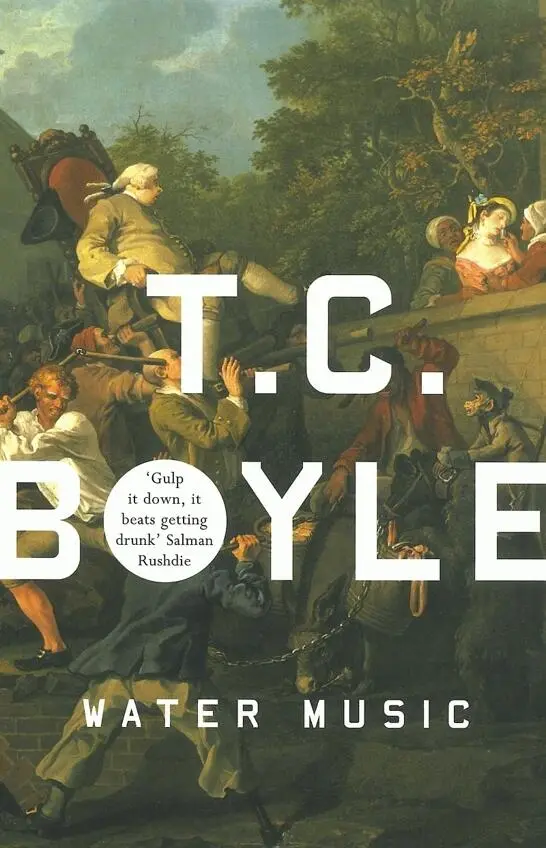
- Название:Water Music
- Автор:
- Издательство:Granta Books
- Жанр:
- Год:1983
- ISBN:9781862071551
- Рейтинг книги:3 / 5. Голосов: 1
-
Избранное:Добавить в избранное
- Отзывы:
-
Ваша оценка:
Water Music: краткое содержание, описание и аннотация
Предлагаем к чтению аннотацию, описание, краткое содержание или предисловие (зависит от того, что написал сам автор книги «Water Music»). Если вы не нашли необходимую информацию о книге — напишите в комментариях, мы постараемся отыскать её.
Water Music — читать онлайн бесплатно полную книгу (весь текст) целиком
Ниже представлен текст книги, разбитый по страницам. Система сохранения места последней прочитанной страницы, позволяет с удобством читать онлайн бесплатно книгу «Water Music», без необходимости каждый раз заново искать на чём Вы остановились. Поставьте закладку, и сможете в любой момент перейти на страницу, на которой закончили чтение.
Интервал:
Закладка:
Meanwhile, Eboe stands there, gazing into the shadows: still snuffing. The women are large, middle-aged at best. Their dugs are pendulous, gravid, balloons filled with water. If they can boast twenty teeth between them, they’re lucky. “Eboe!” shouts Johnson, but the women are doing fascinating things beneath their skirts, then holding up their fingers and licking them. The old necromancer can stand it no longer. He cracks a withered grin, gives Johnson the thumbs-up sign, and saunters into the shadows.
Johnson is stunned. Disappointed. Disgusted. Envious. He wants a beer, a plate of meat and rice, a woman, a bed. Here he is, a man of dignity and education, well past the age of retirement, a man with wives and children and a happy home — and what does he do? Wanders all over the continent, risking life and limb to bail out some half-witted, glory-hungry son of a crofter. He heaves a great wet sigh of despair and resignation, and turns to mount the balky blue ass, trying his level best to ignore the big flat-faced woman who dances out into the street and lifts her skirt for him.
♦ ♦ ♦
Fifteen minutes later (after following his hunches first, and then, as he draws closer, his ears), Johnson finally manages to locate the explorer. Emerging from a maze of narrow earthen streets into a sort of square fronting the riverbank, he is all at once confronted with an extraordinary scene. People — packed in like bees in a hive — as far as the eye can see. There must be three or four thousand of them, hanging from windows, treetops, roofs, perched on shoulders, the backs of camels, straining on tiptoe. The banks of the river are black with them, scores in water up to their ankles, knees, necks, scores more bobbing in pirogues and coracles. All gathered to stand hushed and appalled while this impossible, inexplicable presence, this man in the moon fallen to earth, this white demon from hell chants, screeches, laughs, gibbers and sings, churning up the water, cursing the crops, bringing the sky down, and who knows what else.
Johnson, lost somewhere in the rear of the press, steadies the blue ass and gingerly raises himself atop the washboard of its back until he is able to stand erect. From his eminence he can see the woolly expanse of four thousand heads. Closer to the river (the Niger — how about that? he thinks), the heads are more congested, like thick stands of papyrus reed. Way up front, just off the lip of a rickety bamboo dock, Mungo Park is kicking up a froth and singing “God Save the King” at the top of his lungs. The Bambarrans seem mesmerized, stunned — as silent and sober as the awestruck crowds that slowly filed past the bier of George II.
But then, as is often the case in a world of action and reaction, things begin to lose their center. The explorer, totally oblivious to the audience gathered round him, suddenly slashes toward the dock in a moment of enthusiasm. His object is a yellow gourd attached to a fishing net; his intention, to set it adrift and thereby determine for the western world and all the generations of posterity the true direction of flow of the River Niger. Unfortunately, however, those Bambarrans closest to him misinterpret his motive and fall back with a shriek. In an instant the shriek is universal: the panic has begun.
Johnson is knocked from the ass and trampled. Lepers drop fingers and toes, the blind run into walls. There are shouts and curses, cries of pain and surprise, the drum of footsteps and the wail of lost children. The crowd surges against the mud-walled buildings like a river in flood, gushing through into streets and alleys, washing off with the undertow. Two minutes later the square is deserted, the banks empty, the river stripped of boats. All that remain are Johnson, a crumpled ass and nag, and the amphibious explorer. In the distance: the sound of hubbub and turmoil, voices raised, doors slammed.
Meanwhile, the yellow gourd has been drifting — inexorably and beyond a doubt — to the eastward. The explorer, momentarily distracted by the clamor of the Bambarran withdrawal, turns back to his experiment with a shout of exhilaration. “Pip!” he shouts. “Pip-pip!”
Johnson raises himself from the dust with a groan and wearily hobbles down the the water’s edge. “Mr. Park,” he calls. “Come on out of there and let’s pay our respects to Mansong the Potentate before he sends his army out after us.”
The explorer looks up, dripping, mats of algae caught in his beard and hair. The river parts round his waist, the current sluggish. He focuses on Johnson like a man waking from a deep sleep.
Straddling the dock now, arms akimbo, Johnson presents his case. “Look: if we get it together and offer him some gifts and trinkets and whatnot, he could just treat us like visitin’ dignitaries. And that means food and drink, a roof, maybe even some female companionship. I don’t know about you, but I’m damn sick and tired of sleepin’ on the ground, eatin’ thistles and makin’ love to my hand.”
The explorer sloshes toward him, his eyes gone buttery, arms outstretched in a wide, vacant embrace. “Johnson — we’ve done it! The Niger, Johnson.” He pauses to flail his arm in the direction of the far bank. “Look at it, will you? Wide across as the Thames at Westminster. And to think: through all the ages, from the time of Creation till this very minute, it’s tumbled along in ignorance and legend. It took me, old boy. It took me to uncover it.”
Johnson glances back over his shoulder at the ranks of whitewashed buildings clustered on the hillside, the bamboo docks ranged along the shoreline, the dugouts bobbing at their tethers. “I can appreciate that, Mr. Park, and I extend my sincere congratulations. But if we don’t get our asses over to the Mansa’s palace and start grovelin’ at his feet, we just might not live to tell about it.”
The sun beats at them like a fist, the baked earth of the square throws up a shimmer of heat, somewhere a dog whimpers. Everything seems to steam and stink. Malignant odors hang in the air, corrosive, thick with rot. They tell of fishheads, human waste, blackening leaves, muck. All at once the explorer begins to feel queasy. Overpowered, actually. Things are slowing down, anticlimactic, and his senses are gradually reawakening to the realities of hammering sun, putrid water, festering riverbank. He reaches for Johnson’s hand and pulls himself from the river.
“You’re right, Johnson. We can celebrate when we get back to Pisania. But for now we’ve got a job to do.” The explorer’s voice catches and stutters, his body seized with a sudden shiver. The blue velvet coat hangs limp, black and shapeless, duckweed spots his shirt, his boots are fishponds. A huge water strider, enmeshed in the tangle of his beard, waves its ungainly legs.
Behind him, the beaver top hat — stuffed with notes on manners and mores, distances, temperatures and topographic curiosities — perches on the edge of the dock like some strange fungal growth. High and dry. Johnson dusts it against his leg.
“Mansa’s palace?” suggests Mungo.
Johnson hands him the hat. “Mansa’s palace.”
♦ MANSONG♦
The potentate of Bambarra, having just finished an enormous breakfast (baked plantain, four varieties of melon, boiled rice with spinach, fried cichlids, sorghum pudding, palm wine), is in the process of slaking his lust with the aid of two prepubescent boys singled out from among the Jarran refugees, when news of the explorer’s arrival reaches him. His initial reaction is a protracted belch. Naked, big-bellied, indolent, he is stretched out beneath the sycamore fig in the inner courtyard of his townhouse, still as a sunning crocodile. Sandalwood sweetens the air, caged birds warble of peace and solitude, the cool of the rain forest. The royal flyswatters, scrawny old men in loincloths, are busily at work, the soft swish-swish of their whisks like footsteps in a dream. Mansong sucks meditatively at the hookah, its bowl glowing with mutokuane [1] thinking “Ah, ah,” while his twenty grim and devoted bodyguards, each manipulating a long-stemmed fan, stir up a bit of a breeze. His senses reel. The younger of the boys is gently fellating him, while the other licks at his face, running a stiff probing tongue over his lips and nose and eyelids, as if he were lapping milk from a bowl. The whole thing is so blissful and sensual, such an orgasm of neuron and synapse — such a trip — that at first the runner’s words don’t register. Blanched demon? Cat’s eyes? Mass hysteria? But then, like pinpricks, the words begin to penetrate: outside the gate, white horror, begging admittance. This. Very. Minute.
Читать дальшеИнтервал:
Закладка:
Похожие книги на «Water Music»
Представляем Вашему вниманию похожие книги на «Water Music» списком для выбора. Мы отобрали схожую по названию и смыслу литературу в надежде предоставить читателям больше вариантов отыскать новые, интересные, ещё непрочитанные произведения.











Обсуждение, отзывы о книге «Water Music» и просто собственные мнения читателей. Оставьте ваши комментарии, напишите, что Вы думаете о произведении, его смысле или главных героях. Укажите что конкретно понравилось, а что нет, и почему Вы так считаете.