Olja Savicevic - Adios, Cowboy
Здесь есть возможность читать онлайн «Olja Savicevic - Adios, Cowboy» весь текст электронной книги совершенно бесплатно (целиком полную версию без сокращений). В некоторых случаях можно слушать аудио, скачать через торрент в формате fb2 и присутствует краткое содержание. Год выпуска: 2016, Издательство: McSweeney's, Жанр: Современная проза, на английском языке. Описание произведения, (предисловие) а так же отзывы посетителей доступны на портале библиотеки ЛибКат.
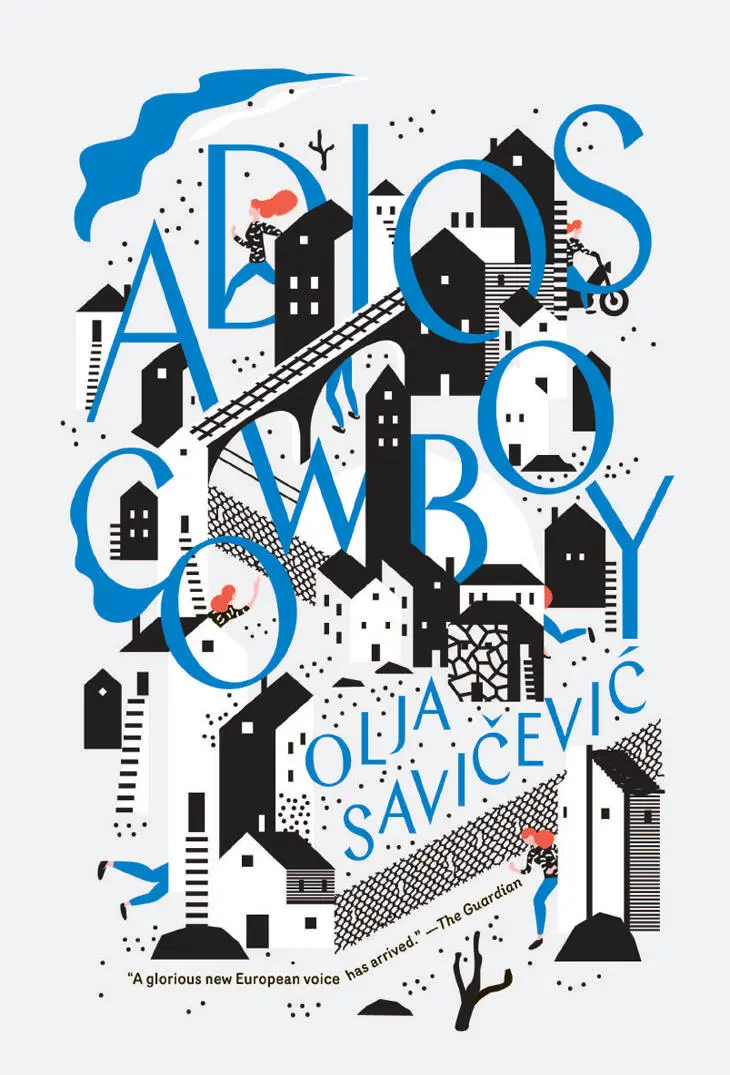
- Название:Adios, Cowboy
- Автор:
- Издательство:McSweeney's
- Жанр:
- Год:2016
- ISBN:нет данных
- Рейтинг книги:4 / 5. Голосов: 1
-
Избранное:Добавить в избранное
- Отзывы:
-
Ваша оценка:
Adios, Cowboy: краткое содержание, описание и аннотация
Предлагаем к чтению аннотацию, описание, краткое содержание или предисловие (зависит от того, что написал сам автор книги «Adios, Cowboy»). Если вы не нашли необходимую информацию о книге — напишите в комментариях, мы постараемся отыскать её.
Hoping to free her family from the grip of the past, Dada vows to unravel the mystery of Daniel’s final days. This American debut by a poet from Croatia’s “lost generation” explores a beautiful Mediterranean town’s darkest alleys: the bars where secrets can be bought, the rooms where bodies can be sold, the plains and streets and houses where blood is shed. By the end of the long summer, the lies, lust, feuds, and frustration will come to a violent and hallucinatory head.
Adios, Cowboy — читать онлайн бесплатно полную книгу (весь текст) целиком
Ниже представлен текст книги, разбитый по страницам. Система сохранения места последней прочитанной страницы, позволяет с удобством читать онлайн бесплатно книгу «Adios, Cowboy», без необходимости каждый раз заново искать на чём Вы остановились. Поставьте закладку, и сможете в любой момент перейти на страницу, на которой закончили чтение.
Интервал:
Закладка:
“Cul-de-sac,” Herr Professor would say. Blind alley.
The old men didn’t dally in that district — they just waved briefly and moved on — they occupied themselves at the other end of the Settlement, behind the Illyria and the slipway. The public social life of pensioners was strictly divided into female and male, as in a boarding school. The men played chess or cards at a long pine table or just sat, talking loudly. On the table’s concrete supports, someone had long ago written TABLE OF LIES.
Spat at, laughed at, then the next day patted on the back and celebrated, the knights of the Table of Lies, senile amateur politicians with a heart attack in their chests, moved figures of horses and huntsmen with their arthritic fingers, lost castles and pawns and exchanged an oral history of wars, fishing, and tourist sex. Demonstrating, proving that the past endures, that everything that once happened goes on simultaneously, and that in fact only the imperfect tense exists — that perfect verbal era and that thin, little borderline of shining conditionals: what would have happened if, a border stretched to infinity between the pluperfect and the future perfect, I reflected.
In former times, the lads from the Old Settlement who were going off to the Yugoslav National Army used to write their names on the walls of their houses, their date of birth and year they were called up. And they added some well-known lines of verse. At the bus station was written WAIT FOR ME SELENA from some song or other.
All these inscriptions became toponyms.
People say: “Let’s meet at Call-up ’65” or “Saw ’im this morning passing the Table of Lies,” or “Wait for me at Selena.” By now the words have been largely washed away by rain and sun — people are beginning to forget why the building with shutters the color of cornflowers, near the bus station, is called Selena.
The best-known of all the graffiti in the Old Settlement was written along the whole length of the parapet at the Main Jetty.
It was the spectacle of our childhood — greasy black letters on the white windbreak: STRANGER, THE LAW DOES NOT PROTECT YOU HERE. And high up on a mast, at the peak of the windbreak, on one leg stood not a vulture, a scavenger, but a seagull, a scrounger, Martin. All tame seagulls here are called Martin.
Legend has it that this graffito was the work of the Iroquois Brothers, which is impossible — I think that the inscription on the jetty was quite a lot older than the oldest of them.
In any case, when the waterfront was renovated a dozen years ago, they demolished the whole jetty, stone by stone. Afterward they put all those large stone blocks back, creating a new windbreak so that you could only make out here and there scattered parts of letters from which it was impossible to read STRANGER, THE LAW DOES NOT PROTECT YOU HERE. But then again, that graffito is forever inside, preserved in a sense.
An indelible mark was also left by the unknown hero who wrote, in bright blue paint all over the Settlement and down in the center: I LOVE YOU, NEDA. AND LOTS MORE BESIDES.
Just to be sure, he marked several of the more prominent places also with: HEY, NEDA, DO YOU READ BLUE GRAFITTI?
And there wasn’t a single Neda in the Settlement, just three Nadas. I wondered whether it was meant for one of them, and which.
Then, for a while, there was nothing new on the walls. If you don’t count the time when someone poured black paint over the plaque in the Community Hall listing the names of local Partisans and drew a swastika underneath it, and the following night the Partisan statues outside the primary schools and secondary school had their heads taken off. People all muttered about the Iroquois Brothers again, but I think that the business with the bronze heads was carried out by people from the new, not-yet-completed, three-story buildings on the other side of the railway. “Neo-outliers,” my sister called them. But maybe it wasn’t them; maybe I’m mistaken. Except in one thing: the Iroquois Brothers were vermin, even when they grew up, but they were too clever to destroy monuments.
In the Settlement there was no war in the sense of shooting; Yugoslav National Army ships fired at the western part of the town for two weeks, and then stopped. From time to time there’d be an air-raid siren as well. We were “cut off like on a lilo with sharks circling round it,” said Herr Professor.
My sister said “there was a stench.” Fear stinks, especially in shelters.
Some young guys from the Old Settlement, several years older than us, died in the war. We all cried.
Some other local men were taken away and disappeared without trace. We were all silent.
Some of our friends and their parents left the Settlement overnight and never came back.
We kids shouted “Serbian pervert!” to each other. Even the Serbs shouted that, those that hadn’t fled during the war or the hostile years that followed.
Everyone talked about snipers, and Mariana Mateljan, who had a personal demon in her head making her a target, arrived from the center in her orange Lada, drenched in sweat from holding her foot on the accelerator, and shouted from the doorway: “Give me sugar and water! What a dog’s life! Like I was driving soup in a shallow dish!” I recall. But I’ve forgotten quite a lot.
At that time, since we’re discussing graffiti, a big-eared U for the fascist Ustasha regime sprang up for the most part in the center as a popular design on street wallpaper. Some people did it for a joke, some out of conviction, some as an initiation ritual, and everyone out of boredom.
As far as the monuments went, the worthy citizens used to erect new totems and idols to replace the old ones, in a generational exchange of heroes.
For several days the papers chewed over the case of the name of the waterfront in the Old Settlement: should it be Jere Botušić (fighter in the National Liberation War, b. 1921—blown to bits by a hand grenade, 1943) Promenade or should the name be changed to Jere Botušić (Croatian defender, b. 1969—shot to pieces by a shell in 1993) Promenade. In the end a new inscription was placed on the waterfront with the name: Jere Botušić Promenade.
And the days passed peacefully, the walls were silent, the heads of the old statues sunk in the shifting bottom of the sea were silent, and indeed the new statues were silent too, guessing that it was just a matter of time before they too lost their heads.
Of the remaining graffiti of interest to me, there is one up by the railway track, in the little building that was once a waiting room and now serves as a shit house — an unofficial WC. It’s a drawing of a young, smiling, freckled cowboy, riding, instead of a bareback thoroughbred mare, an old bike, 50cc, toward the setting sun. Underneath, it says:
DANIEL R.I.P. THAT’S WHERE COWBOYS GO.
* * *
I’ve learned something about simultaneity: that memory is the present of all remembered events. The tape rolls forward and backwards. Fw-stop-rew-stop-rec-play-stop, it stops at important places, some images flicker dimly frozen in a permanent pause, unclear. But memory is also the saboteur editor in the back room, cutting and pasting, reframing to the very end, or at least until Alzheimer’s.
“The past is never completed, obviously,” Herr Professor announces, taking a VHS cassette out of an ancient video player. Only in the Old Settlement are there still people using video players.
“The past isn’t what it was,” I said.
That was all that was left of my brother, of his games, this pathetic Herr Karlo, I reflected. He placed his large misshapen mitts on the little garden table among the porcelain crockery. Like on my brother’s skinny shoulders.
“Gingernut,” that’s what he called him in the film.
Читать дальшеИнтервал:
Закладка:
Похожие книги на «Adios, Cowboy»
Представляем Вашему вниманию похожие книги на «Adios, Cowboy» списком для выбора. Мы отобрали схожую по названию и смыслу литературу в надежде предоставить читателям больше вариантов отыскать новые, интересные, ещё непрочитанные произведения.











Обсуждение, отзывы о книге «Adios, Cowboy» и просто собственные мнения читателей. Оставьте ваши комментарии, напишите, что Вы думаете о произведении, его смысле или главных героях. Укажите что конкретно понравилось, а что нет, и почему Вы так считаете.