Olja Savicevic - Adios, Cowboy
Здесь есть возможность читать онлайн «Olja Savicevic - Adios, Cowboy» весь текст электронной книги совершенно бесплатно (целиком полную версию без сокращений). В некоторых случаях можно слушать аудио, скачать через торрент в формате fb2 и присутствует краткое содержание. Год выпуска: 2016, Издательство: McSweeney's, Жанр: Современная проза, на английском языке. Описание произведения, (предисловие) а так же отзывы посетителей доступны на портале библиотеки ЛибКат.
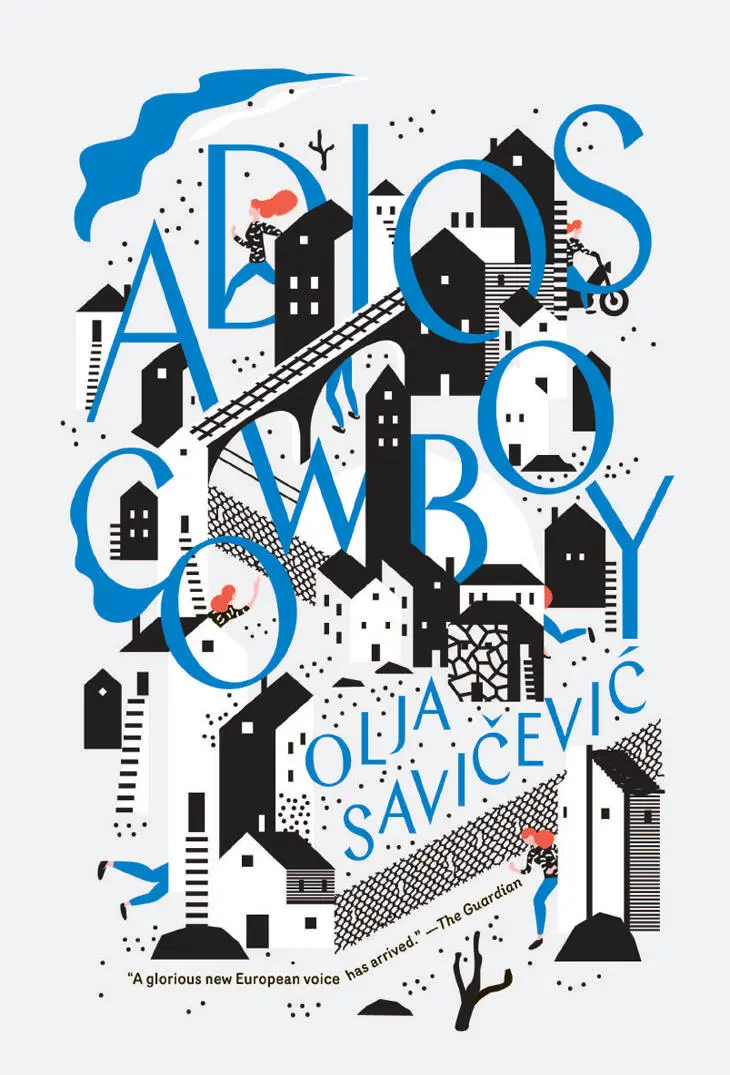
- Название:Adios, Cowboy
- Автор:
- Издательство:McSweeney's
- Жанр:
- Год:2016
- ISBN:нет данных
- Рейтинг книги:4 / 5. Голосов: 1
-
Избранное:Добавить в избранное
- Отзывы:
-
Ваша оценка:
Adios, Cowboy: краткое содержание, описание и аннотация
Предлагаем к чтению аннотацию, описание, краткое содержание или предисловие (зависит от того, что написал сам автор книги «Adios, Cowboy»). Если вы не нашли необходимую информацию о книге — напишите в комментариях, мы постараемся отыскать её.
Hoping to free her family from the grip of the past, Dada vows to unravel the mystery of Daniel’s final days. This American debut by a poet from Croatia’s “lost generation” explores a beautiful Mediterranean town’s darkest alleys: the bars where secrets can be bought, the rooms where bodies can be sold, the plains and streets and houses where blood is shed. By the end of the long summer, the lies, lust, feuds, and frustration will come to a violent and hallucinatory head.
Adios, Cowboy — читать онлайн бесплатно полную книгу (весь текст) целиком
Ниже представлен текст книги, разбитый по страницам. Система сохранения места последней прочитанной страницы, позволяет с удобством читать онлайн бесплатно книгу «Adios, Cowboy», без необходимости каждый раз заново искать на чём Вы остановились. Поставьте закладку, и сможете в любой момент перейти на страницу, на которой закончили чтение.
Интервал:
Закладка:
After them come nuns and women from the Choir of St. Lisa, singing “Christ on the Beach” and other such hymns. Their freshly shaved husbands carry large candles that sway, so they look like the burning masts of foreign yachts down in the Little Lagoon. Male aromas of incense and Pitralon spread around.
The largest candle, the Leader, was supposed to be carried by our father, but that’s impossible because of his illness and imminent death. Death has settled behind his pillow like the monkey, disguised, I could see.
Daniel had gone regularly, almost every day, to the fraternities and asked to be the one to carry it, but the Fjokans said he wasn’t strong enough and that “he should definitely come back in two or three years’ time.” In the end they gave in, nevertheless.
It was carried in seven circles, up and down, then down and up Long Street. When he couldn’t do any more, a large man would take the candle over, that’s what the men from the fraternity arranged, Daniel said.
“I’ll manage six,” said Daniel seriously. Ma was angry; she thought it was a bad idea.
“Maybe all seven!” he said to me and my sister, later.
They were hot days when the algae were blooming, in which the world as we had known it broke away from our future like part of the Red Sea on the poster for The Ten Commandments on the wall of Braco & Co., while we stayed for a little longer in between, on dry land, perplexed, but careless, cheerful, and foolish.
That morning, on St. Fjoko’s Day, I cut my hair.
Little flame by little flame, the breadbasket filled with fire and when Jill went to sleep in it, I saw that our fur coats were the same, of a similar color and softness.
This was no ritual, but just a case of “putting the moment into practice,” as Daniel would say — and I don’t think it had the slightest connection with what happened later. But it gave me the idea, I recall.
I was still a boy in those days. It was only the following year that my boobs began to grow. (For the rest of the summer, the girls from the Red Cross holiday home would whistle after me in the street and sometimes I liked it, and sometimes I didn’t.)
I stood for a long time in front of the mirror in Daniel’s room in the Fjokans’ festive costume, with the hood over my eyes: I’m taller than my brother, but not much, enough — I calculate. And similar, if I drop my shoulders like this and arrange my arms. And my hips, I observed.
“You can’t be the captain,” Daniel said yesterday as we were sailing on the dysentery sea. He was holding a palm-branch oar, I had the plastic one from the blow-up boat.
“Captainess!” I shrieked.
“You don’t get it, there’s no such thing. A captain, a cowboy, or a woman priest, they don’t exist.” He shrugged his shoulders. “What can I do,” he said, smiling, and I recall he had a tooth missing.
“What about Calamity Jane?” I yelled fiercely.
He thought for a moment.
“She turns into an ordinary lady in the end.”
I love the scene in which Calamity Jane appears at the top of the stairs in a dress and Wild Bill Hickock falls in love with her — I could rewind it and watch it for hours. He knows that, he’s teasing me. I gave him a shove with my oar so that he fell into the sea and I paddled to the shore.
That same afternoon I crept into his room: Indian patchouli sticks were burning to disguise the cigarette smoke. I smoked in the mirror under James Coburn and Kris Kristofferson from “a stupid, boring male story,” as I told Daniel. I had a bit of a rummage through his things, and then picked up the tidily laid-out Fjokan costume, put it on, and strutted about a bit.
Then, in front of the mirror it struck me. Why not? Something nice and warm rolled up to me and spread through the room. Why not?
“Biiii-iiitch!” yelled Daniel, a little later, down in my room, locked in.
“I’ll mur-der you! Honest to God!”
In vain — my room was in the cellar, deep in the rocks, in the house’s subconscious. I was sorry for my brother and felt disobedient, but not afraid. The Fearless Rusty.
The joy that buoys me up is strongest. It’s called excitement, a warm, golden ball in the belly and lower down, outside me. Like waking again and again. I’ll make it through all seven circles. It’ll be remembered. Oh, yes.
“Bravo, good for you,” I thought people’s eyes were saying in the procession.
“Bravo, Daniel, good lad, well done,” the dumb Fjokans would say afterward.
My body aches, everything in it hurts, every muscle and nerve, but the joy that buoys me up is far stronger. Behind the crossbearer with the cross, behind the two candle holders, behind the little silver box on the brocade cushion.
When we passed my father’s window for the fourth time, I summoned the strength to raise my head and look up: I wanted him to see me, and recognize me. He would be surprised, I imagined, and then he would burst out laughing. That was the scenario.
But the window was empty — a breeze had got up, so the blind was down.
The bells rang out again, and the greasy wax Leader slipped through my wet hands and broke dully on the ground.
At the top of the steps, in front of the door, my sister met me with red eyes and slapped me suddenly, palm open, on the cheek: “You’ve shorn yourself, you goat!”
From the bedroom we heard my mother’s thin squeal and the monkey slunk cackling through the open door, without anyone seeing it, apart from me and ginger Jill.
I broke away and ran after it down the hill to Long Street, toward the castle, though the lanes and dark vaults, to the slipway.
In the dusk, the procession was still milling about like ants when you tread on their anthill. They had stuck the Leader together with isolating tape, I observed from around the corner where I’d hidden. The monkey had crept where it was safest, among people, and vanished in the crowd under the wide skirt of one of the nuns, I saw.
I crawled unseen through the long empty rows of benches and white plastic tables on the square.
Down at the slipway, I’ll find Daniel, who has forgiven me.
“Sorry,” I’ll say. And it’ll be sorted.
There he is, my brother: he’s picking up seagull feathers for an Indian headdress, and we barely hear the sound of a departing ambulance.
4
EVERY DAY I SAY I’M LOOKING for work and then I go wandering. Although no one expects me to get a job: my sister acquired a sharp tongue, my brother a silver Colt, while I acquired my father’s pension in order to carry on studying. But I didn’t feel like learning anything anymore, not in school.
“You just be yet another stupid character in the Croatian novel,” my sister snapped.
She doesn’t understand. She studied at home, worked, and took all her exams on time, I know. Whenever I mention abandoning my degree, she looks at me the way one looks at a lost cause or an incomprehensible object. Which is, truth to tell, ontologically speaking the same thing, I reflected.
I had left Zagreb behind me as the most faraway city on earth, farther than Osaka and Juneau and Santa Fe.
“That’s what the towns where you abandon your failed illusions are like,” Ned Montgomery would say, riding off into the sunset with a cigarette between his teeth. Ned Montgomery is a romantic cowboy, after all.
“I can’t imagine going back to that city.”
Читать дальшеИнтервал:
Закладка:
Похожие книги на «Adios, Cowboy»
Представляем Вашему вниманию похожие книги на «Adios, Cowboy» списком для выбора. Мы отобрали схожую по названию и смыслу литературу в надежде предоставить читателям больше вариантов отыскать новые, интересные, ещё непрочитанные произведения.








Обсуждение, отзывы о книге «Adios, Cowboy» и просто собственные мнения читателей. Оставьте ваши комментарии, напишите, что Вы думаете о произведении, его смысле или главных героях. Укажите что конкретно понравилось, а что нет, и почему Вы так считаете.