Olja Savicevic - Adios, Cowboy
Здесь есть возможность читать онлайн «Olja Savicevic - Adios, Cowboy» весь текст электронной книги совершенно бесплатно (целиком полную версию без сокращений). В некоторых случаях можно слушать аудио, скачать через торрент в формате fb2 и присутствует краткое содержание. Год выпуска: 2016, Издательство: McSweeney's, Жанр: Современная проза, на английском языке. Описание произведения, (предисловие) а так же отзывы посетителей доступны на портале библиотеки ЛибКат.
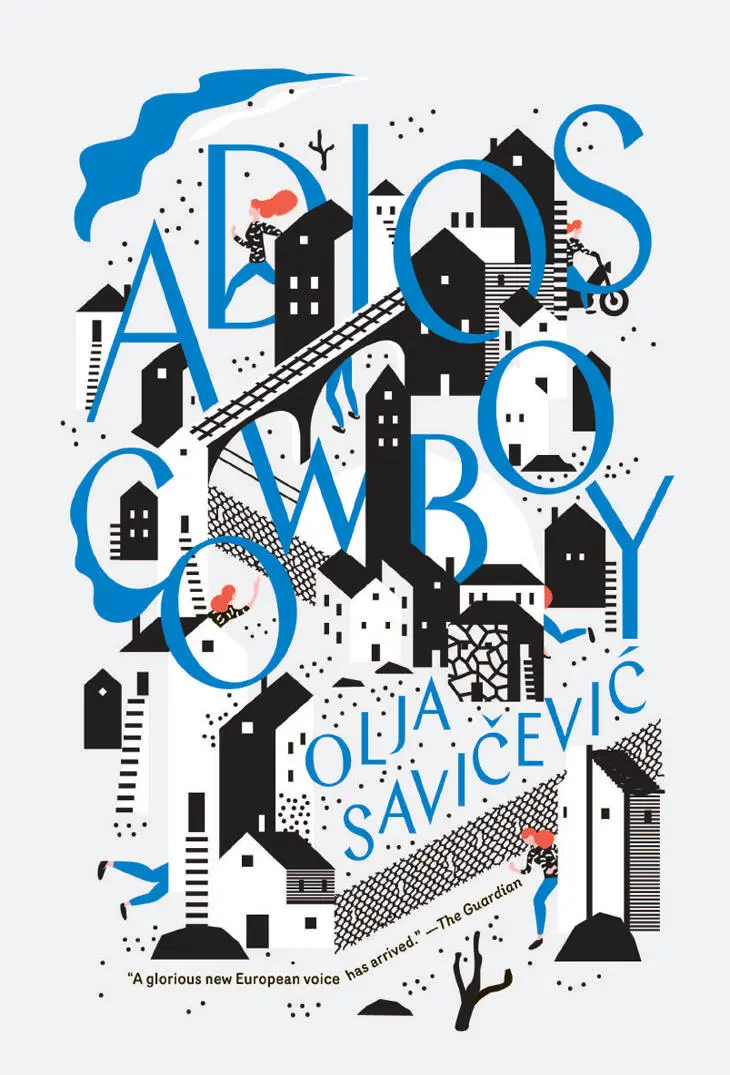
- Название:Adios, Cowboy
- Автор:
- Издательство:McSweeney's
- Жанр:
- Год:2016
- ISBN:нет данных
- Рейтинг книги:4 / 5. Голосов: 1
-
Избранное:Добавить в избранное
- Отзывы:
-
Ваша оценка:
Adios, Cowboy: краткое содержание, описание и аннотация
Предлагаем к чтению аннотацию, описание, краткое содержание или предисловие (зависит от того, что написал сам автор книги «Adios, Cowboy»). Если вы не нашли необходимую информацию о книге — напишите в комментариях, мы постараемся отыскать её.
Hoping to free her family from the grip of the past, Dada vows to unravel the mystery of Daniel’s final days. This American debut by a poet from Croatia’s “lost generation” explores a beautiful Mediterranean town’s darkest alleys: the bars where secrets can be bought, the rooms where bodies can be sold, the plains and streets and houses where blood is shed. By the end of the long summer, the lies, lust, feuds, and frustration will come to a violent and hallucinatory head.
Adios, Cowboy — читать онлайн бесплатно полную книгу (весь текст) целиком
Ниже представлен текст книги, разбитый по страницам. Система сохранения места последней прочитанной страницы, позволяет с удобством читать онлайн бесплатно книгу «Adios, Cowboy», без необходимости каждый раз заново искать на чём Вы остановились. Поставьте закладку, и сможете в любой момент перейти на страницу, на которой закончили чтение.
Интервал:
Закладка:
We were there, at the waterfalls on the Krka River, on an excursion that I had entirely wiped from my memory. Here’s my gingernut , says the vet on the film we had just watched together.
Gingernut and a large hand on the back of his neck, the fingers wrapped in little rusty flames.
Shit, maybe he really did do that with Daniel, I reflected.
I imagined him falling prostrate in front of Daniel, on the cold floor with its mosaic of Chinese tiles, spattered with cat’s and dog’s blood, and taking out of his jeans fly with his fat fingers Daniel’s proud and indifferent penis.
In the terrarium the lizards fidget, in the formalin the salamanders float, and the crocodile slaps its tail against the cabbage tub.
Herr Karlo trembles like a bashed cymbal.
After the next cymbal blow (it’s a nice day and a holiday, but a filthy gray nimbus has sailed up from the west), together with the lame horns and shrill trumpet, other sounds begin to enter: a ring tone, the church, a muffled meowing from the street, the calling and shrieking of a grasshopper that Ma is beating with a twig of tamarisk while loudly cursing its mother. I always return to reality with some invested effort, as though from a distance. Even if they call me at eleven in the morning or six in the evening, people ask me: Did I wake you? Because that’s how I sound. I was awake, of course. I hadn’t even been asleep, I reflected.
In reality there exists that almost unreal letter chafing me in my pocket, of that I am certain.
“Mr. Šain,” I say in an unfamiliar voice.
Here, in the courtyard, enclosed in high stone walls, where the light is soft, transparent, for an instant I feel (mistakenly) that I have finally, after many years, sat down beside water.
He hasn’t heard me. The bell in the tower is ringing more loudly — for St. Fjoko — and over the top of the carob tree, crammed with black fruits, I see the turquoise of the sky being squeezed out by the dense evening indigo.
“I need to ask you something.”
“Dada, my dear?”
“Did Daniel ever contact you, after you went away, did he send you any message, letter, email, did he ever get in touch?”
The catfish twitches, barely perceptibly.
Then, as though to himself: “Why are you tormenting yourself with this? He’s no longer here, you have to think of the living — yourself, your mother.”
“It’s better not to know some things,” said Ma, and look where her desire not to know has got her. That’s what I think, saying nothing.
He pulls out a used handkerchief with a blue edge and blows his nose loudly.
“Why, how would he have found me, I kept moving, from Brela to Rotterdam and then… No, I was all over the place, until I completely ran out of money. I was even, I was even robbed, yes.”
“What about email?”
“I don’t know.” He shrugs his shoulders and returns my gaze. “I rarely use it, if I have to,” he says. “I’ve got a bit old,” he says, and smiles somewhat bitterly.
The tortoises have separated and are now at two different ends of the garden. They hardly move. What are the chances of them never finding each other again?
“I’d never have done anything to hurt him. It may seem strange to you now, because Dani was almost a child, and I am, obviously, already almost an old man, but he was my best friend.”
As he speaks, the huge man quivers, closes his eyes and opens them wide, swallowing air:
“The fact that he got involved with some lads, a gang, you may know that…
… I warned him, that’s not the right company for you…
… He didn’t come back here again, anyway…
… They don’t like being lectured…
… Perhaps I could have done more…
… I always wonder…
… I could have done more…
… After that, I don’t know…
… In any case, you know what happened to me before I left, I was beaten up, half to death, for God’s sake…”
As he speaks, he clasps his large hands like a sick person suffering from some acute physical discomfort.
A few unexpected large drops of rain tinkle onto the crockery and drive the magic scarab beetle out of its hiding place under a plate. It stops on the white tablecloth like a forgotten amulet.
“Dung-beetle,” the vet comments drily.
“Yes,” I reply briefly.
My throat is constricted, as though he has stuffed it with those dirty, crusty rags, now dripping on the washing line before our eyes.
“It must be hard for the rain, once it starts, to stop. It would be for me. Like when you’re a child and pee in your sleep, without feeling shame or stopping,” says Karlo Šain.
We’re protected by the treetop and the porch, while beyond us it’s pouring.
I think fleetingly that Ma has probably not taken the shoes off the steps and now they’re getting wet.
I feel the piece of paper in my pocket, the envelope with the stamp; the image of Laika and postmark Perm — where’s that and why there — typewritten, a letter that was late and arrived after Daniel’s death. If I got it out now, would Karlo Šain say it was his? He would, I think, and I push the envelope under the tray on the table. Let him find it.
If this reply exists, there must also be a letter that preceded it. I’ve waited for four years for Herr Professor and that letter of Daniel’s, or email, whatever, his voice. And Karlo Šain says it doesn’t exist, that Daniel’s letter doesn’t exist. He looks me in the eye, lying. And mumbles about the rain.
Prof Šain says no letter of any kind  . I send my sister a message later.
Reply: What did I tell you! Leave him be. Who knows who wrote the letter .
For a time I look blindly at the screen, peed on by the downpour.
Like hell there’s no letter. And he’s the one. What other idiot would still use a typewriter.
Y et another one of those hottest and longest summers in our lives — the last prewar one. The sea blossomed and during the day the heat made it stink horribly of decay and sulphur, so during that whole unbearable time we bathed only at night in twinkling phosphorous.
Our father died at the beginning of August. It was the summer in the middle of which our time snapped and became forever unstuck, divided into before and after. It was impossible to put that broken, scattered time back together, or even connect its parts, which is what I keep trying to do.
During those days, the song of billions of cicadas and grasshoppers was transformed into a steady sound that stupefied, into afternoons that boiled noisily and into nocturnal effervescence. Our father told us that if you woke up early enough and went down to the sea, you could hear the seaweed cracking and emitting from its wounds a sticky juice like honey.
“They use it to sweeten tea and spicy foods in Mexico,” he said.
That man had learned everything he knew about the world beyond the Settlement from films.
They sent him home from the hospital three weeks ago. He is dying in the big double bed, in the light, airy room on the first floor. If I wake at night, I can hear his alveoli wheezing, his lungs separating, and a poisonous sticky juice like honey leaking into the cavities.
My father’s window, full of sky, is the only one in the house that looks out onto Long Street. Today is St. Fjoko’s Day, the town feast day, and on the corner table are pieces of used cotton wool and a dish of dewy figs.
This is the feast day, when trombones, a bassoon and cymbals sound, tables and chairs are taken out onto the square and in front of houses.
In the evening, fraternities, Fjokans, put on the specially adorned robes of their brotherhood with hoods and an embroidered gold-and-scarlet badge on their chests and process one after the other behind the crossbearer, behind two candle holders, behind the little silver box on a brocade cushion.
Читать дальшеИнтервал:
Закладка:
Похожие книги на «Adios, Cowboy»
Представляем Вашему вниманию похожие книги на «Adios, Cowboy» списком для выбора. Мы отобрали схожую по названию и смыслу литературу в надежде предоставить читателям больше вариантов отыскать новые, интересные, ещё непрочитанные произведения.











Обсуждение, отзывы о книге «Adios, Cowboy» и просто собственные мнения читателей. Оставьте ваши комментарии, напишите, что Вы думаете о произведении, его смысле или главных героях. Укажите что конкретно понравилось, а что нет, и почему Вы так считаете.