Olja Savicevic - Adios, Cowboy
Здесь есть возможность читать онлайн «Olja Savicevic - Adios, Cowboy» весь текст электронной книги совершенно бесплатно (целиком полную версию без сокращений). В некоторых случаях можно слушать аудио, скачать через торрент в формате fb2 и присутствует краткое содержание. Год выпуска: 2016, Издательство: McSweeney's, Жанр: Современная проза, на английском языке. Описание произведения, (предисловие) а так же отзывы посетителей доступны на портале библиотеки ЛибКат.
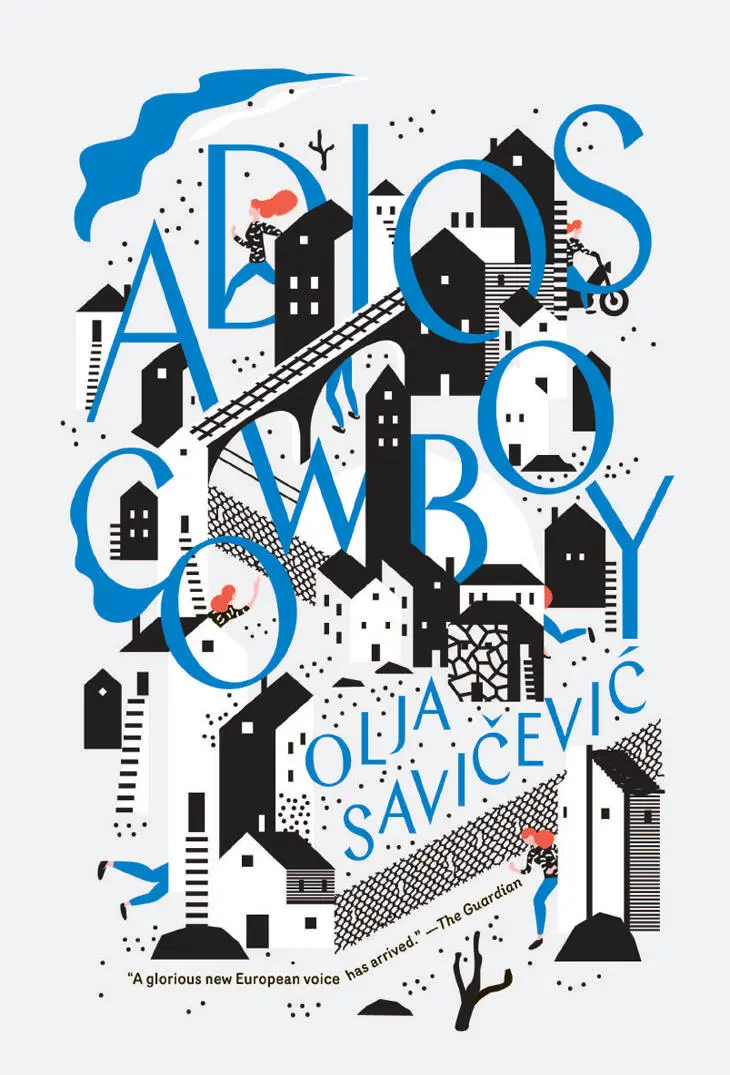
- Название:Adios, Cowboy
- Автор:
- Издательство:McSweeney's
- Жанр:
- Год:2016
- ISBN:нет данных
- Рейтинг книги:4 / 5. Голосов: 1
-
Избранное:Добавить в избранное
- Отзывы:
-
Ваша оценка:
Adios, Cowboy: краткое содержание, описание и аннотация
Предлагаем к чтению аннотацию, описание, краткое содержание или предисловие (зависит от того, что написал сам автор книги «Adios, Cowboy»). Если вы не нашли необходимую информацию о книге — напишите в комментариях, мы постараемся отыскать её.
Hoping to free her family from the grip of the past, Dada vows to unravel the mystery of Daniel’s final days. This American debut by a poet from Croatia’s “lost generation” explores a beautiful Mediterranean town’s darkest alleys: the bars where secrets can be bought, the rooms where bodies can be sold, the plains and streets and houses where blood is shed. By the end of the long summer, the lies, lust, feuds, and frustration will come to a violent and hallucinatory head.
Adios, Cowboy — читать онлайн бесплатно полную книгу (весь текст) целиком
Ниже представлен текст книги, разбитый по страницам. Система сохранения места последней прочитанной страницы, позволяет с удобством читать онлайн бесплатно книгу «Adios, Cowboy», без необходимости каждый раз заново искать на чём Вы остановились. Поставьте закладку, и сможете в любой момент перейти на страницу, на которой закончили чтение.
Интервал:
Закладка:
Nevertheless, the boy is really nice-looking, I thought to myself. Handsome, they would say in books. One of those whom you could just look at for hours and it would be interesting. Dark legs in white socks and grimy white trainers. Shoulders, bearing — is that indifference — eyes narrow between his lashes. He was kicking a squashed plastic bottle over the gravel, unaware of how striking he was.
“Angelo,” a tall passerby in a hurry addressed him, that’s how he had been greeted by someone in a Municipal Cleaning Department uniform who had passed by a little while ago, pushing a cart with brushes and a black plastic bucket, that was the name that a thin little girl whispered to another, long-legged, laughing, as they glided past him on Rollerblades.
After a while a woman came for him in a convertible, around thirty, dressed formally and elegantly: cream skirt, lilac blouse, fine and bright, and cream sandals with low heels. She was carrying a summer coat over her arm, under her armpits she had visible damp patches, her limbs were slender and firm, the tanned skin on them polished, shiny, her long hair gathered up into a bun.
“Like an advert,” Ma would say.
As he walked toward her little sports car, the young man looked up, toward the place where I was standing, leaning out. But I don’t believe he saw me. The western sun was gleaming from the direction of the house.
Beside Angelo, on the sunny side, his short shadow glided, suddenly lengthening as he walked, reaching right up to the woman’s feet, then touching them, covering them, stroking them.
Outside our building, the tepid salt air was filled with motionless images without perspective. It was a world of theater flats and vertical planes, which a cat can scuttle over or a child with a bloody knee pushing a scooter crosses in a few steps. This is the part of the day when birds go crazy above the factory chimneys, a ripe August afternoon in which the bare Settlement bakes under a heavy lid and the sea evaporates.
“Sultry, heavy, and desolate,” the insatiable one would say.
I had never considered burned-up landscapes ugly, only tedious; or desperate, if I was myself in despair. Not in a hundred years will this ever bloom into a paradise garden. No way, I thought.
The whole day the sky looked like an apocalyptic postcard.
“Divine Providence!” the insatiable one would observe of such dramatic stage designs. Because cumulus clouds had begun to gather in the west and the oppressive heat would be so intense that, although it was nearly evening, the wallpaper in the rooms would start to sweat, and the branches of the poisonous oleanders in the yard, scalded with damp, would droop to the ground.
People would walk with greasy, wet faces and tap their barometers in disbelief when they predicted stormy weather and low blood pressure, sometimes unconsciousness. Inertia, in any case, and “that’s not laziness, but an acute sickness of the will,” my sister correctly observed.
The boy with the mouth organ and his escort (or, in fact, he’s most probably the escort) had left the stage, so for a moment the street was empty and abandoned.
“Rusty’s back!” shouted the little girl on the Rollerblades to her friend, sailing into the frame. I waved to them. I picked up a hat and waved harder.
“Hey-ey, Rusty!” the little girls waved back.
On my way out I jumped over the shoes that Ma had forgotten and that were still baking on the steps; there was fresh seagull shit on some of them.
In Long Road, the suburb smelled of impending rain and incense from the impending procession, and some people were taking tables out for this evening’s festivities. Like an apparition, down the street rode that old blacksmith on his horse, talking to someone on his cell phone, hands free.
When the sun goes down I say: I’ll go and look for a job, and then I wander. In fact, I wander from morning to night. On Monday and Friday mornings Ma and I follow the standard route from the graveyard to the beach.
“When I’m up there, I’m with them,” says Ma solemnly, in a high register like an amen.
“Go with her, she’ll fall under a truck, she’s so woozy in this sun,” my sister phoned to say.
So I accompany her. We’re becoming like those mother-daughter pairs that don’t separate even when the little girl grows up. Only then it usually turns out that it’s the daughter, rather than the mother, who’s lost the plot.
Such pairs can often be seen in the more affluent districts, in better-educated and well-to-do families, also in families with no sons, I’ve observed. So we don’t satisfy a single one of the criteria.
The mothers and daughters I’m talking about are often very similar physically and they dress in a similar way, but sometimes the mother is pretty and young, while the daughter is ugly or fat. They sit in the morning at Clio or Twingo and go to shopping centers and cafés together.
“Your younger sister?” passing acquaintances will inquire courteously.
And the mother and daughter smile equally courteously or the mad daughter will just keep going, while the mother feels uncomfortable and breaks off the chat.
The news here is that last Monday Super Mario clones came to our settlement, with little red caps and red boiler suits, and in a matter of days demolished and then began to rebuild the Illyria.
We passed the Illyria almost every day, so that we were able to follow that amazing development as on a speeded-up film. It was as though the cement contained some luxury substance that made the building rise like dough and be rejuvenated.
This reminded me of a program about nature that Ma regularly watched — the credits would show a gaudy flower that germinated, swelled, and burst into flower from an ordinary seed in five seconds, and then, in the next five seconds, in a new frame we would see an embryo becoming, in an incomprehensible transformation, a burly fellow, with the face of an urban peasant, but no doubt of a romantic disposition, because he picks the flower.
That sequence left me with a certain skepticism about the natural sluggishness of the eye.
A gust of wind briefly cooled the air, but it also washed all kinds of rubbish into the Little Lagoon — the main attraction being the corpse of a young shark — so on the whole I lounged in the shade with a towel spread out between cigarette butts and peach stones, watching the boats moving around the little islands outside the bay, in the middle of the channel.
Mother would stretch out on the beach, picking from it a morning rosary of tiny shells and sea snails, smaller than a child’s nail and delicately formed. She was more likely to be intrigued by a snowflake, filigree, or a word on a grain of rice than the Eiffel Tower or the Sahara. She once bought special paints and drew miniature drawings on hollow eggshells. But that was before her narcotic phase, while she still had ambitions of a sort.
The sea in the bay is a dense color and as stable as primeval soup. Later, around midday, little boys come and gambol extravagantly in the shallows, but first thing in the morning it is tranquil, apart from the sounds of building works from the direction of the Illyria.
I like the Little Lagoon more than the other beaches in the Settlement because of the five old pines whose crowns are so high that I have to turn my head upside down and gaze straight into the sky to see them, which makes me dizzy; and it’s not exposed to the south wind, so that there has always been less tar than at the other bathing places, from which we returned with black marks on our pants, I recalled. The beach was edged with laurel and pittosporum, planted by a Czech doctor who had once lived above the Little Lagoon. Even today his house is still the nicest in the Old Settlement, “far nicer than Karlo Šain’s house,” said Ma. The pittosporum bushes were decorated with ice cream wrappings and condoms; “at least the Little Lagoon hasn’t yet been totally shit to pieces,” said my sister.
Читать дальшеИнтервал:
Закладка:
Похожие книги на «Adios, Cowboy»
Представляем Вашему вниманию похожие книги на «Adios, Cowboy» списком для выбора. Мы отобрали схожую по названию и смыслу литературу в надежде предоставить читателям больше вариантов отыскать новые, интересные, ещё непрочитанные произведения.








Обсуждение, отзывы о книге «Adios, Cowboy» и просто собственные мнения читателей. Оставьте ваши комментарии, напишите, что Вы думаете о произведении, его смысле или главных героях. Укажите что конкретно понравилось, а что нет, и почему Вы так считаете.