Olja Savicevic - Adios, Cowboy
Здесь есть возможность читать онлайн «Olja Savicevic - Adios, Cowboy» весь текст электронной книги совершенно бесплатно (целиком полную версию без сокращений). В некоторых случаях можно слушать аудио, скачать через торрент в формате fb2 и присутствует краткое содержание. Год выпуска: 2016, Издательство: McSweeney's, Жанр: Современная проза, на английском языке. Описание произведения, (предисловие) а так же отзывы посетителей доступны на портале библиотеки ЛибКат.
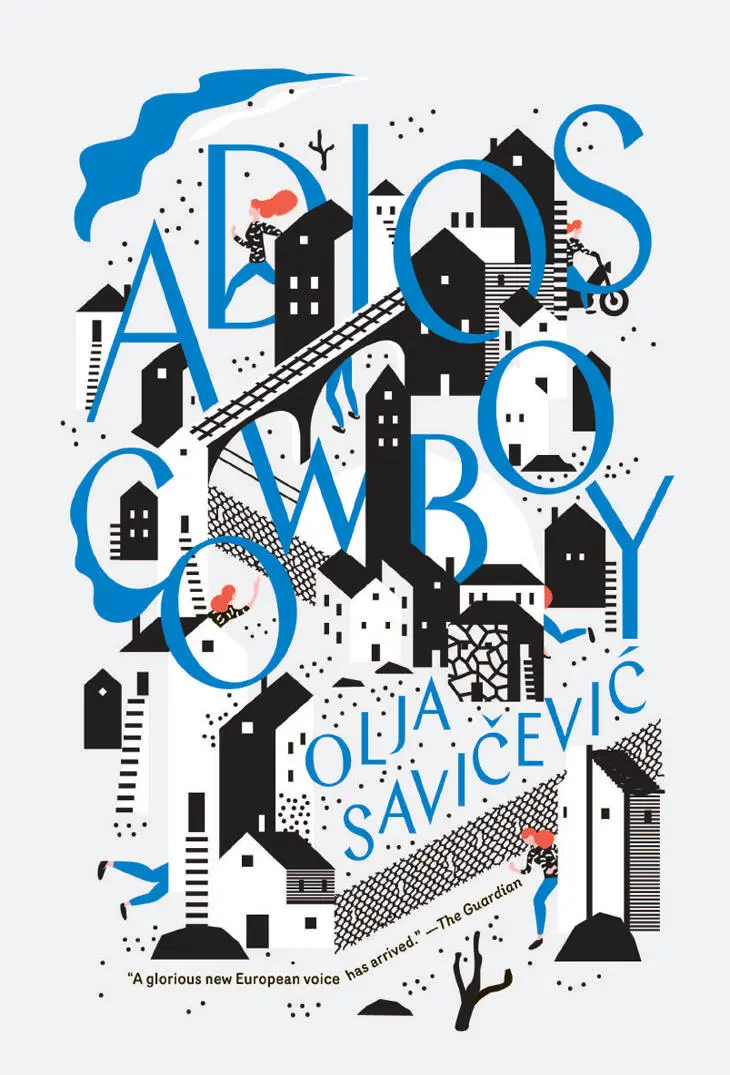
- Название:Adios, Cowboy
- Автор:
- Издательство:McSweeney's
- Жанр:
- Год:2016
- ISBN:нет данных
- Рейтинг книги:4 / 5. Голосов: 1
-
Избранное:Добавить в избранное
- Отзывы:
-
Ваша оценка:
Adios, Cowboy: краткое содержание, описание и аннотация
Предлагаем к чтению аннотацию, описание, краткое содержание или предисловие (зависит от того, что написал сам автор книги «Adios, Cowboy»). Если вы не нашли необходимую информацию о книге — напишите в комментариях, мы постараемся отыскать её.
Hoping to free her family from the grip of the past, Dada vows to unravel the mystery of Daniel’s final days. This American debut by a poet from Croatia’s “lost generation” explores a beautiful Mediterranean town’s darkest alleys: the bars where secrets can be bought, the rooms where bodies can be sold, the plains and streets and houses where blood is shed. By the end of the long summer, the lies, lust, feuds, and frustration will come to a violent and hallucinatory head.
Adios, Cowboy — читать онлайн бесплатно полную книгу (весь текст) целиком
Ниже представлен текст книги, разбитый по страницам. Система сохранения места последней прочитанной страницы, позволяет с удобством читать онлайн бесплатно книгу «Adios, Cowboy», без необходимости каждый раз заново искать на чём Вы остановились. Поставьте закладку, и сможете в любой момент перейти на страницу, на которой закончили чтение.
Интервал:
Закладка:
Today the telephone rang as Ma was making coffee for herself and her relative Mariana Mateljan. Cigarette smoke swirled down the corridor from the kitchen, water gurgled in the pot on the hot plate. They were both staring at a soap.
Šain Karlo here, please, I would like… to speak to Dada… So, at last, dear Dada!
“Mariana’s my oldest friend,” Ma would mention from time to time. “And my close relative,” she’d add.
Mariana had been coming from the city center in an orange Lada for decades — on Sundays, sometimes also on Wednesdays. Then one of the two of them would say something they shouldn’t have and Mariana Mateljan would vanish without trace for a week, a month, and once even for two years. A black fart of smoke would puff out of the Lada’s exhaust and she would drive off furiously like an orange out of hell. The last time that happened, we wrote her off forever, but then she did appear again just after Daniel’s death.
I did not wish to disturb your dear mother… Otherwise, I would have got in touch myself, had I known that you… Had I known that you had come. Yes, yes, I did, I got your messages, but — I was away. Out of town on business. But, of course! It would be important for me, I would be glad if you came. Of cooourse… To remember the old days. Besides, besides…
“Hell, I thought we’d got rid of her, like the others,” said my sister when Mariana appeared among us again, with swollen eyes.
My sister polished her hatred of her to a high shine, I recall.
But still, Mariana finally found an appropriate role in our house and played it briskly and steadfastly. She was devoted to our ebbing Ma; Ma’s misfortune brought Mariana freedom in their relationship. We knew — had it not been for Daniel’s death, our relative would never have crossed the threshold of this house again.
Pride is such a bizarre attribute, and self-destructive; I’m not really clear why we count it a virtue.
For the first two weeks after Daniel’s funeral, there would be up to thirty people in our house every day, they drank brandy, smoked and talked, and then suddenly, no one remembers the transition, they disappeared. Bit by bit, after some time, they stopped phoning as well. They probably didn’t know what to talk about, it “discom-mod-ed them all,” said my sister.
Mother sat and nodded the wax mask on her face up and down, like people on antipsychotic drugs when they come out of the madhouse, looking like robots or disinterred totems. My sister washed glasses ceaselessly, emptied ashtrays, and sent piercing glances toward her soft, now former, husband. Tragedy swayed in the room, hanging from the ceiling light between the visitors and us.
“Someone else’s tragedy, that requires commitment,” said my sister.
Come as soon as you can, come whenever you like. We’re not far, we’re neighbors, after all! Yes, yes, of course. Knock hard… my bell still doesn’t work… on the door… Bye. Bye, my dear.
I put the receiver down.
Mariana was sitting in a preparing-to-concentrate attitude in front of the television, cracking walnuts.
“It’s our St. Fjoko’s Day today,” she said.
“He saved us from the plague,” she added, scratching her belly.
“And died of syphilis,” she said emphatically.
I guessed that this was the beginning of one of Mariana’s bravura tirades, and they shouldn’t be missed. I’ll go this afternoon, besides, besides .
I’ve no clue what our Fjoko died of or why. His holy bone was carried up and down in a silver box behind the high cross along the one decent road in the Settlement. The Long Road leading from the port to the way out onto the highway.
On St. Fjoko’s Day, a band of male and female blowers, sweaty in their blue uniforms, blares away all day, morning and afternoon. Toward evening the men from the brotherhood squeeze into cowls and set off in a procession with flaming torches, while behind them the nuns and women from the church choir of St. Lisa sing monotonously.
Around the tail of the centipede that is twice as long as Long Road, the emotional populace mills with dignity. They mill, because Long Road is not particularly long and sometimes the procession’s head catches up with its own tail.
“ Dunque, ” continues Mariana, licking honey from the piece of bread on which she has laid the walnuts, “the future saint’s embarrassing illness never stops him carrying on with his lovers. In fact, his body’s falling apart, his bones is decaying, but his spirit’s still lively. That’s why merciful and almighty God left our martyr, for all he was syphilitic, untouched in the part that was for his devotees, as indeed for the whole town today, a holy relic — here, like this!”
She stretched out her fat middle finger with two gold rings and a long, polished nail.
“He never did!” I bleated. She sometimes imagined things, like every born storyteller who sacrifices truth on the altar of the story.
Everyone knows that Fjoko had a blessed finger whose touch cured lepers. So what was so fantastic about this, I asked her.
Mariana’s body, covered in tinkling jewellery, in its wide tunic of dazzling brightness, had settled into the couch, but only in order to spread its crest.
“All depends,” she answered. “You can lie to tell the truth. When all’s said and done, in all the hullabaloo over St. Fjoko there’s a little bone from his middle finger, so you just have a think.”
She smacked her lips and lightly stroked her gold and silver rings over sleepy Jill, who had snuggled in between the cushions.
Mariana has a long head, good-looking in a horsey way, and you can’t say that horses aren’t beautiful, but her body is enormous, it seethes even when it’s still, creating ebbing and flowing tides around it as it moves.
Ma was smiling absently as she put out her cigarette. The ashtray was brimming with flat cigarette butts and walnut shells. Then she immediately rolled and lit a new one and turned up the volume.
Aaron clasped Minerva in a passionate embrace.
Mariana wiped away an invisible tear with her thumb.
Beside her, Ma looked like a wax candle beside a lighted Chinese lantern, I observed.
Our relative waved her hands, pressing the heat and stench out of the room. She sank still more deeply into the couch, occupying all the comfort available. I thought about the way Mariana sucked in through her pores the comfort of whatever room she found herself in. Along with the comfort, all the kitchen smells and household dust and odor of Tiger Balm from Mother’s skin entered into her as well. Created from all those particles, which she absorbed like a brightly colored hole in space, her laughter swelled and bubbled out of the windows, while her imperial flesh gushed under her wide clothes.
“Someday she’ll go into our kitchen,” my sister said once, and our kitchen is small, “and she’ll never be able to get out again.”
After the soap, we drank up our bitter Turkish coffee, listening to the clock ticking in the hall as in some distant-period pantry, muffled by many years of accumulated preserves that time had forgotten to abandon and move on.
Perhaps they were thinking about poor Aaron, a mulatto who dies of jealousy on a daily basis. The people, who occasionally pass under our windows, carrying benches and large pots for fish stew into Long Road, are surely thinking about the celebration, the feast day. I was thinking about the afternoon and about Herr Professor Karlo Šain, who still had to answer my question and whose neighboring house suddenly seemed to me as though it were at the end of a forest.
That evening, beneath the window stood a young man with a mouth organ, only without the mouth organ — the good-looker I saw the night I arrived in town, at the Last Chance. I had already recognized him through the thin curtains by his silhouette. He was, evidently, waiting for someone on the corner behind the former Co-operative Building, directly opposite the baker’s house. Like this, without his blue tuxedo, he looked like an ordinary lad, killing time.
Читать дальшеИнтервал:
Закладка:
Похожие книги на «Adios, Cowboy»
Представляем Вашему вниманию похожие книги на «Adios, Cowboy» списком для выбора. Мы отобрали схожую по названию и смыслу литературу в надежде предоставить читателям больше вариантов отыскать новые, интересные, ещё непрочитанные произведения.









Обсуждение, отзывы о книге «Adios, Cowboy» и просто собственные мнения читателей. Оставьте ваши комментарии, напишите, что Вы думаете о произведении, его смысле или главных героях. Укажите что конкретно понравилось, а что нет, и почему Вы так считаете.