Olja Savicevic - Adios, Cowboy
Здесь есть возможность читать онлайн «Olja Savicevic - Adios, Cowboy» весь текст электронной книги совершенно бесплатно (целиком полную версию без сокращений). В некоторых случаях можно слушать аудио, скачать через торрент в формате fb2 и присутствует краткое содержание. Год выпуска: 2016, Издательство: McSweeney's, Жанр: Современная проза, на английском языке. Описание произведения, (предисловие) а так же отзывы посетителей доступны на портале библиотеки ЛибКат.
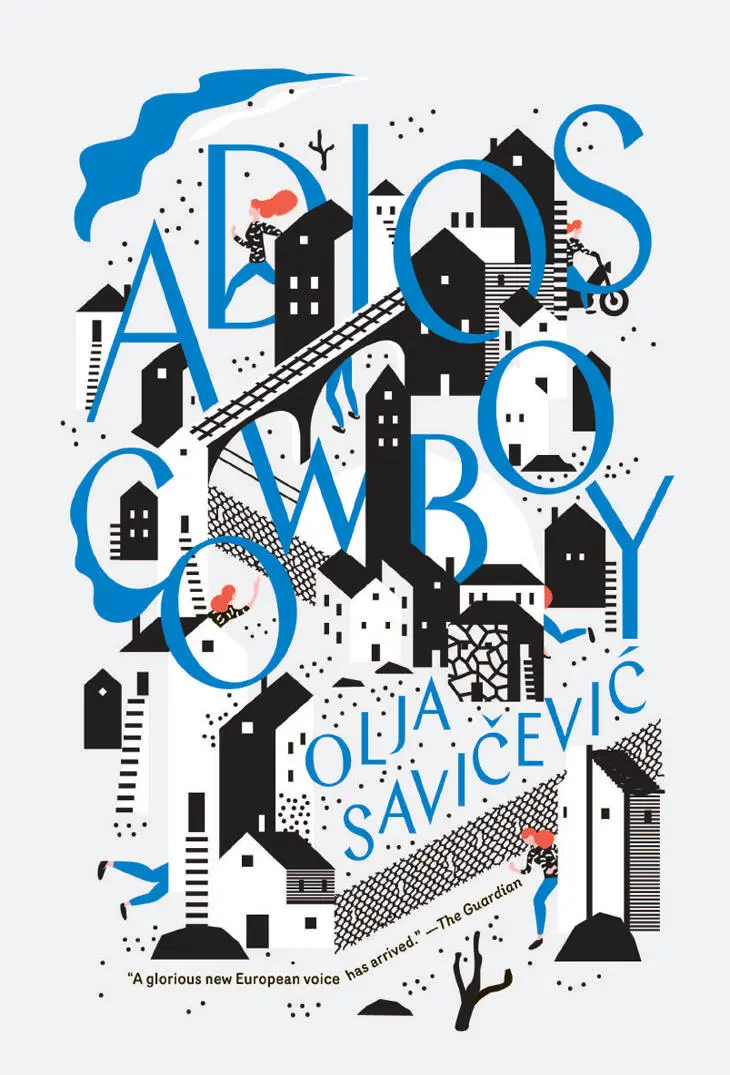
- Название:Adios, Cowboy
- Автор:
- Издательство:McSweeney's
- Жанр:
- Год:2016
- ISBN:нет данных
- Рейтинг книги:4 / 5. Голосов: 1
-
Избранное:Добавить в избранное
- Отзывы:
-
Ваша оценка:
Adios, Cowboy: краткое содержание, описание и аннотация
Предлагаем к чтению аннотацию, описание, краткое содержание или предисловие (зависит от того, что написал сам автор книги «Adios, Cowboy»). Если вы не нашли необходимую информацию о книге — напишите в комментариях, мы постараемся отыскать её.
Hoping to free her family from the grip of the past, Dada vows to unravel the mystery of Daniel’s final days. This American debut by a poet from Croatia’s “lost generation” explores a beautiful Mediterranean town’s darkest alleys: the bars where secrets can be bought, the rooms where bodies can be sold, the plains and streets and houses where blood is shed. By the end of the long summer, the lies, lust, feuds, and frustration will come to a violent and hallucinatory head.
Adios, Cowboy — читать онлайн бесплатно полную книгу (весь текст) целиком
Ниже представлен текст книги, разбитый по страницам. Система сохранения места последней прочитанной страницы, позволяет с удобством читать онлайн бесплатно книгу «Adios, Cowboy», без необходимости каждый раз заново искать на чём Вы остановились. Поставьте закладку, и сможете в любой момент перейти на страницу, на которой закончили чтение.
Интервал:
Закладка:
“Ah, damnation, what can you do,” I said to my little motorized pony, watching the tall, handsome young man walking away from me, without ever having been mine.
Tame as a little dog, I reflected sadly.
I had the impression they were arguing, so I sparked the bike and sped off along the tarmac. I didn’t have much appetite for marital or nonmarital scenes, and besides, there was an important errand I had to make.
Behind the tents, the extras were drinking coffee that they poured from a thermos flask into cups — I observed — and the Gypsy, laying her feathers down beside her on a chair, read their fortunes in the grounds.
Several hens squawked when I revved the bike.
Through the window of the red car, in my rear mirror, Billy the Kid kissed his tanned sponsor.
* * *
I dashed through the early dusk toward the Last Chance, following the smooth curves of its neon aura. In front of me, in the distance above the wood, the skeletons of cranes loomed over the hill and high-rise buildings. My tires crunched on fir cones scattered over the ground by the night wind — a loud summer wind that drove me to go faster. Inland the wind has no sharpness, it excites you softly, but when I slow down, I can hear the rigging jangling on the masts down in the harbor and ships howling through their halyards.
The Last Chance is a place with a reputation: good and bad. Its dark door always swallows us gladly and afterward spits us, communicants, out into the calmer night.
Dutch Sonja opened this dive in the middle of the nineteen-eighties in a copse beside the sea, in Kućica — an abandoned beach complex below the former Red Cross rest home, halfway between the Settlement and the town center, on the shore. The place became famous because it stayed open until 4 a.m., when everything else was closed.
As children, we rarely went into that pinewood; by day a local exhibitionist tended to roam around there, and at night there was no lighting.
“Wanker,” that’s what we called them, those exhibitionists. There were two or three of them in the Settlement, and the girls used sometimes to see them in the company of their fathers or brothers, in cafés or garages. So the girls generally said nothing about it. Sometimes the wankers were their fathers or brothers. I knew four sisters who had a house beside a stream, below the highway. The oldest would blush whenever she saw us, even at school, she was always red in the face, that little girl we called Karolina-the-wanker’s-daughter, casually, as though we were saying Karolina the postman’s or the dentist’s daughter or Karolina of Monaco.
There’s something suppressed about the Old Settlement, “like venereal disease on the brain,” said my sister.
“Like Twin Peaks ?” I asked, while my stomach gave a lurch backwards, as when I was a child.
The innocent and God-fearing Old Settlement, at the time of plant spraying, at the time of the intensive evaporation of smells, stank and crackled like a red-hot codfish in a pan.
“Man,” said my sister, “sometimes I think no one here fucks naturally or without a pang of conscience.”
“Catholicism in the Balkans, think about it, what a combination, that simply has to be perversion to the nth degree,” she said.
But people do fuck, because the streetlights never work, I reflected. The attempts to fix them were a serial fiasco, because some sensitive lover would always throw a stone from a copse and break the bulb. The only light was the neon coconut palm at the Last Chance, flickering on the deserted island of sighs, in the middle of the indigo night. The Chance changed its owners, closed, but in the end always reopened the entrance into its deep maw with the bright pink tongues of light reaching out from inside. For every lost creature on the road. For all of us.
I left the moped unchained outside the door and bowled in along with the wind. The little house immediately licked its lips.
From the doorway, I caught sight of the short figure with the baseball cap I was looking for. His short legs, out of proportion to his body-built torso and round head, were swinging comically from the bar stool. He was sitting at the poker game, pressing a red button with two fingers of one hand.
“Ahoy, long time no see,” the man at the bar winked by way of a greeting and gestured with his chin toward my dealer. “Hacker,” he said. “Plays better than the machine.”
Diana was smoking and putting clean glasses away.
The queer fellow swiveled on the stool to face me.
“Rusty? Henry George,” he said, offering me his hand cordially and formally, in the style of a traveling salesman, a young manager. He had glasses with thick lenses, but in fashionable frames, like TV hosts or teenage rap stars.
His little feet, size thirty-seven, roughly, in high Nike trainers, kept slipping off the footrest and dangling in the air. He was chewing gum; he’d blocked his ears with headphones.
I wouldn’t have been surprised if he started offering me porn movies, LSD, or decoded cell phones.
“This is my seventh coffee today,” said Henry George, licking his plastic spoon.
“Not good for the stomach,” I said for something to say.
“That’s what life’s like for us journalists, legend,” said the to-halfway-man-from-halfway-child.
His name had been appearing recently on the pages of corporation newsletters, I’d noticed. But any information, or disinformation, could be bought from him in various forms also privately; he was known for that.
“Here’s the money, give me the file, and I’m off,” I said.
He thrust a little black stick, with “DataTraveler” written on it under my nose.
“You’re jittery… What’s the rush, legend?”
I put the money on the table, picked up the USB stick, nodded to him, and left.
“Hey-hey,” I heard a voice behind me in the wood, after I’d already taken a few steps, and was trying to kick-start the engine and leap on — that was an old trick for starting crocks like my bike. The man behind me was Henry George, and I knew without looking around, he was coming toward me.
“Hey, legend, you’re the first person not to ask me which is my first name and which my surname.”
I shrugged my shoulders.
“I’ll buy you a drink.”
“No, thanks. My stomach’s not quite right,” I lied.
“No shit? As you like. Well, if you ever need me…”
He made that call-my-cell gesture with raised thumb and crooked little finger. I really hate that so I glowered.
“Hey, legend, don’t be mad at me, don’t forget you were the one who looked me up,” he said, winking.
“I didn’t say anything,” I said.
“Sure, but I get your drift,” he said. “Always the same, always ’enry the cunt. And who is it I get this shit for, if not for you, fine, honest folk. And what’m I, an ordinary supplier, small-scale merchant. People say, George, oh ’e spreads tales around, sells scandals, dubious type. But I’m a professional, a ’andler. I don’t ask superfluous questions, I work to order. If it wasn’t me, it’d be someone else, worse, wouldn’t it? Private landlord, showman, obliging fixer and bar girl, if you want, that’s me, nothing else! But the clientele wants celebrity soup and blood, that’s what they say. It’s all showbiz. And I do this for fun and dosh. Like everyone else.
“You’re presumably not so stupid as to think that people do bad things ’cause of some childhood trauma or some ideology, religion, doctrine, or motherfucker? I’ve got news for you, legend — folk like shit! They’re crazy for shit. For instance, people really like to ’ammer someone from time to time. It just comes over them. And if we’re being radical, think of wars, when their leash is loosened a bit and it’s, like, they’re doing it under the patronage of some God-the-father, like, they kill and rape for the ’omeland, church, king, some big wanker. The rabble can’t ’ardly wait for a war like a sports match to let off some steam. You don’t know who enjoys it more, the one watching and cheering or the one taking part.
Читать дальшеИнтервал:
Закладка:
Похожие книги на «Adios, Cowboy»
Представляем Вашему вниманию похожие книги на «Adios, Cowboy» списком для выбора. Мы отобрали схожую по названию и смыслу литературу в надежде предоставить читателям больше вариантов отыскать новые, интересные, ещё непрочитанные произведения.







Обсуждение, отзывы о книге «Adios, Cowboy» и просто собственные мнения читателей. Оставьте ваши комментарии, напишите, что Вы думаете о произведении, его смысле или главных героях. Укажите что конкретно понравилось, а что нет, и почему Вы так считаете.