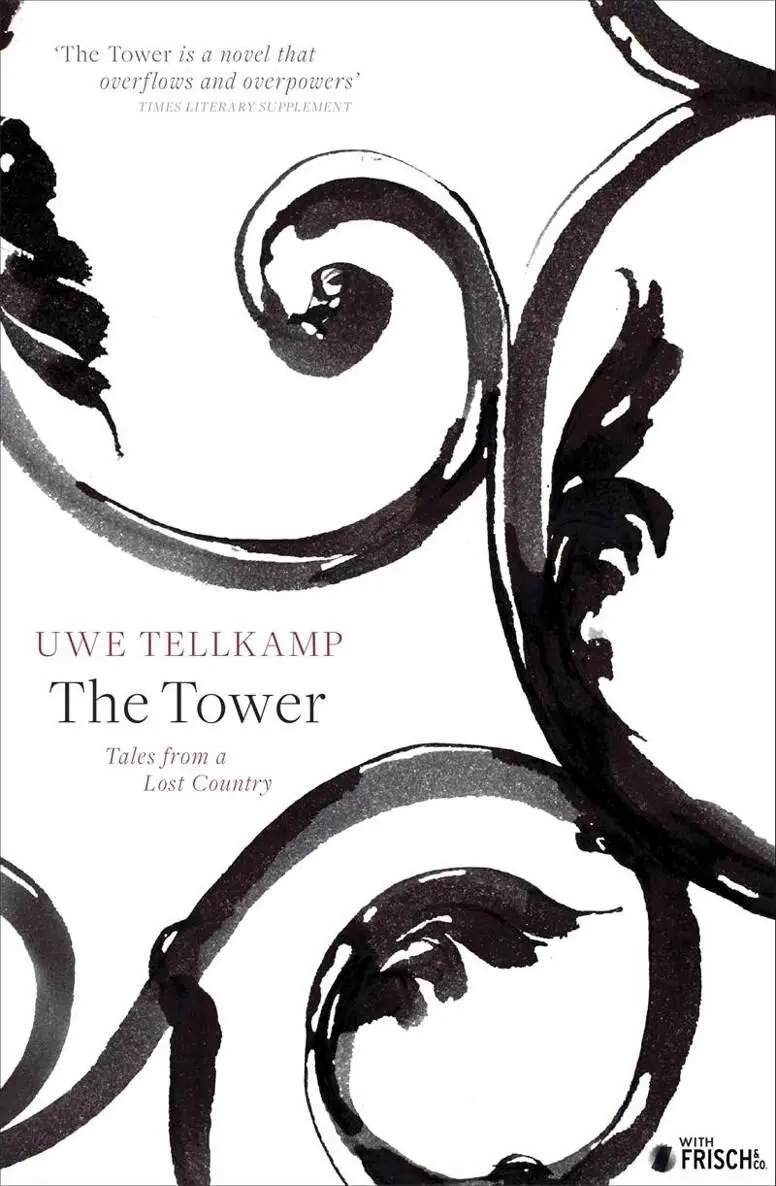
Uwe Tellkamp - The Tower
Здесь есть возможность читать онлайн «Uwe Tellkamp - The Tower» весь текст электронной книги совершенно бесплатно (целиком полную версию без сокращений). В некоторых случаях можно слушать аудио, скачать через торрент в формате fb2 и присутствует краткое содержание. Год выпуска: 2014, Издательство: Penguin, Жанр: Современная проза, на английском языке. Описание произведения, (предисловие) а так же отзывы посетителей доступны на портале библиотеки ЛибКат.
- Название:The Tower
- Автор:
- Издательство:Penguin
- Жанр:
- Год:2014
- ISBN:нет данных
- Рейтинг книги:5 / 5. Голосов: 1
-
Избранное:Добавить в избранное
- Отзывы:
-
Ваша оценка:
The Tower: краткое содержание, описание и аннотация
Предлагаем к чтению аннотацию, описание, краткое содержание или предисловие (зависит от того, что написал сам автор книги «The Tower»). Если вы не нашли необходимую информацию о книге — напишите в комментариях, мы постараемся отыскать её.
The Tower — читать онлайн бесплатно полную книгу (весь текст) целиком
Ниже представлен текст книги, разбитый по страницам. Система сохранения места последней прочитанной страницы, позволяет с удобством читать онлайн бесплатно книгу «The Tower», без необходимости каждый раз заново искать на чём Вы остановились. Поставьте закладку, и сможете в любой момент перейти на страницу, на которой закончили чтение.
Интервал:
Закладка:
‘It’s not that. I know you. You’re different when it’s that kind of thing.’ She went up to him. He was turned away, leaning over the workbench, closed his eyes when she took his hand.
‘Is there something you’re keeping from me?’
They’d made it a rule not to discuss serious problems in their own home but on a walk. These walks were a general custom in the district. Couples were often to be seen walking in silence and with heads bowed or in a discussion with hurried gestures — one could only assume it was being held in a whisper, since it immediately broke off as soon as others came within hearing.
‘Is it another woman?’
‘No. What makes you think that? No.’
‘So it isn’t another woman?’
‘No. No! I’ve just told you.’
‘You hear this and that. People pass rumours on to me.’
‘Rumours, rumours! Are these rumours worth anything? It’s just people making things up.’
‘A colleague of mine has a sister who works in the Academy, another was recently a patient in your orthopaedics department —’
‘Stupid gossip!’
‘So it’s not another woman.’
‘How often do I have to tell you: no!’
These problem walks seemed to have become more frequent recently. There were days when it seemed to him as if all the inhabitants apart from the children had left their apartments and were walking round the streets, murmuring, so that the whispered conversations were constantly being interrupted to say hello, raise your hat, wave. How grotesque it was! He couldn’t help laughing — broke off. That he was still able to laugh! Anne gave him a disturbed look. She had wrapped up warm and was grasping the collar of her coat with her hands.
‘And you believe this scandalmongering! They’re trying to pin something on me, perhaps out of jealousy —’
‘They? Who’re they?’
‘Not your colleagues.’ Richard leant against a fence. ‘They’ve dug up the old business. When I was a student. Back in Leipzig.’
He started to tell her about the discussion, at first hesitantly, disjointedly, by fits and starts, then more and more urgently.
‘But what reason could they have …? After all these years …’
‘I don’t know.’
Sometimes several couples could be seen leaning against a fence, sometimes Arbogast turned up; he had a strange sense of the comic, would greet them silently with his stick and if it was a fence on Holländische Leite he would have chairs brought up from the Institute.
‘This old story … did you tell me everything back then?’
‘Yes, I did.’
‘And Weniger … does he know about it?’
‘No. No he can’t know about it.’
‘He’s your friend … The way you treat him, pat him on the shoulder, sometimes I watch you and —’
‘Do stop it!’
‘And I’m afraid. You can’t tell, not at all. Perhaps you’re deceiving me, perhaps you’ve been deceiving me all these years, just as you’ve deceived Weniger —’
‘Anne! Can’t you understand? Can you really not understand? I … I was different then, the fifties in Leipzig, you never went through that, the mood there was then, and I was honestly convinced as well —’
‘So honestly that you shopped your friend to them. My God, I’ve been living with —’
‘Anne!’ Richard had gone white as a sheet. He grasped her by the shoulders, shook her. ‘We’ve talked about this already, talked until we’re sick of it, right down to the very last detail, don’t throw it at me again now. That’s what they want! They want it to drive a wedge between us, they want to use it to destroy us because … because they’re afraid of love, yes, that’s it. Because they’re afraid of people sticking together and …’
Anne burst out into a shrill peal of laughter. ‘Afraid of love … What nonsense you’re talking. You ought to hear yourself, how … sentimental and ridiculous you sound. That isn’t you at all and I don’t want to hear any more of your pseudophilosophical analysis … My God, Richard.’ She raised her hands, shook them at him, burst into tears.
He embraced her. They stood like that for a while. Richard stared at the street, shadows moved and came nearer. He closed his eyes, opened them again, the shadows had disappeared. Treetops and hedges, their branches still dead and bare, were hanging over the fences; there was a mild breeze and a smell of grass trailing through the air that smelt of coal. In his mind’s eye he saw the sheet of paper with the figures on that Lucie had given him for his birthday, the seven wearing a hat, the five smoking a cigar. He tried to repress the image but he couldn’t, it kept coming back, the figures seemed to be alive, malicious creatures that kept on bouncing back up. Lucie coming in through the door, carrying her teddy bear, complaining she had tummy ache. The smiling dolls in the hall. Then he felt as if Josta were looking at him. He shook his head, but that image wouldn’t disappear either. ‘Let’s move on.’
They headed for Turmstrasse, walking in silence for a while. He observed Anne. She wasn’t crying any more, was staring straight ahead. Again he remembered one of the evenings when the whole district seemed to be on the move. People embracing each other had been standing, silent and motionless, out in the streets. The lamps cast a pale light, which suddenly went out, it was dark in the houses all round as well. A power failure. Then something grotesque had happened: Julie Heckmann, generally known in the district as Julie-the-horses, standing with Frau Knabe, had burst out laughing, a hoarse male laugh, swelling into a piercing screech such as he had never before heard; it had gradually infected all those out there, even the ones embracing each other, and set off an outburst of laughter that seemed strangely liberating, vital, now sobbing, now roaring, spreading down the streets; you could hear windows in the houses all around being opened, suddenly someone shouted, ‘Bureaucracy!’, in response someone else shouted, ‘Individualism!’ and another, ‘Socialism!’ — ‘I’m frightened,’ a woman cried, another, ‘Me too!’ and still the laughter echoed round the whole street, interrupted by shouts of ‘Shh!’ and ‘Be quiet’; ‘Soon there’ll be zilch left to scoff,’ someone brayed in a disguised voice, ‘There’s no meat left in Wismar,’ came a squeak out of the darkness; ‘Is there a war on in Poland?’ — ‘Don’t tempt fate, for heaven’s sake!’ — ‘Are they frightened as well?’ roared a female voice Richard thought he recognized as Frau Knabe’s. — ‘Sure they are! Of us!’ and once more the street shook with laughter, and it came from the buildings as well. ‘Marx-isn’t!’ — ‘Stalin-isn’t’ — ‘Hey: generalism.’ The barking of dogs could be heard, immediately the laughter died away and the people quickly dispersed. Someone came towards Richard, stopped close beside him, scrutinized him, hesitated; it was Malthakus, he tipped his hat with his cane, whispered with his sly smile, ‘Well, neighbour, and what’s your problem?’ then quickly disappeared in the darkness.
Richard pulled his coat tighter round him, the memory of the incident had made him uneasy.
‘So they’re trying to put pressure on us,’ Anne said; he was grateful for the ‘us’, but she didn’t take his hand. ‘We must think what we can do.’ Her voice was firm again. That gave him back the power to think clearly. ‘There are two alternatives, either I play along with them — or I don’t play along with them.’
‘It’s not a matter of playing,’ she replied quickly and tersely. ‘Exit visa. We have to get out of here. We can ask Regine about making an application.’
‘What are you going to ask her? How to fill out the form correctly? It won’t work. They made it quite clear to me that they won’t let me go. Doctors are needed in our country … it would be a betrayal of the patients in your care …’
Читать дальшеИнтервал:
Закладка:
Похожие книги на «The Tower»
Представляем Вашему вниманию похожие книги на «The Tower» списком для выбора. Мы отобрали схожую по названию и смыслу литературу в надежде предоставить читателям больше вариантов отыскать новые, интересные, ещё непрочитанные произведения.





Обсуждение, отзывы о книге «The Tower» и просто собственные мнения читателей. Оставьте ваши комментарии, напишите, что Вы думаете о произведении, его смысле или главных героях. Укажите что конкретно понравилось, а что нет, и почему Вы так считаете.