Raja Alem - The Dove's Necklace
Здесь есть возможность читать онлайн «Raja Alem - The Dove's Necklace» весь текст электронной книги совершенно бесплатно (целиком полную версию без сокращений). В некоторых случаях можно слушать аудио, скачать через торрент в формате fb2 и присутствует краткое содержание. Год выпуска: 2016, Издательство: The Overlook Press, Жанр: Современная проза, на английском языке. Описание произведения, (предисловие) а так же отзывы посетителей доступны на портале библиотеки ЛибКат.
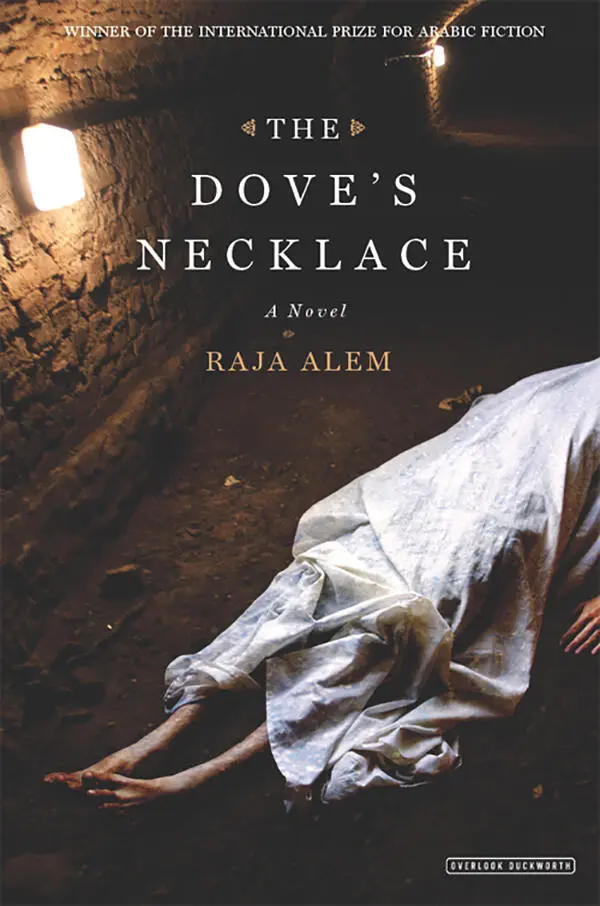
- Название:The Dove's Necklace
- Автор:
- Издательство:The Overlook Press
- Жанр:
- Год:2016
- ISBN:нет данных
- Рейтинг книги:4 / 5. Голосов: 1
-
Избранное:Добавить в избранное
- Отзывы:
-
Ваша оценка:
The Dove's Necklace: краткое содержание, описание и аннотация
Предлагаем к чтению аннотацию, описание, краткое содержание или предисловие (зависит от того, что написал сам автор книги «The Dove's Necklace»). Если вы не нашли необходимую информацию о книге — напишите в комментариях, мы постараемся отыскать её.
Tackling powerful issues with beautiful and evocative writing, Raja Alem reveals a city-and a civilization-at once beholden to brutal customs, and reckoning (uneasily) with new traditions. Told from a variety of perspectives-including that of Abu Al Roos itself-
is a virtuosic work of literature, and an ambitious portrait of a changing city that deserves our attention.
The Dove's Necklace — читать онлайн бесплатно полную книгу (весь текст) целиком
Ниже представлен текст книги, разбитый по страницам. Система сохранения места последней прочитанной страницы, позволяет с удобством читать онлайн бесплатно книгу «The Dove's Necklace», без необходимости каждый раз заново искать на чём Вы остановились. Поставьте закладку, и сможете в любой момент перейти на страницу, на которой закончили чтение.
Интервал:
Закладка:
Nasser watched her. He was no longer a detective; she’d made him a witness. “Don’t you miss all that?” he murmured, but she didn’t hear him and she didn’t reply. All she did was ask him to wait a moment and then got up and disappeared inside the room. She returned with a bundle and unfolded it in her lap in silence, spreading her palms over the old satin fabric like a dove spreads its wings. Without looking up from the bundle, she said, “This contains everything that’s dear to me. Feast your eyes!”
When she lifted her hands off of the bundle, there appeared four embroidered rose bushes, their pots at each corner of the fabric and their branches and flowers leaning toward the center, where a woman in a full skirt with rings on her fingers and bright red lips stood against the white background, clutching a bouquet, a foot in a black high-heeled shoe stepping gaily forward to present the green bouquet … To whom? Who was she stepping toward? Nasser felt prickles like fireflies glowing in his skin, the prickle of a single name and of letters emerging one on top of the other from the weave of the satin to announce its owner—
Yousriya flipped open the bundle and took out a golden wing spread around a circle. “This is the lapel pin that Saudi Airlines pilots wear. And this is his hat, with the same logo — Khalil left it with me. He hasn’t needed it since that damned day when he was fired.”
She was interrupted by someone knocking on the wall. “Sister,” called a voice, “are you talking to someone from one of the charities? Ask them why they haven’t delivered the bedpans yet. My sisters’ backs are broken from carrying me to and from the bathroom all night!” Yousriya tapped back to acknowledge she’d heard, but Aminah wailed again, “We were born in a box and we’ll die in a scrap of cloth! Give us some light! Help us pay the electricity bill, good Muslims!”
“Yes, yes, I’m sure it’ll be sorted out, don’t worry,” said Nasser, getting up. He wasn’t quite sure what he was promising. The curtain that divided the room into two twitched and a dumpy face peered out. “Come back and visit us,” it implored. “I haven’t left this room for thirty years! Don’t forget us, son. No, don’t take photos! Not even of the curtain …”
You ought to come back, Nasser, he thought to himself as he left. It won’t cost you anything. He thought about what he’d read on some website — the ideal charity menu: “a quarter-chicken, a handful of rice, one samosa, four dates, a bottle of water and a small pot of yogurt. 300 riyals can feed all twenty-seven residents.” Some local do-gooder had arranged for the set-menu meals to cost donors just six riyals by making up the rest himself.
You really ought to come back to visit once a month, Nasser, and bring them a donation once a year. It wouldn’t cost you anything.
From: Aisha
Subject: Message 10
I’m amazed by the battle you went through with your wife to try to give her what no other man had ever been able to. That constant, exhausting effort on the long road of insatiability … You two tried everything you could — specialist books, couples therapy, pornography — for four years, but by the end of it your morale as a virile man was totally destroyed.
Looking back, though, I wonder if maybe that process wasn’t the hellfire that forged you into the person you are now. I don’t know what magic it is you do, but you make me soar. With your hand at the center. That’s real flying. A woman’s body is the storm’s slumbering eye. Do you know where to find the thing that gets it going? Spreadingall over the world, and the wider you spread open, the higher you soar.
Higher and higher, sharpening that lightning tongue, spreading in from the tips of the wings to touch the core, so close to the agony of death, a beating of wings between the ribs, the belly, and the legs.
The eye of the storm opens up to swallow the whole world and still asks for more,
The male body is nothing more than an ejaculator. The female body vacuums up the whole universe!
An hour later, a muscle was still twitching involuntarily in my thigh — do I come off as an amateur to you? I could go on explaining forever — and I could still feel that branch of lightning cracking all around me.
Yours,
Aisha
P.S. Do you remember that morning when we bumped into each other in the library? You were so surprised to see me. You stopped for a while to have a look at the research I was doing on the computer. It was about an extinguished star, which had a black hole at the center and a green halo around it, and had been discovered accidentally by some amateur. Your eyes kept flicking nervously to the door, however. You must have had a date with some girl. I felt sorry for you so I tried to distract you by saying, “There are black holes in space threatening the young stars that are trying to come fully to life, like this one.”
“And was this one also discovered by an amateur like me?” you said, teasing me in turn and laughing.
P. P. S. I just remembered that song my mom and Auntie Halima used to sing about how babies are made: “Water mixed with water …” They’d giggle and say, “Can you believe we used to sing that out loud when we were young?”
An Eye and an Eye
M U’AZ WAITED EAGERLY FOR HIS FREE MOMENTS SO HE COULD GO AND VISIT Yusuf. He knew he might attract people’s attention, but he couldn’t stay away from the treasure whose keys he’d given up willingly. He felt deprived; it pained him for that world to be taken from him.
The moment he stepped into the hall, he sensed the profound change that had come over the house all of a sudden. It was as if the house was conspiring with Yusuf. It was giving him access to places Mu’az had never been to, showing him photos Mu’az had never seen.
His first thought was to kick Yusuf out, then he calmed himself down and considered locking Yusuf into the central hallway and taking back the keys to the upper floors, but the kind soul within him, the one who’d memorized the Quran, intervened on Yusuf’s behalf. Nevertheless he was still possessed by a burning jealousy. What was it about Yusuf that exerted such power over the house in a way he never could?
Yusuf avoided Mu’az’s accusing gaze, hiding a deep sense of guilt. Over the days he’d spent alone in the house, he’d fallen into an arid solitude, which had driven him to sneak into the parlor where all those faces were, impelled by a sudden urge to be among those Meccan features. There must be faces he knew or faces that knew him and could make him feel at home. Just one face might be enough to give him a sense of place and bring a sense of center to all the broken vignettes around him and the wholesale destruction of ancient landmarks. He stared at every photo; he didn’t pass a single patch of wall without interrogating every picture, looking for threads to tie him to Mecca or to the Lane of Many Heads, examining events that he hadn’t noticed at the time, which had brought him to this destitution. He’d known full well that Mu’az wouldn’t be happy, but the house was reeling him in like it wanted to prod and revive his memory.
~ ~ ~
Mu’az bored into Yusuf’s face. The eyes, which evaded his own, worried him. Was Yusuf seeing the Mecca hidden in that place through the eyes of history? Whereas he, Mu’az, had only ever seen through the eyes of art and technique, like al-Lababidi? Art’s eye was restorative and healing, but history’s eye liked to pick at scabs. Why had he let that coarse eye in here to pick through Marie and al-Lababidi’s treasure? Without realizing what he was doing, Mu’az hurried to beat Yusuf to the biggest scab in the place.
Читать дальшеИнтервал:
Закладка:
Похожие книги на «The Dove's Necklace»
Представляем Вашему вниманию похожие книги на «The Dove's Necklace» списком для выбора. Мы отобрали схожую по названию и смыслу литературу в надежде предоставить читателям больше вариантов отыскать новые, интересные, ещё непрочитанные произведения.




Обсуждение, отзывы о книге «The Dove's Necklace» и просто собственные мнения читателей. Оставьте ваши комментарии, напишите, что Вы думаете о произведении, его смысле или главных героях. Укажите что конкретно понравилось, а что нет, и почему Вы так считаете.