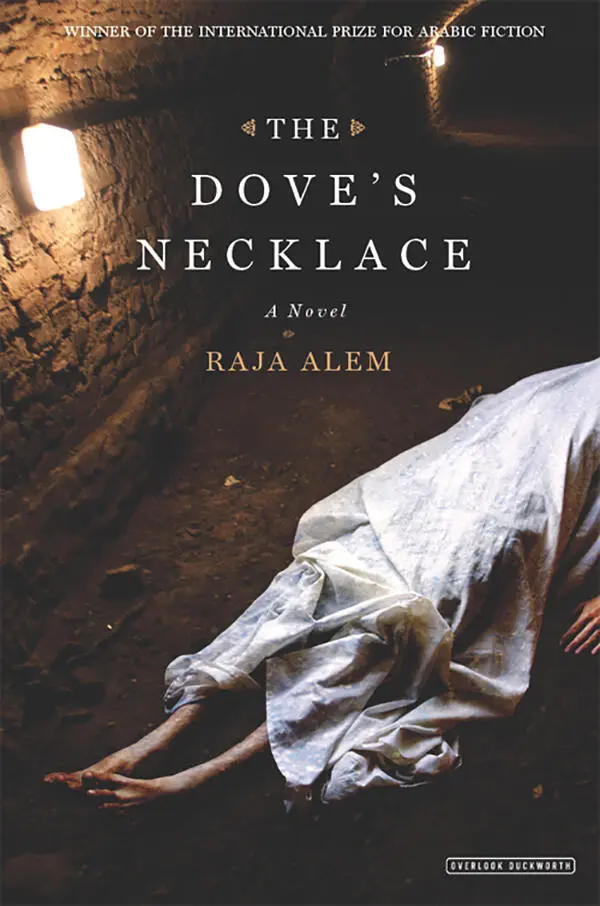
Raja Alem - The Dove's Necklace
Здесь есть возможность читать онлайн «Raja Alem - The Dove's Necklace» весь текст электронной книги совершенно бесплатно (целиком полную версию без сокращений). В некоторых случаях можно слушать аудио, скачать через торрент в формате fb2 и присутствует краткое содержание. Год выпуска: 2016, Издательство: The Overlook Press, Жанр: Современная проза, на английском языке. Описание произведения, (предисловие) а так же отзывы посетителей доступны на портале библиотеки ЛибКат.
- Название:The Dove's Necklace
- Автор:
- Издательство:The Overlook Press
- Жанр:
- Год:2016
- ISBN:нет данных
- Рейтинг книги:4 / 5. Голосов: 1
-
Избранное:Добавить в избранное
- Отзывы:
-
Ваша оценка:
The Dove's Necklace: краткое содержание, описание и аннотация
Предлагаем к чтению аннотацию, описание, краткое содержание или предисловие (зависит от того, что написал сам автор книги «The Dove's Necklace»). Если вы не нашли необходимую информацию о книге — напишите в комментариях, мы постараемся отыскать её.
Tackling powerful issues with beautiful and evocative writing, Raja Alem reveals a city-and a civilization-at once beholden to brutal customs, and reckoning (uneasily) with new traditions. Told from a variety of perspectives-including that of Abu Al Roos itself-
is a virtuosic work of literature, and an ambitious portrait of a changing city that deserves our attention.
The Dove's Necklace — читать онлайн бесплатно полную книгу (весь текст) целиком
Ниже представлен текст книги, разбитый по страницам. Система сохранения места последней прочитанной страницы, позволяет с удобством читать онлайн бесплатно книгу «The Dove's Necklace», без необходимости каждый раз заново искать на чём Вы остановились. Поставьте закладку, и сможете в любой момент перейти на страницу, на которой закончили чтение.
Интервал:
Закладка:
Yousriya laughed, quickly covering her mouth to stifle it. “The dinosaur was suddenly a mouse cowering, paralyzed in a corner, waiting for the stick. When our father got up from his seat to descend upon us he really warmed us up with those lashes. Fresh welts across our shoulders, feet, and behinds, ready to have salt rubbed in. The marks that that stick left on our bodies were the only words we exchanged with our father. ‘Miserable bastard’ was how Khalil eloquently put it when the subject of our father Nuri’s severity arose. The language had been handed down from the time of Ottoman rule in Mecca, to our grandfather Ateeq, then Sulayman, and from him to our father Nuri, and now it had reached Khalil. Prophets of torment, all of them. People would say they ‘stood on the doorstep weathering necks,’ which meant the mere sight of one of them was enough to crack a person’s neck with fright.
“After weeks of not talking, and tormenting each other, their moods would relax and our father would take Khalil out on trips to look for Uncle Ismail — whom we didn’t know and never had known and never would know.
“Khalil’s a good boy. He never once fell out with me. Even now he comes every Thursday to pour his heart out into my hands. The two of us got on like a house on fire, but sometimes during the punishments the fire would go out. The cracks of the cane brought our bodies closer together.
“Khalil was ground down hard. He’s severe in his affection, too, though. Even at that age, he wanted to imprison me hot cold, but after the fire I forswore this new world — I just couldn’t endure it. I decided I’d kneel and pray and serve my sisters instead. I look after the aged and sick, and when their time comes, I shut their eyes and pray over them … I know my path: it’s here with my isolated sisters, here with these twenty-seven women who are trapped between two darknesses, the darkness of glaucoma and the darkness of these rooms they haven’t left for thirty or maybe even fifty years.”
Yousriya’s eyes settled on Nasser’s form as if awaiting sentence, but quickly relaxed into a knowing smile. “And you, what’s your story?”
“I haven’t got a story!” he answered quickly, embarrassed, but he found himself adding, “I’m also being pursued by nightmarish dreams about a woman.” He had to repeat his words for Yousriya like an echo, but she was completely deaf and still couldn’t hear him. She must have been able to read his features, though. “The same one?!” she asked.
“No, a friend of hers.” She gave him a look of surprise, which soon turned into pity.
“Same thing,” she said, before retreating to her memories. “Khalil and I found refuge from our father’s harshness with our grandfather, our mother’s father. His house looked over al-Malah Cemetery so we got to watch all the funeral processions in Mecca. We played a game where we’d try to tell the different kinds of dead people apart: the elderly were covered in gray, which was very different from the green draped over those who’d died when they were still young; the biers of children could be distinguished by the bright, embellished drapes, and then there were the cages laid over women’s bodies which our grandfather explained to us.
“These cages were first widely used in the time of Fatima, the Prophet’s daughter, peace be upon him. She was the first Muslim woman whose bier was covered in this way, having been told about the tradition by Asma bint Amees, who had said to her, ‘Shall I tell you about something I saw in Ethiopia?’ She asked for some pliant palm-frond stalks, bent them and covered them with cloth, making a canopy like a bridal howdah. We used to imagine how Fatima, the Prophet’s daughter, had ordered that nobody be allowed to see her dead body and how it emerged in that bridal litter. Khalil used to terrorize me by saying, ‘I can picture you as a silent bride in one of those cages for dead women!’ And here I am, a spinster. I never married and never even went out into the world, and I’m waiting here in my cage for my funeral procession to set off. Death and I know each other pretty well after all this time.
“From a window in my grandfather’s house, Khalil and I used to watch the Yemeni gravedigger. We’d watch him eating his flatbread and leek with one hand, while the whole time using his other to collect bones from fresh graves, which were only a month or so old, and transferring them to a mass grave at the far end of the cemetery. We knew all about that pit of bones and it hardened our hearts. That was where all the skulls of Mecca got to know one another, teeth chattering in the cold. In summer, we’d see him come out in his red sarong and light white headscarf, barefoot on the death-molded, sun-fired earth, walking across the plots in the blazing sun, sprinkling water to cool the dead, stopping at the freshly-dug graves to take a hit of the strong rot.
“We spent our childhood between death and my severe father, coming and going through the carnival of Mecca’s old markets in the vicinity of the Holy Mosque. We knew all the traders at the Night Market and the Mudda’i Market because we were the grandchildren of the Sheikh of al-Malah — the biggest Wihda fan in Mecca.
“Khalil used to always wear the red and white Wihda uniform at Grandad’s. We were eternal rivals for our grandfather’s pride and affection, but Grandfather called me ‘top of the bundle,’ meaning the choice bit that’s placed on the very top of a bundle of surprises, and he always took me out to show me off. He’d take me by the hand and we’d head out to the Mas’a and all the neighboring markets; starting from the house of Abu Sufyan at the Turkish Qubbaniya Hospital, we’d enter ‘Egg Alley’ where there were stalls displaying handicrafts and caged pets — we always stopped to look at the red-eyed rabbits — and then move on to the auction at the Night Market and the goldsmiths’ alley, then turning east toward the Gaza Market where we’d stroll past the masterpieces of joiners and wood-turners, met on both sides by greetings:
“‘God preserve you, sir!’
“That was Bafaqih, the silk merchant, who was echoed by al-Fadl, the perfumer.
“‘Us and you both, my man!’ Grandfather would reply. He had a booming voice that made me wide-eyed with pride.
“Next we’d head north to al-Mudda’a Market where Sheikh al-Wazzan would always greet me with a ‘God bless you!’ The market was full of huge food and perfume storehouses, nut-and-sweet shops, and fabric stalls. ‘Oh generous Lord, a pot of gold and a righteous girl …’ the dervishes would cry as we walked past.
“Those were the days,” sighed Yousriya. “We used to dip our bread in salt and that was enough to fill us up. I live off these memories here, and share what I have with my sisters. They take our minds off things. We don’t need a glowing TV to fall asleep in front of, just a little yellow lamp that won’t go out in the evening when there’s a power cut …”
Her eyes shone at the memory of a distant yellow glow. “On the twelfth day of Rabi’ al-Awwal, our grandfather would take us on an outing that began at the Prophet’s birthplace, the house of Ibn Yusuf in an alley called Ali’s Path that lies at the foot of Abu Qubays, at the end of the Night Market. We’d imagine all the torches, candles, and lanterns gathering there after the early evening prayer, and he’d stop to tell us gravely: ‘Under the Kurdish bookshop here, in the earth right beneath this spot, is where our beloved Prophet was born. Remember this!’ He’d pinch my earlobe, pinching Khalil’s with the other hand, and repeat his words once more before shepherding us on toward the wonders of al-Jawdariah, the market of the cobblers and cotton merchants and quilt-makers. We’d stand for hours watching them card the cotton and watching the cobblers as they made shoes and other leather goods. We’d go next to al-Malah market where there were seed-sellers and piles of vegetables, clover, charcoal, and firewood. Finally, we’d end up at the Friday afternoon auction where they sold antique furniture. One Friday he bought me this Syrian-made inlaid chair. I rescued it from the fire, but I forgot my own mother! I was determined to bring it here with me. I used to sit on it just waiting for it to accompany me on this trip.”
Читать дальшеИнтервал:
Закладка:
Похожие книги на «The Dove's Necklace»
Представляем Вашему вниманию похожие книги на «The Dove's Necklace» списком для выбора. Мы отобрали схожую по названию и смыслу литературу в надежде предоставить читателям больше вариантов отыскать новые, интересные, ещё непрочитанные произведения.





Обсуждение, отзывы о книге «The Dove's Necklace» и просто собственные мнения читателей. Оставьте ваши комментарии, напишите, что Вы думаете о произведении, его смысле или главных героях. Укажите что конкретно понравилось, а что нет, и почему Вы так считаете.