Raja Alem - The Dove's Necklace
Здесь есть возможность читать онлайн «Raja Alem - The Dove's Necklace» весь текст электронной книги совершенно бесплатно (целиком полную версию без сокращений). В некоторых случаях можно слушать аудио, скачать через торрент в формате fb2 и присутствует краткое содержание. Год выпуска: 2016, Издательство: The Overlook Press, Жанр: Современная проза, на английском языке. Описание произведения, (предисловие) а так же отзывы посетителей доступны на портале библиотеки ЛибКат.
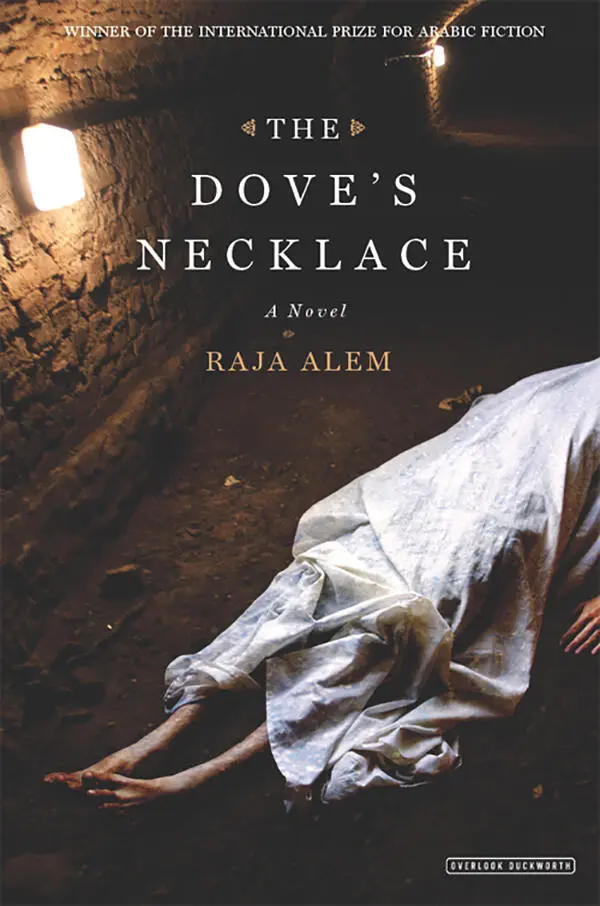
- Название:The Dove's Necklace
- Автор:
- Издательство:The Overlook Press
- Жанр:
- Год:2016
- ISBN:нет данных
- Рейтинг книги:4 / 5. Голосов: 1
-
Избранное:Добавить в избранное
- Отзывы:
-
Ваша оценка:
The Dove's Necklace: краткое содержание, описание и аннотация
Предлагаем к чтению аннотацию, описание, краткое содержание или предисловие (зависит от того, что написал сам автор книги «The Dove's Necklace»). Если вы не нашли необходимую информацию о книге — напишите в комментариях, мы постараемся отыскать её.
Tackling powerful issues with beautiful and evocative writing, Raja Alem reveals a city-and a civilization-at once beholden to brutal customs, and reckoning (uneasily) with new traditions. Told from a variety of perspectives-including that of Abu Al Roos itself-
is a virtuosic work of literature, and an ambitious portrait of a changing city that deserves our attention.
The Dove's Necklace — читать онлайн бесплатно полную книгу (весь текст) целиком
Ниже представлен текст книги, разбитый по страницам. Система сохранения места последней прочитанной страницы, позволяет с удобством читать онлайн бесплатно книгу «The Dove's Necklace», без необходимости каждый раз заново искать на чём Вы остановились. Поставьте закладку, и сможете в любой момент перейти на страницу, на которой закончили чтение.
Интервал:
Закладка:
Nasser brought some tinned food and a couple of bags of rice with him. He parked his car at my entrance, by the cafe, and followed behind some children who’d promised to show him the way. They bounded ahead, racing and sparring with one another — with the shadows they cast on the crumbling walls even — each trying to kick up the biggest cloud of dust, while Nasser followed passively, surrendering himself to a map that was beyond his control. They took him down alleys within alleys, beneath decaying buildings, which Nasser feared might collapse on their heads at any moment, until they came face-to-face with a hundred-year-old house. Nasser read the inscription over the door: ENDOWED BY HAJJ MUHAMMAD AL-SILAHDAR. The excited children tossed pebbles at the Yemeni guard lying on a bench to the right of the door, and he in turn gleefully opened his mouth as wide as it would go, revealing a tongueless cavity, blackened by licorice and rotting gums. Nasser tried talking to him, but quickly realized he was simple. Delighted by the children’s shrieks of laughter, the guard repeated his grimace with a throaty gurgle, but when he noticed that Nasser was holding a bag of donations he went ahead to the door and knocked. There was scuffling and murmuring on the other side. Three loud claps came by way of reply and then a woman’s voice barked: “Media or charity?”
“I’ve brought some provisions for Yousriya on behalf of her brother Khalil the Pilot,” Nasser replied without looking inside.
The door clove open and a damp smell gushed out as the women scurried to hide behind the doors to their rooms. As lonely and forlorn as the Seven Sleepers, they eavesdropped on the newcomer and peeped at what he was carrying from behind the doors. A tall, broad-shouldered woman in a blue and white floral prayer shawl came toward him, yanking one corner of it across her lower face so that only her eyes, which studied him carefully with every step she took, could be seen. Slipping back off her forehead, the shawl revealed a few white locks poking out of the tight green kerchief she’d tied around her hair. She surprised him with an elegant gesture of greeting — a remote handshake formed by a thumb pressed to the palm, three fingers swept through the air and the littlest extended gracefully outward — and then she led him to Yousriya’s room, the first of several doors along either side of a dark corridor on the first-floor.
“Has Khalil visited you recently?” Nasser asked her immediately.
“You from the press?” she asked anxiously.
“No, no,” he reassured her. But she didn’t appear to be listening.
She didn’t stop for his answer, just plowed on: “because we’re not allowed to talk to the media.” Then she added, “Khalil said there was something he had to sort out in Ta’if.”
“Ta’if?” echoed Nasser in surprise. They were separated by the doorway, but she pushed a chair out into the hall so that he could sit down as she sat facing him on an ornate chair just inside her bedroom. Yousriya began speaking, her lips writhing like a chrysalis behind her shawl. Every time Nasser asked a question, seasoned memories poured out of her, unrestrained. For a moment it seemed to him that it wasn’t even Yousriya speaking but the puzzle-master, unlocking women’s heads so he could peer inside and leading him into storerooms full of their memories, which were crumbling like the walls of the home they inhabited, atrophying like their forgotten bodies. Nasser was amazed by her closely and vividly sketched memories, which seemed trivial now and sluggish compared to how much had changed so quickly. Details, details, details; he listened intently.
She began, “Khalil is possessed by a black and white dinosaur. He will tell you in great detail about how our father used to take him to the ravine in the South Martyrs’ neighborhood in Ta’if, to the cinema where our father himself went to watch films with his grandfather and his friends in the sixties. Such a shame they always repeated the same movie — the one about the dinosaur that tramples cities with his enormous feet. Would you believe that, in the sixties, our father was able to buy a ticket to the cinema and go and watch a movie with other people? That would be an impossible luxury nowadays, even in a modern city like Jeddah, or in Dhahran or al-Khubar in the land of oil. Our father was a furnace of money, or rather like a pumpjack that spewed money like crude and pumped Khalil into the finest aviation school in the USA. He used to always say that we could fly, and that we pissed all over those barefoot naked shepherds with our constitution that dated from the time of the Sharifs. A load of good those words did him — he ended up a broken man in Egypt and he had to cut us off. The money he used to give us stopped at the banks of the Nile, and the old man retired and flew away. I left the world to them, and Khalil started to say, ‘Embrace evil …’ Khalil’s been shaken by two earthquakes in his life: coming back from America, and losing his job at the airline. Returning to Mecca from the other side of the Atlantic was like being placed on a road between heaven and hell. Khalil was like a lion in a cage, traveling from Mecca to Jeddah to attend movie screenings organized by the British Council on the invitation of the son of the last sultan of Hadramawt, who’d taken refuge in Jeddah with his family. Khalil had met the man at Heathrow on one of his stopovers on the way to Florida, and they became good friends, until the guy moved to live permanently in London. With the sultan’s son gone, the cinema was closed in Khalil’s face, just like all the concerts and art exhibitions were closed in everyone’s faces by various embassies when terrorists began threatening the expat communities.”
The scarf fell from her face, exposing her dark lips. Yousriya coughed and fanned the air around her mouth with an elegant, practiced wave followed by three light raps on her ample chest. She continued with her face uncovered, chewing every word with pleasure:
“Khalil considers himself part of the generation who were taken to the sea and came home thirsty — the generation who fled to American movies to escape the image of the belly dancer — it was either Taheya Carioca or Samia Gamal, I can’t remember — pouring champagne into her shiny stiletto for some Pasha who’s crawling around her on all fours like a dog. Khalil felt like he’d been transformed, as they say — into a monster. A cross between a Pasha, a dog, and the Incredible Hulk. Just to make it absolutely clear to us that he was made of different stuff than ordinary people, that he was a modern-day combination of movie hero and space explorer who belonged to a world of science fiction, they took away his pilot’s license — what a shame — and let him loose in the streets of Mecca, to make the rounds with his taxi … He would say that inside an airplane he always became a silent drop of night, gliding transparently, searching inside himself for the young woman who made him fall in love after thirty years of liberty.
“I used to tell him, ‘Khalil, you’ve only ever seen the shadow of her abaya!’ But he’d say, ‘Yes, but still my mind is licked!’ He’d captivated and conquered nightclubs in Florida and Los Angeles, he had adventures to his name like those of Abu Nuwas and dervishes and hashish smokers. He was excessive in everything he did, even in his daydreams, apparently, which all revolved around that cunning temptress, Azza the idiot, who was half his age. Khalil’s philosophy was absolute: he was looking for an odorless woman, and he thought he’d found her in Azza. He thought she was a different species from the kind he’d tried on his airplanes. The thing that terrified him most about those women was how promiscuous they were. His stomach would be whisked away and turned upside down in disgust; he’d lose control and become violent, and say he was the dinosaur and that he’d awoken to go on a pitiless rampage. I remember the night after the first screening of the dinosaur film: Khalil’s body was taken over by the dinosaur, which was something he’d inherited from our father when he was only nine years old. He stepped out of the house at noon to find a Thai man had spread his watermelon stall out on our doorstep. Suddenly Khalil was throwing watermelons left and right, hurling them down Qarara hill where they exploded like bombs. The Thai man’s shrieks brought our mother to the window. Her loud, forceful clap was enough to rein us in, and she tied us up with the firm rope of a threat: ‘Wait till your father wakes up and sees what you’ve done!’”
Читать дальшеИнтервал:
Закладка:
Похожие книги на «The Dove's Necklace»
Представляем Вашему вниманию похожие книги на «The Dove's Necklace» списком для выбора. Мы отобрали схожую по названию и смыслу литературу в надежде предоставить читателям больше вариантов отыскать новые, интересные, ещё непрочитанные произведения.



Обсуждение, отзывы о книге «The Dove's Necklace» и просто собственные мнения читателей. Оставьте ваши комментарии, напишите, что Вы думаете о произведении, его смысле или главных героях. Укажите что конкретно понравилось, а что нет, и почему Вы так считаете.