Raja Alem - The Dove's Necklace
Здесь есть возможность читать онлайн «Raja Alem - The Dove's Necklace» весь текст электронной книги совершенно бесплатно (целиком полную версию без сокращений). В некоторых случаях можно слушать аудио, скачать через торрент в формате fb2 и присутствует краткое содержание. Год выпуска: 2016, Издательство: The Overlook Press, Жанр: Современная проза, на английском языке. Описание произведения, (предисловие) а так же отзывы посетителей доступны на портале библиотеки ЛибКат.
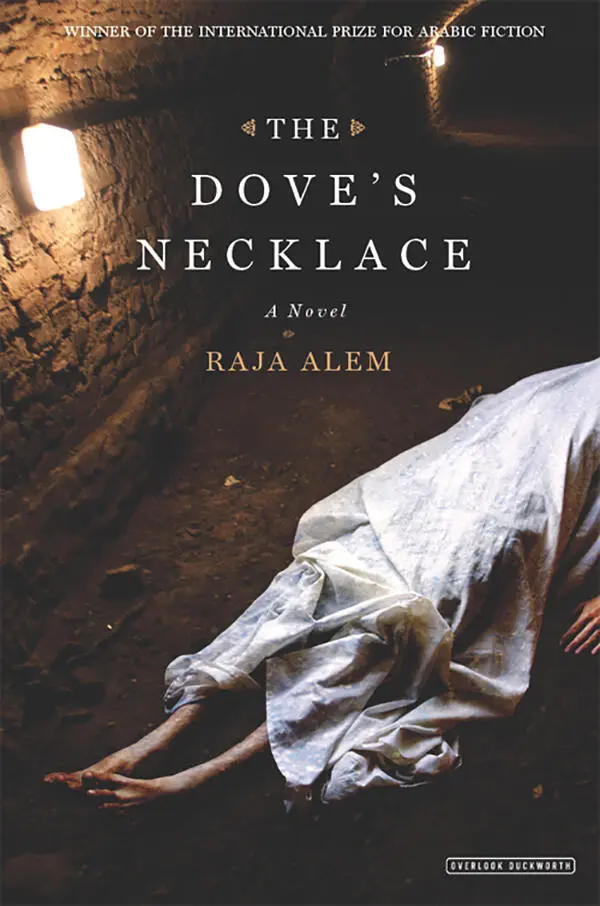
- Название:The Dove's Necklace
- Автор:
- Издательство:The Overlook Press
- Жанр:
- Год:2016
- ISBN:нет данных
- Рейтинг книги:4 / 5. Голосов: 1
-
Избранное:Добавить в избранное
- Отзывы:
-
Ваша оценка:
The Dove's Necklace: краткое содержание, описание и аннотация
Предлагаем к чтению аннотацию, описание, краткое содержание или предисловие (зависит от того, что написал сам автор книги «The Dove's Necklace»). Если вы не нашли необходимую информацию о книге — напишите в комментариях, мы постараемся отыскать её.
Tackling powerful issues with beautiful and evocative writing, Raja Alem reveals a city-and a civilization-at once beholden to brutal customs, and reckoning (uneasily) with new traditions. Told from a variety of perspectives-including that of Abu Al Roos itself-
is a virtuosic work of literature, and an ambitious portrait of a changing city that deserves our attention.
The Dove's Necklace — читать онлайн бесплатно полную книгу (весь текст) целиком
Ниже представлен текст книги, разбитый по страницам. Система сохранения места последней прочитанной страницы, позволяет с удобством читать онлайн бесплатно книгу «The Dove's Necklace», без необходимости каждый раз заново искать на чём Вы остановились. Поставьте закладку, и сможете в любой момент перейти на страницу, на которой закончили чтение.
Интервал:
Закладка:
“The poor guy kept yelling, ‘What about the sequins? What about the glitter?’
“So I asked him, ‘Would you like me to add a few crystals?’
“‘A few?!’ he spluttered. ‘Listen, sister, do you know who the groom is? Ahmad the sewage cleaner’s son! He works for some seriously important people,’ he bragged by way of explanation, ‘and he gave us the best dower the neighborhood’s ever seen. So we need to be up to standard!’
“He gave some instructions and left. Aisha was deserted, robbed of her lovely gloves, and we had to add shoulders, a chestpiece, and sleeves sturdy enough to hold all the crystals her father had demanded. They nearly broke her neck with their weight, and brashly outshone her lucky stars, which dropped out of the sky one by one.
“The day of her wedding, of course, the women were awestruck, craning their necks enviously to get a better look at that glittering vision. Poor thing. He left her two months later. The whole neighborhood blamed me for ruining the marriage from afar, and for the death of her family in that crash … They said it was all because of that unlucky dress! Any time anything bad happens to you guys in the Middle East, you always blame me, me and the Ottomans. When we brought those black robes and face veils you shouted, ‘You’ve brought the Black Death!’ and now when I design revealing dresses you scream, ‘You’ve unloosed the Evil Eye!’ At least our veils had slits for women to see and breathe out of; when the hurricane blew out of your desert it sealed them all up!
“Anyway,” she finished with a wink, “I’m beyond all of that.” Nasser hoped that wink wouldn’t drag him into another snare.
That night, he went through Aisha’s emails looking for the dress.
Dear ^,
I freed the dress. I spent a whole night snipping crystalsoff the fine lace, and ripped off the sleeves, and when I stood in front of the mirror with bare shoulders I felt such ecstasy. I went up to the roof and stood on a barrel to recreate that first fitting, and let the Meccan night and the lace take turns licking my breasts. I wore it directly on my skin and raised my weightless arms to the sky, ready to fly like I do in my sleep.
Aisha
Rubber Membrane
David,
The sentence I’d read in Yusuf’s Window in Umm al-Qura floated around in my head: “The Kaaba refused the first covering that was placed on it by the king of the Himyarites: he had it covered in skins and hessian but the House rose up and shook them off, and then it did the same when he had it covered in woven palm fronds. But when he clothed it in water and patchwork Yemeni silk, the Kaaba assented.”
Believe me, there are clothes that torture.
I recall the coat my father was wearing when he turned up unexpectedly in my bedroom the day after my wedding. The heat was stifling and there was no reason to be wearing such a heavy coat over the crumpled robe he’d been wearing since the celebration the night before. I was still lying where Ahmad had left me, barely able even to bend my legs. I’d heard the door slam when he’d left in fury at midnight, and then again when he returned at dawn, about an hour before my father appeared. These details are chiseled into my memory. I try to find an explanation for the scene that’s stuck in my mind, but I don’t dare face the knifehe hid there. I remember my father came in without knocking and leaned against the doorjamb; he looked as if he were wavering between two possible decisions. It was as though he’d cornered Ahmad in my bedroom cubbyhole, in the bed that filled the entire space. Without uttering a single word, he handed over a piece of paper, and I knew, I knew exactly what it was. I remember how my father’s face was flush with blood. This was his second heart attack, and it cast a bloody shadow over the bedroom. The first was when he saw the pan of still-warm blood that had come from between my legs and his face turned the color of raw liver. I was twelve at the time.
My adolescence began in distress. For three whole days, a feverish grape of menstrual blood, my first, grew between my legs. The doctor came to our house with a nurse in tow and rendered a diagnosis as unmitigated as his scalpel. You see, David, I have a history with scalpels. They laid me down in that same bedroom and shut the door. I could sense tiny, shining, curious eyes that turned dull when a needle was stuck in my vein. The world began to recede as a voice ordered me to “clench.” I was clenching and my mother was spreading my legs farther apart when the cold scalpel hit, and the world was blown open in that red bubble between my legs.
I was twelve years old, and when I came to nothing was left except for the pan, which our neighbor Halima could attest to. The blood that had stored up in my womb for three days burned as it poured out of me.
And thus my father handed Ahmad, who felt duped, that piece of paper. He looked at it blankly.
“A medical certificatesigned and sealed.” The conversation was one-sided. It was only then that I noticed the knife in the inside breast pocket of my father’s coat. A knife?! What’s a knife doing on the morning after my wedding?! The room was suddenly calm now that Ahmad had surrendered completely to silence. Even now when I think back on that knife — in the pocket of that small man of many slogans, my father — and the sealed certificate, it still seems like a border between life and death. Ahmad had no idea that even just a glance, whether mocking or incredulous, in the face of that piece of paper would have been enough to make one of us cross that border.
The certificate wasn’t on my father’s mind that morning. It was my mother who’d got it out and slipped it into his pocket. He’d picked up the knife! Was it Ahmad, the doctor, the nurse, or was it me? Who had my father been planning to stab before chickening out at the last minute?
“ Rubberhymens.” I was the first person to introduce that novelty to the Lane of Many Heads. And Ahmad nearly bought it.
My father took his rage out on what he understood a honeymoon to mean. “He’s going to take her somewhere and mull it over? No fucking way.” It was the nightmare he’d feared.
Even now my menstrual blood burns, between my legs and his.
Aisha
P. S. The scalpel, the cleaving between my legs, propelled the blood all the way up to my nose. I can still taste it in the back of my throat. All that to be rid of a rubber barrier. But that wasn’t all. There were more barriers, devious barriers that no scalpel, no doctor, could tear down. Ahmad failed as well. And yet two years later, you came and you conquered.
The Bundle Girl and the Dinosaur Age
V AGUE RUMORS HAD BEGUN TO SPREAD ABOUT THE MASQUERADE GAME KHALIL liked to stage in his taxi, but Nasser did his best to ignore them — in part because his only meeting with Khalil had caused him so much consternation — but the puzzle-master was prodding his suspicions about that skittish, agitated character. Likewise the police hound inside Nasser wouldn’t let him pretend not to know that Khalil was capable of suicide. He’d already committed career suicide, so what was he capable of now that he was about to turn fifty? It’s a turning point in a man’s life that causes him to start making calculations and the thought of how to regain what he’s lost consumes him. How could he pursue a man who was in his prime and yet so full of anger, defiant?
In any case, tracking Khalil down in the neighborhood wasn’t going to be easy any more. This was perhaps partly because his backstory had taken place outside the Lane of Many Heads, but more than anything it was due to the dispute over al-Labban’s building, the Arab League, and the forced evictions. Khalil had simply left his wife Ramziya on her father the sewage cleaner’s doorstep and disappeared. Nasser worried he’d never be able to find him again, but Halima had some advice for him: “Your best bet now is his sister Yousriya. Ask her and she’ll lead you to him. She lives in Hajj Silahdar’s home for the destitute. The Pilot’s well known there. No matter where he’s hidden himself or how long he stays away, he’s bound to go back to Yousriya. He adores her and she adores him.” It never occurred to Khalil that I, the Lane of Many Heads, could be the reason he had to burrow down into the network of banishment places that eroded my perimeter.
Читать дальшеИнтервал:
Закладка:
Похожие книги на «The Dove's Necklace»
Представляем Вашему вниманию похожие книги на «The Dove's Necklace» списком для выбора. Мы отобрали схожую по названию и смыслу литературу в надежде предоставить читателям больше вариантов отыскать новые, интересные, ещё непрочитанные произведения.





Обсуждение, отзывы о книге «The Dove's Necklace» и просто собственные мнения читателей. Оставьте ваши комментарии, напишите, что Вы думаете о произведении, его смысле или главных героях. Укажите что конкретно понравилось, а что нет, и почему Вы так считаете.