Raja Alem - The Dove's Necklace
Здесь есть возможность читать онлайн «Raja Alem - The Dove's Necklace» весь текст электронной книги совершенно бесплатно (целиком полную версию без сокращений). В некоторых случаях можно слушать аудио, скачать через торрент в формате fb2 и присутствует краткое содержание. Год выпуска: 2016, Издательство: The Overlook Press, Жанр: Современная проза, на английском языке. Описание произведения, (предисловие) а так же отзывы посетителей доступны на портале библиотеки ЛибКат.
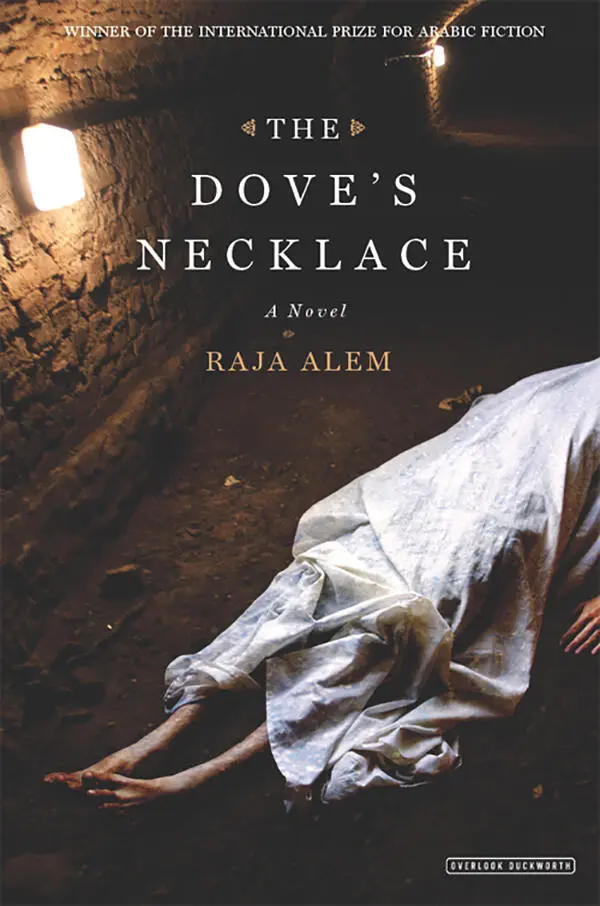
- Название:The Dove's Necklace
- Автор:
- Издательство:The Overlook Press
- Жанр:
- Год:2016
- ISBN:нет данных
- Рейтинг книги:4 / 5. Голосов: 1
-
Избранное:Добавить в избранное
- Отзывы:
-
Ваша оценка:
The Dove's Necklace: краткое содержание, описание и аннотация
Предлагаем к чтению аннотацию, описание, краткое содержание или предисловие (зависит от того, что написал сам автор книги «The Dove's Necklace»). Если вы не нашли необходимую информацию о книге — напишите в комментариях, мы постараемся отыскать её.
Tackling powerful issues with beautiful and evocative writing, Raja Alem reveals a city-and a civilization-at once beholden to brutal customs, and reckoning (uneasily) with new traditions. Told from a variety of perspectives-including that of Abu Al Roos itself-
is a virtuosic work of literature, and an ambitious portrait of a changing city that deserves our attention.
The Dove's Necklace — читать онлайн бесплатно полную книгу (весь текст) целиком
Ниже представлен текст книги, разбитый по страницам. Система сохранения места последней прочитанной страницы, позволяет с удобством читать онлайн бесплатно книгу «The Dove's Necklace», без необходимости каждый раз заново искать на чём Вы остановились. Поставьте закладку, и сможете в любой момент перейти на страницу, на которой закончили чтение.
Интервал:
Закладка:
“It was off this very roof that I threw away my book of sins,” he said, pausing to see whether the words had any effect on Yusuf. Unlike Mu’az’s father, though, Yusuf wasn’t frantically obsessed with catalogues of sins, so Mu’az carried on. “Because I was so proud that Marie appointed me to be guardian of the house — even though she warned me never to go through any of the floors without her express permission.” He gazed down at the feather duster he was holding. Yusuf kept silent, having taken note of Mu’az’s tone of accusation, which was no doubt due to the temerity he’d shown by going into the parlor.
“I used to dust Mecca’s every epoch with this peacock feather duster, making sure the pictures on the wall were straight, and I’d clean the developing baths and change the red lightbulb.” He pushed the switch a few times but the lamp didn’t come on. Yusuf felt sorry for him. “They must have cut the electricity off ages ago …”
Mu’az stared at the floor in front of him in silence, unable to describe the part of himself he’d discovered in that house. “Do you know Verse 260 from the Surah of The Cow? When Abraham asks God to show him how he resurrects the dead. Do you remember how God responds? ‘Take four birds and tame them. Then put a part of them on each hill and call them and they will come flying to you.’ How he called them through his faith, and the parts came flying back to him whole? I’m those birds. I was scattered across Mecca’s mountains and scattered among you boys in the Lane of Many Heads, then along came this house and this camera, and it brought me together so I could fly whole …” He strove to impress all this upon Yusuf and to undermine his apparent affinity with the house.
“It’s like a treasure hunt. We are — I mean, each one of us is — scattered about in caves and on mountaintops and in deserts, in places and in people all over the world. And we find — or at least the lucky ones find — a little piece of that treasure as we go along. I found a huge piece of my treasure in this house. Marie allowed me to discover it through a camera lens. I found another part by memorizing the Quran … No, the Quran is the power or the faith with which I called those parts together. They came ‘flying to me’ and made me whole.”
After a pause, he went on, “You never saw me, Yusuf. I was just a shadow of you golden boys in the Lane of Many Heads. I was your negative. I was just a blank sheet for you to scrawl your heroism on. But here … I discovered the image of a black and white Mu’az, who wasn’t just programmed to record you. I develop this world. I am its continuity. All that time it had been waiting for my lens and my flash and my patience as an artist. Marie saw all that in me with her trained eye. She gave me this professional camera and told me, ‘It’s yours.’ It was like recovering a lost piece of myself — like some amputated part suddenly returned to my body to make it whole. When I wandered up and down all the floors, al-Lababidi took over my body. Took me out of the world. And Marie made time to teach me how to use the camera. The sound of the shutter made my entire body tremble! You know? When I was growing up my body could always sense the lost camera. It could sense its twin somewhere in that void — until the twin was embodied in this little light-sensitive contraption. Marie taught me what to see and how to see. The Quran taught me how to find light in the darkness, and Marie showed me how to capture and manifest it. I flew with my camera above the citadel, my heart racing, and I said to myself, ‘I’ll begin where al-Lababidi began. I’ll capture a beauty equal to, even rivaling, my own worth. But I could feel the difference in the camera from the very first shot; the truth hit me and it hurt. Al-Lababidi’s lens had captured growth and construction, mine captured destruction and decay. It could recognize the magnitude of the changes that were happening to the city, not only to its body but also to its spirit. A spirit that had once called out to the Hidden Imam was now preparing for the monster that would smack the ground with its tail and bury the city alive. My eye would flicker thousands of times a minute, following the rapid movements of the shutter leaves, before a wall of collapsing skylights, or a mirror retrieved from the splinters of a house, or the still-standing vaulted ceiling of a caved-in sitting room, or a beautiful doorway closing for the last time with panels bearing the fingerprints of old world craftsmen — wood and plaster panels that vied to out-exquisite the other. They shyly cast their verses of Quran and poetry onto forgotten courtyards, to wait under a layer of dust for resurrection, but they were threatened from both sides: on one side the grasping fist, and on the other the decay eating away at their sweat and blood.
“I can feel Marie watching me now in silent pain. She wanted me to see this, to suffer as I realized how fast the encroaching sands of ignorance and fear were advancing, cementing over and obliterating everything in their path, and getting closer and closer to her heart too. She didn’t want to come too close to the worlds of my camera, but she taught me how to develop them and she used it to record her purification and her innocence for posterity. Straight away, my lost-cause creatures began appearing in al-Lababidi’s photo-worlds — forgotten, snatched, improvised — and Marie began to wilt slowly at the same time. The thought of beginning with death terrified me so I never picked up the camera on days when Marie had nothing to say. She eventually lapsed into total silence …”
Mu’az told Yusuf how one day he’d woken up and found himself up in the little kitchen on the roof, lying on the ground, his head resting on the millstone. A revolution broke out inside of him: he would either bring the outside into the house so that it could become a new pulse for the city or he’d take that pulse out into the pulse of the modern street and let them blend together. He decided to begin with the latter.
When he’d stood there, trying to choose between those worlds embodied in black and white, he’d found he didn’t dare. He just about managed to wrap up a few faces of pilgrims from the thirties in a folded sheet of ihram fabric he found, and leave.
He hadn’t walked so much as been carried along by those old bodies, who were still tramping on their pilgrimage from the ends of the earth. He was overcome by the heroic urge to release those beings to resume their lives of spirituality in Mecca, but he didn’t know where he should take them to set them free. His feet had led him to the teacher at his old primary school, where all the kids in the Lane of Many Heads had been taught. He had a notion that the pupils should see those photos, that they should form part of the curriculum of handwriting and reading that they all went through, so that the photos and the children could grow up together.
The teacher flicked through the stack of photos, then looked up at him and said, “All these people and stones and trees … You’ll be asked about them. Will you be able to breathe life into them on Judgment Day?” The teacher had recently been reading an eyewitness account of the end of days. The big red X s that were slashed across the heads of animals in the drawings in science and reading textbooks crisscrossed in Mu’az’s mind. He pictured them advancing on the necks of his nobles and pilgrims, who’d run out of there.
Realizing he wasn’t going to wait for Judgment Day, he grabbed the photos and dashed out. No second life for these faces.
After that lengthy confession, Mu’az couldn’t stay away from the house. He hurried to the Lababidi house to see Yusuf whenever he could to continue telling the story, fearing that if he stopped, the house would surrender to Yusuf completely. It didn’t take long for Nasser to notice his routine.
Читать дальшеИнтервал:
Закладка:
Похожие книги на «The Dove's Necklace»
Представляем Вашему вниманию похожие книги на «The Dove's Necklace» списком для выбора. Мы отобрали схожую по названию и смыслу литературу в надежде предоставить читателям больше вариантов отыскать новые, интересные, ещё непрочитанные произведения.





Обсуждение, отзывы о книге «The Dove's Necklace» и просто собственные мнения читателей. Оставьте ваши комментарии, напишите, что Вы думаете о произведении, его смысле или главных героях. Укажите что конкретно понравилось, а что нет, и почему Вы так считаете.