Raja Alem - The Dove's Necklace
Здесь есть возможность читать онлайн «Raja Alem - The Dove's Necklace» весь текст электронной книги совершенно бесплатно (целиком полную версию без сокращений). В некоторых случаях можно слушать аудио, скачать через торрент в формате fb2 и присутствует краткое содержание. Год выпуска: 2016, Издательство: The Overlook Press, Жанр: Современная проза, на английском языке. Описание произведения, (предисловие) а так же отзывы посетителей доступны на портале библиотеки ЛибКат.
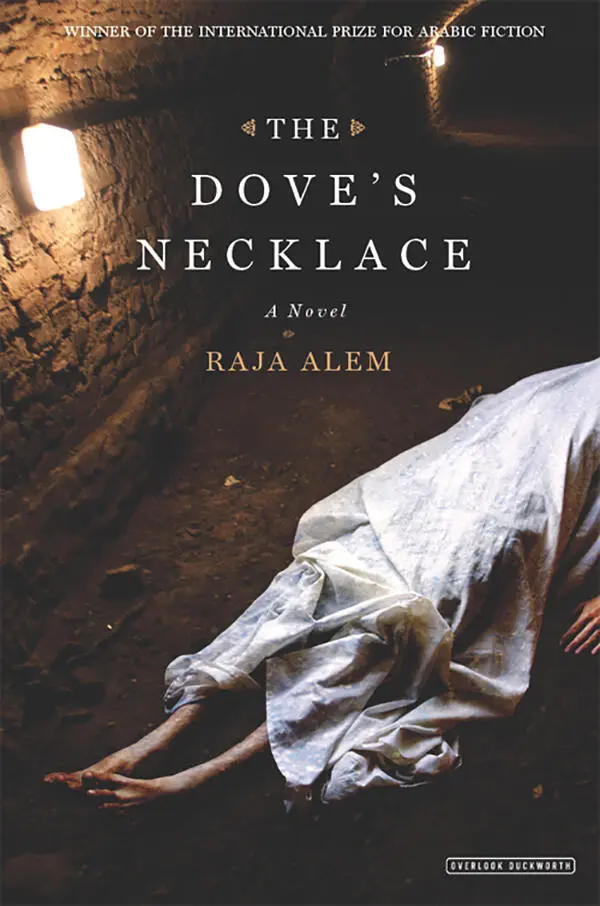
- Название:The Dove's Necklace
- Автор:
- Издательство:The Overlook Press
- Жанр:
- Год:2016
- ISBN:нет данных
- Рейтинг книги:4 / 5. Голосов: 1
-
Избранное:Добавить в избранное
- Отзывы:
-
Ваша оценка:
The Dove's Necklace: краткое содержание, описание и аннотация
Предлагаем к чтению аннотацию, описание, краткое содержание или предисловие (зависит от того, что написал сам автор книги «The Dove's Necklace»). Если вы не нашли необходимую информацию о книге — напишите в комментариях, мы постараемся отыскать её.
Tackling powerful issues with beautiful and evocative writing, Raja Alem reveals a city-and a civilization-at once beholden to brutal customs, and reckoning (uneasily) with new traditions. Told from a variety of perspectives-including that of Abu Al Roos itself-
is a virtuosic work of literature, and an ambitious portrait of a changing city that deserves our attention.
The Dove's Necklace — читать онлайн бесплатно полную книгу (весь текст) целиком
Ниже представлен текст книги, разбитый по страницам. Система сохранения места последней прочитанной страницы, позволяет с удобством читать онлайн бесплатно книгу «The Dove's Necklace», без необходимости каждый раз заново искать на чём Вы остановились. Поставьте закладку, и сможете в любой момент перейти на страницу, на которой закончили чтение.
Интервал:
Закладка:
Making use of the lunch hour when the shop was closed, Mu’az hurried to catch the public minibus, and Nasser followed him on his trip to Mount Hindi. Beneath the building with the APARTMENTS TO LET sign, Nasser saw him with a tall young man, a skinny specter of a guy who reminded Nasser of the ghost in Yusuf’s diaries. His heart started beating faster as if he were about to come face to face with his adversary, and he jumped out of his car, slammed the door, and sprinted toward them. His rapid footsteps caught their attention right away, and the tall young man hurried away while Mu’az turned back toward Nasser and blocked his way.
“Who was that you were just with?” Nasser asked, panting.
“Who are you talking about?” Mu’az asked, answering the accusation with total calm.
“The guy you were just talking to.” The man had disappeared, swallowed up by the mountain, and there was no sign of which path he’d taken.
“Oh, he just stopped me to ask how to get to al-Salam Hotel.”
Nasser was at a loss. “What are you doing here, anyway?” he asked.
“Buying sweet dates for my dad,” replied Mu’az, nodding at the shopping bag he was holding.
His silencing stare bored into Nasser long after he’d left. Nasser’s police nose could smell the prey he’d been searching for all this time, and the heat in his temples agreed. He spent the searing midday hours walking back and forth on the mountainside, peering into people’s houses and faces, sneaking into corridors wherever he found a door ajar and investigating ruined buildings, looking for that tall specter. He knew his target was somewhere in this labyrinth.
That evening, Mu’az tried to find a way to go back. He had to make it absolutely clear to both Yusuf and the house that they couldn’t get rid of him, even if they started making deals with external forces like this Nasser, whom he’d only just managed to stop from uncovering his treasure.
The mountains ceased to tremble when they were both shut up in the Lababidi house together. Mu’az sat sulking on the roof in the shadow of the minaret of the Turkish bath, where he could keep an eye on Yusuf and the house. He wanted to be enveloped by the restful sunset over the rooftops like usual. The old pain attacked him during his long silence. But suddenly, he didn’t need to be jealous any more — didn’t need to possess or to tire himself out. After they had both performed the evening prayer on the roof, he told Yusuf the most important of his secrets. Still facing the Kaaba, he began:
“The day we discovered the corpse in the Lane of Many Heads, I came here to escape everything. Marie was sitting like she usually was, one leg over the other, leaning on those damask cushions and resting her head to the left-hand side, where she had a diamond flower-shaped brooch pinned on her chest — a moon hovering over a flower — and her muslin hat was sitting on her chignon of black and gray hair. My lens was still shaken from seeing the body in the lane so I sat on the floor in front of her, still trembling a bit. We sat there for hours, maybe days, and she said nothing the entire time, so finally I looked up at her. I realized that I’d seen yet another loss. I’d witnessed the death of a whole century. I didn’t dare touch her!
“I still don’t know whether it was me who killed her or not. Did I bring the germ of death with me when I came, destroying her world?
“That evening, the Meccan sky looked like an empty, colorless mirror that didn’t reflect the person looking into it. It was splintered by paths leading into and out of the Holy Mosque like ant trails around a nest, and you could no longer see the inside from the outside. I felt like I’d entered into her moment and I realized that she wanted to be left where she was, looking out over the Haram Mosque, which she’d spent half a century photographing. I was worried it would be disrespectful to the body, though, so I pulled her seat, just as it was, to the darkroom over there, read the Surah of Sovereignty over her, and closed the door. I gathered up my sinful, intimate photos, went down the stairs, locked al-Lababidi’s front door safely on all those heads that had been threatened with decapitation, and left. I buried the set of keys with the interlocking prayer-niches under the top step of the staircase in the minaret in the Lane of Many Heads. And covered them up with my father’s calls to prayers and recitations of the Quran, and I left them undisturbed until you, Yusuf, needed somewhere to escape to. I locked myself out of there; that was as far as I was going to get: shop assistant to the owner of Studio Modern in Gate Lane. Two simultaneous deaths made for a great ending, don’t you think?”
The air around them trembled. The desire for his approval, the desire to please him, held Yusuf in its hot thrall. Could Mu’az have possibly had a hand in — he quashed that train of thought, ignored it. “I know how difficult it is for you to get here.”
“It’s not as bad as going there.”
“Have they found the Kaaba key yet?” Yusuf asked, as a way of distracting him from his sadness.
“No,” sighed Mu’az, “but they’re casting a new one in Turkey and they say it’ll be ready for the next pilgrimage season, in time for the ritual cleaning of the Kaaba …”
Mannequin
D ETECTIVE NASSER TOOK NOTE OF WHAT YUSUF HAD WRITTEN IN HIS WINDOW about the Eunuchs’ Goat, the character who slaughtered sheep every day. He wanted to ascertain whether what Yusuf had written in his window could be a possible alibi for why he wasn’t in the neighborhood when the crime took place.
I doubt you’ll know me when I call to you with this voice: “Azza.”
I’ve lost my most important face in the mirror; I’ve lost the Eunuchs’ Goat.
No one can see me the way the Eunuchs’ Goat sees me. Every time he looks at me it’s like he’s saying, You exist, you’re a citizen, you belong, you’re a historian.
They caught him selling black-market carcasses to the restaurants in the Lane of Many Heads! You should’ve seen it, Azza. It was a parade of photos and titles in the pages of Umm al-Qura newspaper: the brave men of the municipal government and the Holy Capital’s licensing bureaus who’d performed the early morning raid against unregulated slaughterhouses.
I read out loud by your window while the finger of charcoal rattles between your fingers. Are the torsos you draw still fleeing a massacre? Did you make sure to get them marked them with veterinary certification stamps? I can’t stop reading and re-reading it.
“140 tons of spoiled meat intended for distribution and human consumption were seized today, along with the culprits who slaughtered camel mares, sheep, and goats. Authorities stressed that camel mares must be slaughtered systematically under the supervision of veterinarians … Several experts warned in their testimonies of the danger posed by careless treatment of sick animals, pointing to more than 200 diseases common to both animals and humans. Some of these include Malta fever, valley fever, anthrax, tuberculosis, rabies, tapeworm, which can be transferred to humans through contact with a slaughtered camel mare, and there may even be other diseases that are more dangerous.”
Most of them are here this very moment, living side by side with the people of the lane in perfect harmony, sharing their viruses generously. As you can see from the experts’ testimonies, Azza, the Eunuchs’ Goat is a vector for no less than two hundred epidemics. What’s worse, though, is the lie they’re spreading that the Eunuchs’ Goat stole the donation box, “The Bribe Box,” and embezzled all the donations that were meant to help him get his papers.
Читать дальшеИнтервал:
Закладка:
Похожие книги на «The Dove's Necklace»
Представляем Вашему вниманию похожие книги на «The Dove's Necklace» списком для выбора. Мы отобрали схожую по названию и смыслу литературу в надежде предоставить читателям больше вариантов отыскать новые, интересные, ещё непрочитанные произведения.




Обсуждение, отзывы о книге «The Dove's Necklace» и просто собственные мнения читателей. Оставьте ваши комментарии, напишите, что Вы думаете о произведении, его смысле или главных героях. Укажите что конкретно понравилось, а что нет, и почему Вы так считаете.