Rupert Thomson - Divided Kingdom
Здесь есть возможность читать онлайн «Rupert Thomson - Divided Kingdom» весь текст электронной книги совершенно бесплатно (целиком полную версию без сокращений). В некоторых случаях можно слушать аудио, скачать через торрент в формате fb2 и присутствует краткое содержание. Год выпуска: 2012, Издательство: Bloomsbury UK, Жанр: Современная проза, Фантастика и фэнтези, на английском языке. Описание произведения, (предисловие) а так же отзывы посетителей доступны на портале библиотеки ЛибКат.
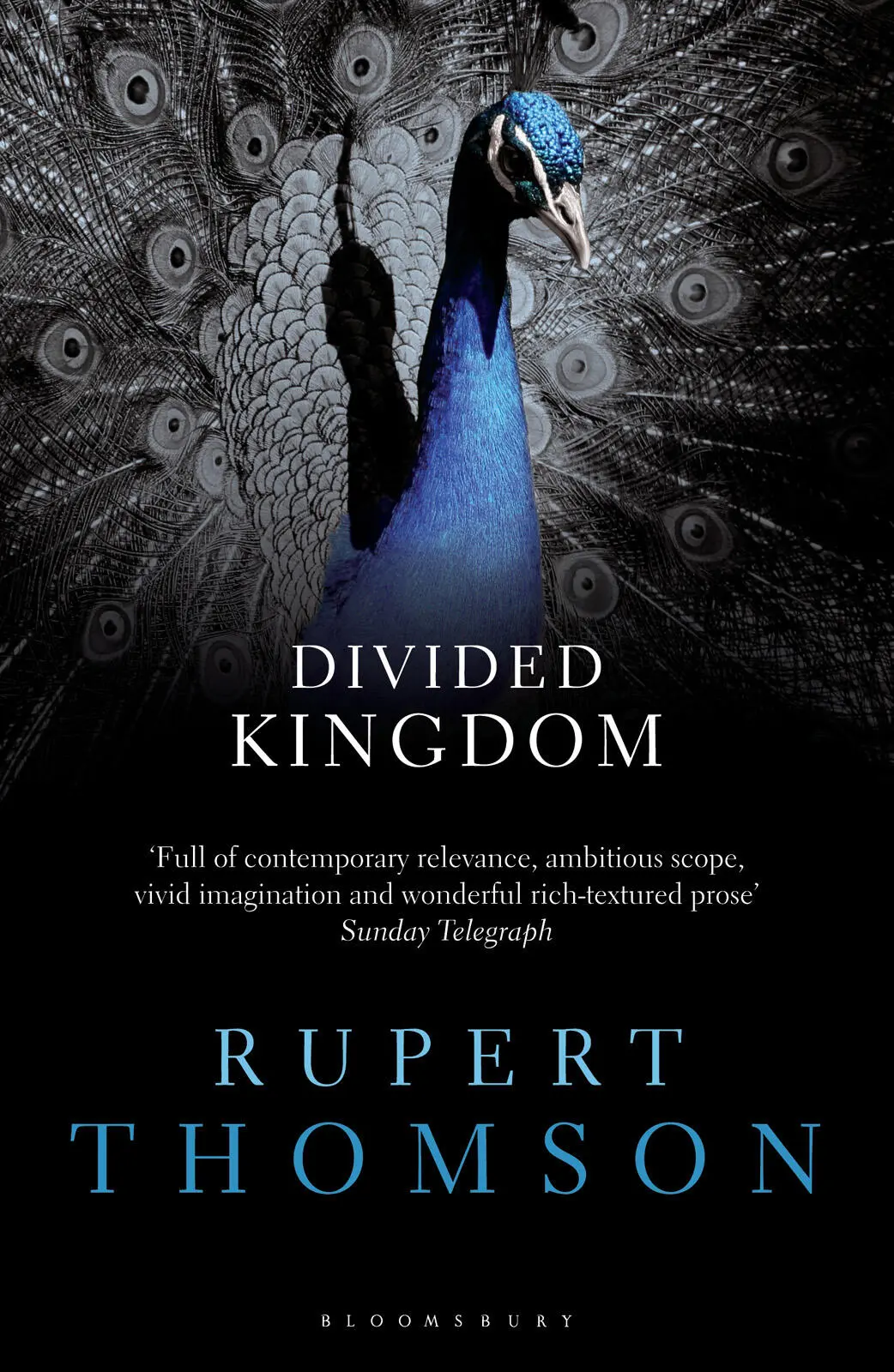
- Название:Divided Kingdom
- Автор:
- Издательство:Bloomsbury UK
- Жанр:
- Год:2012
- ISBN:нет данных
- Рейтинг книги:5 / 5. Голосов: 1
-
Избранное:Добавить в избранное
- Отзывы:
-
Ваша оценка:
Divided Kingdom: краткое содержание, описание и аннотация
Предлагаем к чтению аннотацию, описание, краткое содержание или предисловие (зависит от того, что написал сам автор книги «Divided Kingdom»). Если вы не нашли необходимую информацию о книге — напишите в комментариях, мы постараемся отыскать её.
Divided Kingdom — читать онлайн бесплатно полную книгу (весь текст) целиком
Ниже представлен текст книги, разбитый по страницам. Система сохранения места последней прочитанной страницы, позволяет с удобством читать онлайн бесплатно книгу «Divided Kingdom», без необходимости каждый раз заново искать на чём Вы остановились. Поставьте закладку, и сможете в любой момент перейти на страницу, на которой закончили чтение.
Интервал:
Закладка:
‘Tradition?’ she said once. ‘What tradition?’
He beamed. Her unworldliness never failed to delight him. ‘The shape-shifter, the psychopomp,’ he said. ‘The seer.’
‘What’s a psychopomp?’ This time she was genuinely curious.
‘They’re spirit guides,’ Croy told her. ‘They pilot dead people to their place of rest. They oversee the process whereby souls are purified, transformed.’ He paused. ‘I suppose you could say they teach the craft of dying.’
On another occasion he startled her by proposing that they should become a magic act. ‘Burfoot & Croy,’ he said. ‘Can’t you see it?’ His right hand slid sideways across the air in front of him, palm facing outwards, fingers uppermost and slightly curled, as if to enclose an exotic painted sign. She smiled but said nothing. He had such peculiar fantasies. Was he really suggesting that they should run away together, or was it just another test? She could never quite be certain. If she hadn’t been so strange-looking, she would have said that Adrian Croy was in love with her.
For all his ambiguities, though, and despite the power he wielded over her, they were, at some fundamental level, of one mind. Yes, she had crossed borders illegally, but that didn’t mean she wanted them removed. Far from it. Without borders they would return to the chaos of a quarter of a century ago. Without borders they would find themselves living in what used to be called, laughably in her opinion, the ‘united kingdom’ — a kingdom united in name only, a kingdom otherwise characterised by boorishness, thuggery and greed. She had no desire to live in a place like that. The Blue Quarter might be deficient in some respects, she said, but at least those who lived there were socially aware and ecologically responsible, prizing gentleness above aggression and spiritual development above material success, and on the whole she wanted to preserve things pretty much the way they were. She just liked to bend the rules once in a while, that was all.
‘I still cross the border illegally from time to time,’ she said. ‘You know what I tell them now, if they find out?’
I lay still, waiting for the answer.
‘I tell them I’m practising my craft. That’s the kind of language they understand.’ She fell silent. ‘I’m not breaking the law,’ she said after a while. ‘I’m doing my duty.’ And she laughed softly, delighted by her own capricious logic.
Odell shook me out of a deep sleep, letting me know that it was dawn. I had a feeling I hadn’t had since I was a boy — a panic that uncoiled slowly as a snake, a powerful dread of what the day might bring. I wished I could have stayed in bed or hidden somewhere. I wanted it all to be over. She shook me again. I sat up, blinking. A weak light leaked through the window, grubby as the skin on boiled milk. Birds fumbled in their nests. I pushed my feet into my boots and pulled on the stiff leather coat. We ate the few scraps left over from the previous night’s meal, sharing the inch of red wine in the bottom of the bottle, then it was time to go.
I followed Odell through the second of the two doors and into a small high-ceilinged room. The only piece of furniture in there was a wardrobe, its mirror-panelled door ajar. Our figures crept across the glass, furtive as thieves. On we went, through other, larger rooms, most of which showed evidence of looting. Paintings had been removed, leaving ghostly after-images. Wallpaper had been defaced or gouged. In one room a fire had been lit in the middle of the floor, and I imagined I could smell it, the air inlaid with a thin blue seam of smoke. We stepped out on to a landing, its uneven boards sloping away from us, slippery with light. Pinned to a door at the far end was a life-size black-and-white picture of a soldier with a gun, concentric circles radiating outwards from his heart. There were holes in the paper, and the wood. At the head of the stairs I stooped and peered through a diamond-paned window. Pines lifted before me, their red-brown trunks showing dimly through the mist. To my surprise, the snow had melted. The land looked waterlogged and drab.
Downstairs, in the hall, wooden chairs were arranged against opposing walls, making me think a party had been held here once. Trainee border guards would have cavorted with girls from nearby villages, the guards resplendent in their dress uniforms, all pressed serge and polished brass, the girls in short skirts and white stilettos, their bare legs marbled with the cold. I could almost hear the live band with its thrashing drums, its raunchy lead guitar. Odell led me across the hall and down a passage. Then, as we passed through yet another door, the space seemed to explode above my head. We were in a church. The roof must have been sixty feet high, and the nave could have held a congregation of many hundreds. Here too, though, the vandals had been at work. Pews had been upended and set on fire. Windows had been smashed. The stone flags underfoot were crunchy with stained glass — the blue of saints’ robes, the yellow of their haloes, the green of a green hill far away. I noticed some incongruous additions to the church’s interior — relics of the military occupation, no doubt. Leaning nonchalantly against the font was a motorbike, its back tyre flat. Further up the aisle, empty bullet casings and beer bottles lay scattered about. And there were even more recent intrusions: a pigeon chuckled in the organ loft, and on the altar steps some sheep had deposited their neat but convoluted droppings, each of which looked exactly like a small black brain.
We left through the sacristy. Once outdoors, I paused and looked around. Some fifty yards ahead of me was a drystone wall, and on the hillside beyond were the evergreens I had seen from the landing. Behind me rose the great hunched back of the church. A few traces of snow lingered under trees and bushes, and against the base of north-facing walls.
As I stood there, Odell stepped in front of me. ‘Your face is all wrong.’
I stared at her, perplexed.
‘You look as if you’ve never been here before,’ she said, ‘as if you come from somewhere else. They’ll notice that immediately. You can’t show any surprise or curiosity. I want you to look fed up, long-suffering. We’re a couple, remember, and we don’t get on.’
I nodded. All right.
‘Show me,’ she said, ‘before we go any further.’
I pushed my hands deep into my trouser pockets, then I scowled. I could feel the skin buckling on the bridge of my nose.
‘That’s more like it,’ she said.
We passed through a wicket gate and set off along a footpath. On my shoulder was a bag that held my cloak and undergarments. Without them, I wouldn’t be able to cross back into the Red Quarter. If we were stopped and searched, Odell was going to claim that they were trophies from the recent hunt, as was the watch I was wearing, the one that had no hands. She would tell the story with relish, how we had chased the White People through the woods, how we had terrorised and raped and butchered. I had become so carried away, she would say, that I had completely lost my voice. When she first suggested this strategy, I felt something contract inside me. She noticed the look on my face and said simply, ‘Do you want to get out of here or don’t you?’
We climbed over a stile and down into a country lane, then walked on, side by side, in silence. Stone walls hemmed us in. We passed barns of corrugated-iron, some faded red, some green. Once, the sun broke through, alighting on a piece of rough pasture to the north-east of us, the land all round still deep in shadow. Like a memory of happiness, I thought, that single illuminated field. Like the bits of my life that had been given back to me … We were quiet for so long that I almost forgot the role I was supposed to be playing, but then I saw a man come hobbling towards us. Chained to his wrist was a hawk, its head sheathed in a leather hood.
Читать дальшеИнтервал:
Закладка:
Похожие книги на «Divided Kingdom»
Представляем Вашему вниманию похожие книги на «Divided Kingdom» списком для выбора. Мы отобрали схожую по названию и смыслу литературу в надежде предоставить читателям больше вариантов отыскать новые, интересные, ещё непрочитанные произведения.

Обсуждение, отзывы о книге «Divided Kingdom» и просто собственные мнения читателей. Оставьте ваши комментарии, напишите, что Вы думаете о произведении, его смысле или главных героях. Укажите что конкретно понравилось, а что нет, и почему Вы так считаете.