Rupert Thomson - Divided Kingdom
Здесь есть возможность читать онлайн «Rupert Thomson - Divided Kingdom» весь текст электронной книги совершенно бесплатно (целиком полную версию без сокращений). В некоторых случаях можно слушать аудио, скачать через торрент в формате fb2 и присутствует краткое содержание. Год выпуска: 2012, Издательство: Bloomsbury UK, Жанр: Современная проза, Фантастика и фэнтези, на английском языке. Описание произведения, (предисловие) а так же отзывы посетителей доступны на портале библиотеки ЛибКат.
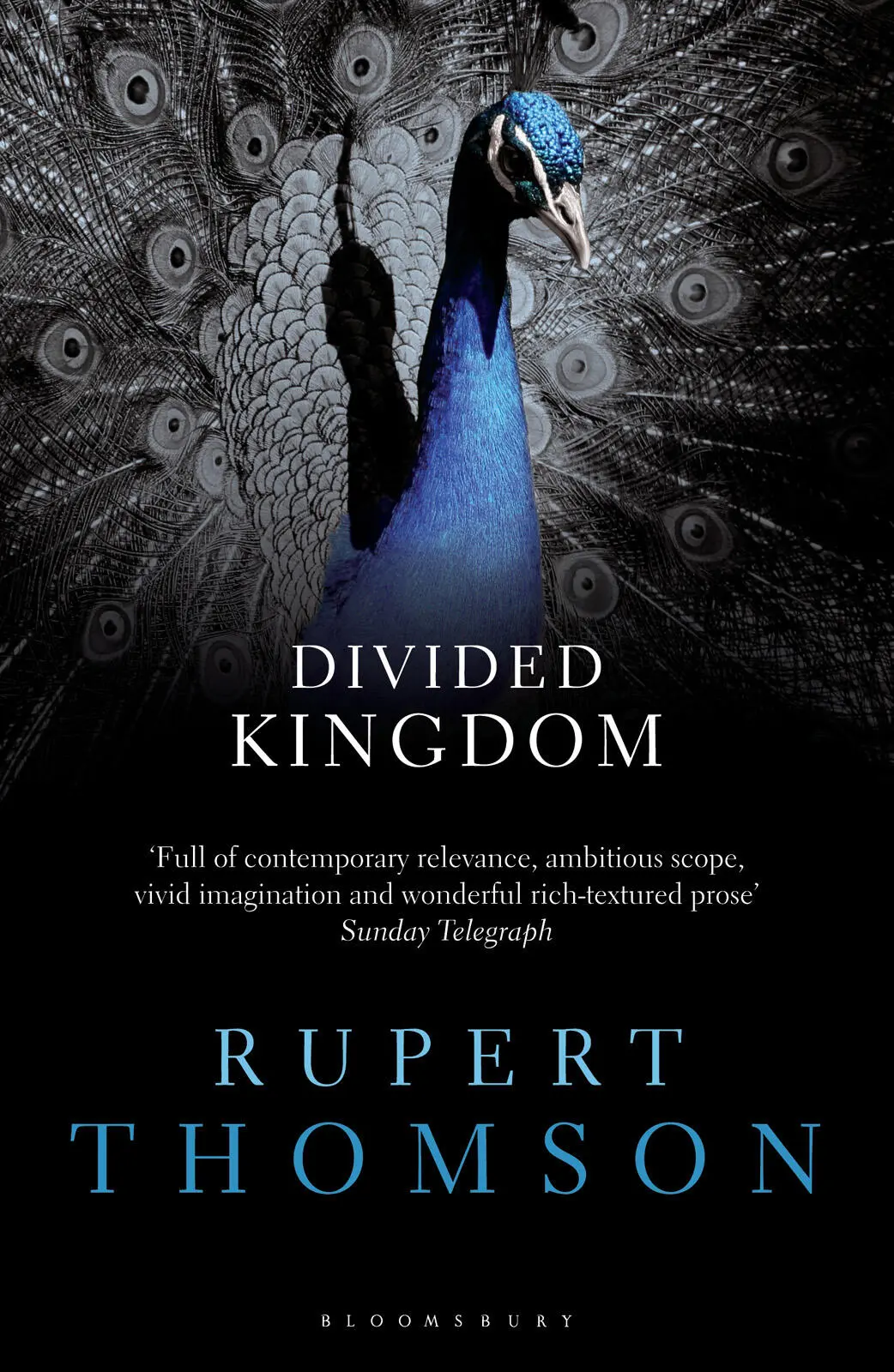
- Название:Divided Kingdom
- Автор:
- Издательство:Bloomsbury UK
- Жанр:
- Год:2012
- ISBN:нет данных
- Рейтинг книги:5 / 5. Голосов: 1
-
Избранное:Добавить в избранное
- Отзывы:
-
Ваша оценка:
Divided Kingdom: краткое содержание, описание и аннотация
Предлагаем к чтению аннотацию, описание, краткое содержание или предисловие (зависит от того, что написал сам автор книги «Divided Kingdom»). Если вы не нашли необходимую информацию о книге — напишите в комментариях, мы постараемся отыскать её.
Divided Kingdom — читать онлайн бесплатно полную книгу (весь текст) целиком
Ниже представлен текст книги, разбитый по страницам. Система сохранения места последней прочитанной страницы, позволяет с удобством читать онлайн бесплатно книгу «Divided Kingdom», без необходимости каждый раз заново искать на чём Вы остановились. Поставьте закладку, и сможете в любой момент перейти на страницу, на которой закончили чтение.
Интервал:
Закладка:
I moved to the water-butt and stripped off my white garments. Spattered with mud, ashes and dried blood, they stood out quite distinctly against the snow. I kicked off one boot, then the other. They lay there awkwardly like a pair of crows that had been shot in mid-air and then plummeted to earth. Bending over the barrel, I brought handful after handful of water to my face. The cold made me gasp. My skin stung. The ring that hung around my neck knocked against the barrel’s lip as I leaned forwards. My fingers soon went numb. I took care not to lift my eyes towards the ridge. I didn’t want to think about what had happened there.
I dried myself on my undershirt, then dressed in the clothes the girl had given me — jeans, a black sweater, thick wool socks and a cheap brown leather coat. I felt in my cloak pocket. It was empty. The key to the front door of the Cliff was gone. So was the lighter and the book of dreams. I must have lost them when I fell. Still fastened to my wrist, though, was my watch, the one that didn’t tell the time. I pulled my boots back on, then folded up the cloak.
When I walked back into the cellar, the girl glanced round, and a single ray of sun reached through a broken pane high in the wall, lighting up her face. I understood what her classmates had meant about her eyes. They were neither black nor green, and yet both colours were involved, somehow.
‘Let’s go back up,’ she said. ‘I’m starving.’
Like peasants from another period of history, we breakfasted on bread, cheese, pickled onions and red wine. While we ate and drank, the girl outlined her plan. We were deep in the Yellow Quarter, so there was no easy option. If we travelled south and luck was on our side, we could reach the Red Quarter in four or five days. It might be dangerous, but it would be better than heading east and crossing into the Green Quarter, where the authorities were probably still looking for me. Also, we would only have to cross one border, not two. We would have to pretend to be a couple, though. A choleric couple. Had I seen how they behaved? No? Well, the beauty of it was I didn’t need to talk. The kind of man she had in mind was more likely to hit a woman than speak to her. The women tended to nag and moan, while the men just grunted or read the papers.
‘That’s all you have to do,’ she said. ‘Ignore me. You can do that, can’t you?’
I nodded slowly. Of course I could ignore her. I didn’t know her. When we first arrived in the room, she’d asked if I remembered her. What was that about? I still had no idea.
After breakfast she suggested a game of draughts to pass the time. I scratched out a board on the floor with a stone while she went to look for objects we could use as pieces. She returned with some chunks of burnt wood and fragments of stained glass, all of which she had collected in the church. We played for most of the morning, and I didn’t win once.
In the middle of the day she had to go out again for provisions. I lay down on the bed and tried to sleep. It was a way of protecting myself from the images that were appearing in my head, images that were graphic, almost medical. Also, if I stayed awake, I would only worry. What if something were to happen to her? I didn’t believe I could survive by myself. Not out here. Without her, I would be dead — or worse.
I slept fitfully, but the images still came, disguised as dreams.
She returned with cold sausage, bread, pickled cabbage and more red wine, but she seemed different, more preoccupied, and we ate in silence. The light gradually faded, the room darkening long before the world outside.
When we had finished, she asked me if she should go on with her story. I nodded, and she picked up exactly where she’d left off.
Ignoring her parents’ advice, she carried on performing for other children in the hope that they would become her friends, but her gift just frightened or bewildered them. She was lonelier than ever. And then, one morning, she received an official-looking letter. Her father opened it and read it first. ‘They know,’ he said.
‘Know what?’ she said.
Her father handed her the letter. She was required to appear before a tribunal, not locally, but in the capital, two hundred miles away. She couldn’t tell what the charge was — the summons contrived to be both menacing and utterly inscrutable — but she knew she was guilty.
On the appointed day she caught a train to Aquaville, her parents’ reproach clearly audible in the rhythm of the wheels on the track: If only you’d listened — if only you’d listened … If only I’d listened, she thought as she climbed the steps to the Ministry, her mouth dry, her heart stumbling inside her. She was convinced she was about to be severely punished. Borstal at the very least, maybe even a prison sentence.
A government official escorted her to a grey door high up in the building. He turned the handle, then stepped aside to let her through. On entering the room, she saw a man sitting behind a desk. In front of him was a piece of moulded plastic with the name Adrian Croy printed on it. The man was alone, which disconcerted her. She had been expecting a judge and jury, something that resembled a court of law.
‘Ah, Miss Burfoot,’ the man said.
Adrian Croy was a slight, dapper man with wrists as narrow as school rulers. His hands twirled and fluttered when he spoke in such a way that she imagined he was simultaneously translating what he was saying into sign language. She felt clumsy in his presence, as if surrounded by bone china.
‘You probably think that you’re in trouble.’ He was looking at her in a manner that did not endear him to her. She saw amusement and curiosity. A kind of craving too. ‘You have crossed the border illegally,’ he said. ‘Twice.’
She sighed. It was true. She had done it as a dare to herself, just to see if it was possible. Then she had done it again, to make sure the first time hadn’t been a fluke. She hadn’t meant anything by it. ‘I knew you’d find out,’ she said.
‘Oh yes, Miss Burfoot, we always find out.’ Croy leaned back in his seat and studied her. ‘We would like to offer you a position.’
‘A position?’
‘A job.’
‘I’ve never had a job,’ she said, ‘except for working on the canal.’
Croy allowed himself a small, neat smile. ‘I’d hardly call that making good use of your particular skills.’
They weren’t going to punish her. They were giving her a job instead. She could scarcely believe her luck.
I shifted uneasily on the bed of sacking and old velvet, reminded of a certain sunlit afternoon, Diana smiling at me across the rim of her wine-glass, the word ‘immunity’ suspended seductively in the air between us.
‘I was so innocent,’ Odell murmured, half to herself.
Me too , I said inside my head.
At the age of seventeen she had come to an arrangement with the authorities. She was paid a modest retainer, and reported to Croy twice a month. Sometimes he would brief her on a specific job — surveillance, usually — but more often than not he would attempt to justify their shadowy activities. At some point, though, the talk would always gravitate towards the nature of her gift. When she told him what she could do — somehow, with Croy, she couldn’t seem to help bragging about it — the black parts of his eyes would widen, and his hands would move more dreamily in front of him, like objects in space. He would claim that she was part of a tradition that dated back thousands of years. In her, he would say, one could see the true flowering of the phlegmatic character — adaptability, yes, but taken to extremes. He had theories about her too. In his opinion, she didn’t actually become invisible. She simply appeared to do so. He called what she did ‘escaping notice’. Frankly, it would bore her having to listen to all this, but she tried not to show it. She had to keep reminding herself that this dainty, middle-aged man was dangerous. If he were to turn against her, he could make things difficult for her. And so it paid to keep him sweet. Aware of this, she always played a little vaguer, a little more spiritual , than she really was.
Читать дальшеИнтервал:
Закладка:
Похожие книги на «Divided Kingdom»
Представляем Вашему вниманию похожие книги на «Divided Kingdom» списком для выбора. Мы отобрали схожую по названию и смыслу литературу в надежде предоставить читателям больше вариантов отыскать новые, интересные, ещё непрочитанные произведения.





Обсуждение, отзывы о книге «Divided Kingdom» и просто собственные мнения читателей. Оставьте ваши комментарии, напишите, что Вы думаете о произведении, его смысле или главных героях. Укажите что конкретно понравилось, а что нет, и почему Вы так считаете.