Rupert Thomson - Divided Kingdom
Здесь есть возможность читать онлайн «Rupert Thomson - Divided Kingdom» весь текст электронной книги совершенно бесплатно (целиком полную версию без сокращений). В некоторых случаях можно слушать аудио, скачать через торрент в формате fb2 и присутствует краткое содержание. Год выпуска: 2012, Издательство: Bloomsbury UK, Жанр: Современная проза, Фантастика и фэнтези, на английском языке. Описание произведения, (предисловие) а так же отзывы посетителей доступны на портале библиотеки ЛибКат.
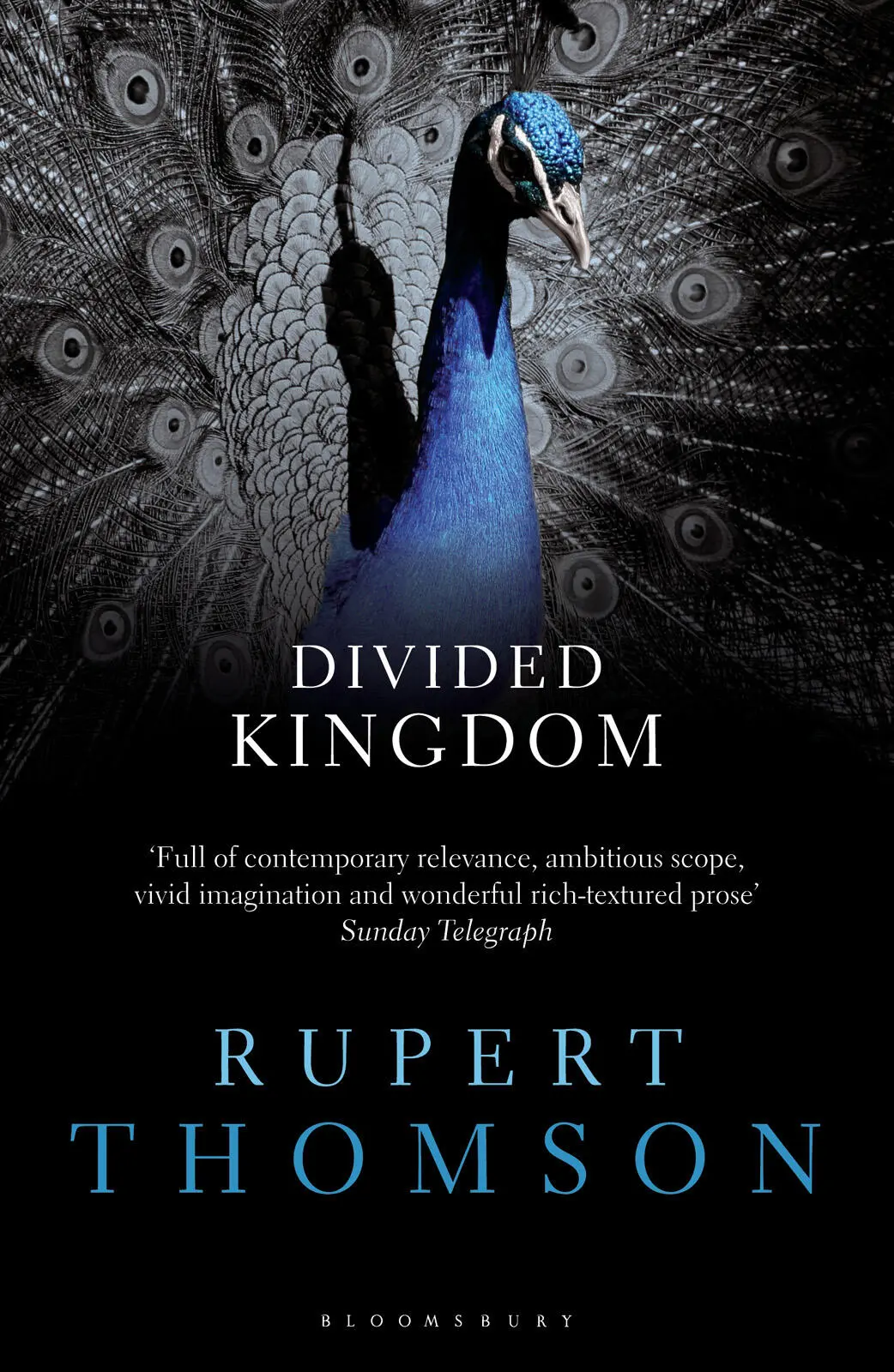
- Название:Divided Kingdom
- Автор:
- Издательство:Bloomsbury UK
- Жанр:
- Год:2012
- ISBN:нет данных
- Рейтинг книги:5 / 5. Голосов: 1
-
Избранное:Добавить в избранное
- Отзывы:
-
Ваша оценка:
Divided Kingdom: краткое содержание, описание и аннотация
Предлагаем к чтению аннотацию, описание, краткое содержание или предисловие (зависит от того, что написал сам автор книги «Divided Kingdom»). Если вы не нашли необходимую информацию о книге — напишите в комментариях, мы постараемся отыскать её.
Divided Kingdom — читать онлайн бесплатно полную книгу (весь текст) целиком
Ниже представлен текст книги, разбитый по страницам. Система сохранения места последней прочитанной страницы, позволяет с удобством читать онлайн бесплатно книгу «Divided Kingdom», без необходимости каждый раз заново искать на чём Вы остановились. Поставьте закладку, и сможете в любой момент перейти на страницу, на которой закончили чтение.
Интервал:
Закладка:
As I set off across the field, a girl jumped out in front of me. She seemed to have appeared from nowhere. I let out a cry. She put a hand over my mouth, then placed one finger upright against her own. Her face was covered with freckles. I’d never seen so many. She gave me a queer blurred smile.
‘This way,’ she whispered. ‘Quick.’
She wasn’t one of them. She was somebody else.
Thank God for that. Thank God.
Chapter Eight
She ran ahead of me, her hair and coat-tails flapping. Snow poured into the gap between us. We passed to the left of a church, its roof partly gone, its stone floor open to the sky. There were other buildings, ancient-looking, some with walls still standing, some torn down to their foundations. Through a hedge and into a garden, the grass waist-high. Buildings here too. More recent. Tall chimneys, narrow windows. All in a state of disrepair. I looked round, eyes half-closed against the swirling snow. I thought I could hear men’s voices, but the men themselves weren’t visible.
We had reached the back of a house, the whole wall hidden behind a screen of vines and creepers. The girl heaved on a door and pushed me inside. Brick steps led down to a cellar. The smell of cold ashes and mouse-droppings. The faintest memory of candle wax. She motioned for me to follow, then parted a frayed curtain to reveal a second door, the wood untreated, dark as peat. She bolted it behind us and started up a narrow staircase. I could only tell where she was by listening to her footsteps on the bare boards. Once, a light flared in my head and I saw a hand splayed on the earth, pale as something that had just been disinterred, and I knew that it belonged to Lum, even though I couldn’t see any other part of her.
At last we came out into a room with a low ceiling and a single round window. There was no view, only a tangle of greenery, the snow a constant slanting movement just beyond. Again the girl bolted the door behind us, then she went to the window and put her face close to the criss-crossing bars. I squatted on my haunches, my heart beating so hard that it seemed to shake my whole body. Blood sizzled in my ears. They were still out there, all the rest of them.
The girl turned from the window. ‘Do you know who I am?’
I stared at her. It had gone all blank inside me. All hollow.
‘You don’t remember me, do you.’
What was she saying?
‘Can you talk?’ She moved towards me, knelt in front of me. I felt her eyes searching my face. All hollow. Just a space. ‘It doesn’t matter,’ she said. ‘It’s not important.’
I’m sorry , I said inside my head.
‘Don’t cry,’ she said. ‘You’re safe now. You’re going to be all right.’ She placed her hand over mine. I was aware of its weight, its heat. ‘They’ll never find us here. It’s too rundown, too overgrown. There are too many rooms. They’ll lose interest. I know what they’re like.’
That’s not what I’m frightened of , I said inside my head.
She couldn’t hear a thing, of course, and yet she held herself quite still as she looked at me, and her look didn’t waver, not for a moment. She didn’t even seem to blink. She had lines in the thin skin below her eyes, which made me think that she had slept too little in her life, or seen too much. ‘You really don’t recognise me, do you?’ She tucked a strand of her bracken-coloured hair behind her ear. ‘Well, maybe it’s no wonder,’ she added, half to herself.
Faint cries reached me from outside. The window was a mouth belonging to someone in great pain.
‘Listen to me,’ the girl said.
I was receiving images of mud and roots, a clearing in the woods, and all from ground-level, as if my face had been forced sideways into the dirt. Men stood round me, a boy too. Thick fingers held his shoulder. A dog panted in my ear, its breathing coarse and hot. Far above me, out of reach, I saw a tree’s branches shifting against a darkening sky, and it was beautiful up there, and quiet, a kind of paradise. I was seeing through the eyes of one of my companions, a person was calling out to me, and there was nothing I could do.
‘Listen,’ the girl said.
And she began to speak to me. She had been with me all along, she said. She had made her share of mistakes. She had been too slow sometimes, too indecisive, which was only to be expected, perhaps, and once or twice she had lost me altogether. But when I slipped just now. When I fell. That was her. She’d pushed me.
What are you saying? I said inside my head.
There had been someone right behind me, she told me. One of them. I shouldn’t worry, though. Everything would be fine now. She was going to take me home. That was why she had appeared. That was what she did.
I still didn’t understand.
Later, she withdrew into the middle of the room, an elbow cupped in the palm of one hand, the fingers curled against her chin. She needed to go out for supplies, she said. I would have to stay put. I wasn’t to leave the room, not under any circumstances. She moved towards a second door, which I hadn’t noticed until that moment. Still sitting on the ground, I drew my knees up to my chest, then laid my forearms over them and lowered my head.
‘That’s right,’ she said. ‘You rest for a while.’
The door closed behind her. Her footsteps receded.
As soon as she had gone, I began to doubt her existence. She seemed so convenient — too good to be true. Had I invented a saviour for myself? Was the only kindness imaginary?
Dusk crept into the room as though it, too, were seeking refuge.
The last of the light picked out a cobweb, its fragile hammock slung high up in one corner. The smell of earth grew stronger, earth that had never seen the sun.
When I finally heard noises, I flattened myself against the wall, expecting men with weapons. The door opened. The girl backed into the room. She had a rucksack over her shoulder, and she was dragging some lengths of material. Velvet, she said. She thought they might have been curtains. She had found a few hessian sacks as well. If we used the sacks as a kind of mattress, she said, we could pull the curtains over us like blankets and it might just be enough to keep us warm. She was sorry she’d been so long. She hoped I hadn’t worried.
While I arranged the bedding on the floor, she opened her rucksack and unpacked a wedge of cheese and a loaf of bread with a jagged crust. There was also a brown-paper bag filled with apples, some pickled onions in a jar and a flask of wine shaped like a teardrop. We could not risk a candle, she said. Someone might see it from outside. We made do with the dim glow that filtered through the window, starlight reflecting off the snow.
She watched as I washed the food down with gulps of rough red wine.
‘Good,’ she said. ‘That’s good.’
After we had eaten, she wrapped up the rest of the food and put it in her rucksack, which she hung on a nail behind the door. Undoing my boots, I climbed into the bed and lay down on my side, one hand beneath my cheek. I was still receiving pictures. They belonged to the operating theatre or the mortuary, the bloodshed casual, plenteous. My whole body flinched each time they came.
She gave me something she called dwale. She kept it in a small glass bottle that she wore on a cord around her neck. The liquid tasted of alcohol and stale herbs. It would help to calm me, she said. I watched her settle beside me, on her back.
Night had filled the room. The darkness of her face against the lesser darkness of the air. Her even breathing. A silence had descended, a silence that didn’t necessarily mean peace. Through the window came the smell of snow. Clean, vaguely metallic. Like stainless steel.
Читать дальшеИнтервал:
Закладка:
Похожие книги на «Divided Kingdom»
Представляем Вашему вниманию похожие книги на «Divided Kingdom» списком для выбора. Мы отобрали схожую по названию и смыслу литературу в надежде предоставить читателям больше вариантов отыскать новые, интересные, ещё непрочитанные произведения.


Обсуждение, отзывы о книге «Divided Kingdom» и просто собственные мнения читателей. Оставьте ваши комментарии, напишите, что Вы думаете о произведении, его смысле или главных героях. Укажите что конкретно понравилось, а что нет, и почему Вы так считаете.